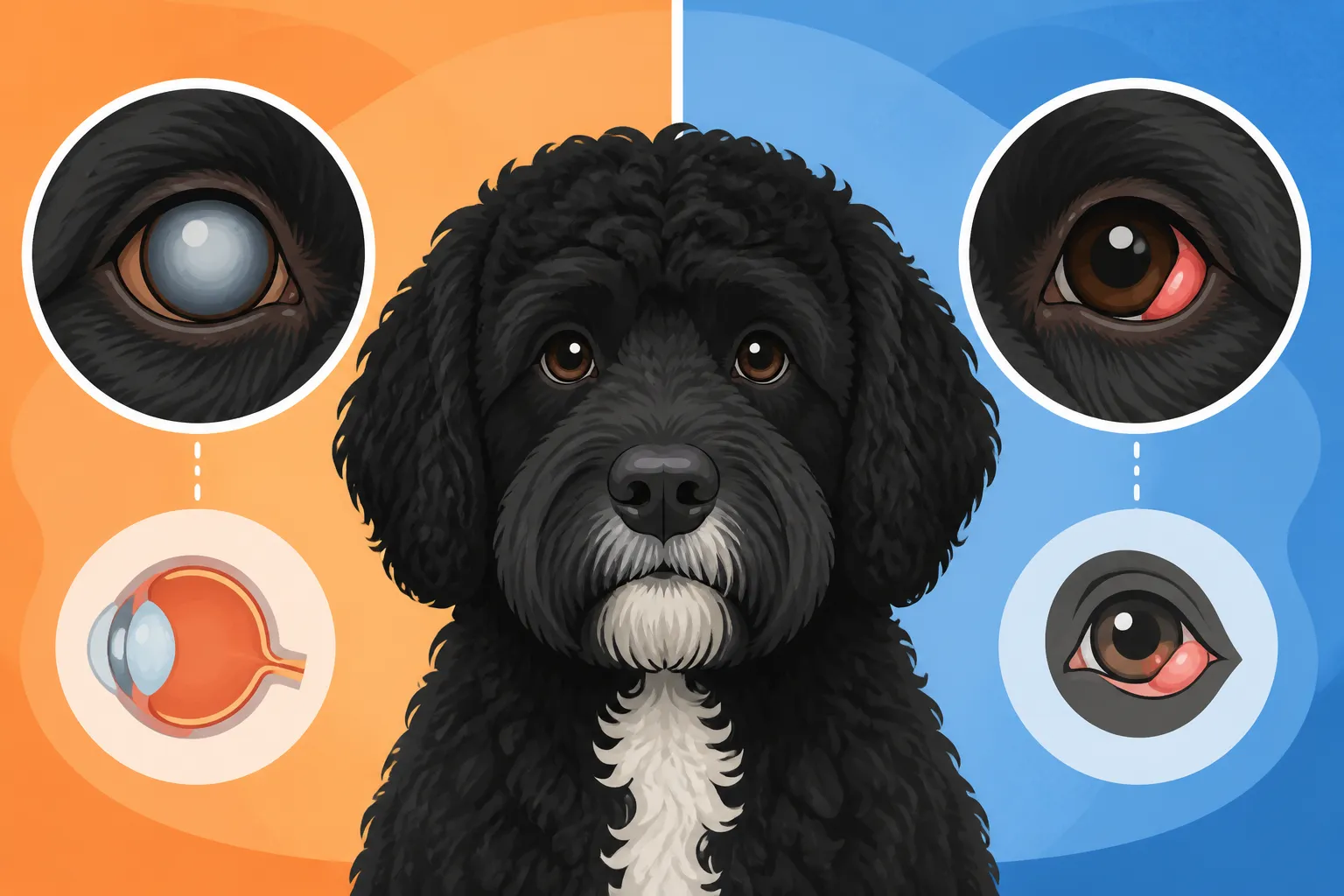
How the Two Portuguese Water Dog Eye Diseases Differ
One of the most heartbreaking challenges for any Portuguese Water Dog owner is discovering their beloved companion is losing their sight. The world can suddenly feel a lot smaller and more frightening for them, and for us, it's a profound shift in how we interact and care for them. This guide is dedicated to helping you understand the two primary forms of Progressive Retinal Atrophy (PRA) that can affect our wonderful PWDs, detailing how they differ, what to look for, and how to best support your dog through this difficult journey.
Understanding Progressive Retinal Atrophy (PRA) in Portuguese Water Dogs
Progressive Retinal Atrophy, or PRA, isn't just one disease; it's a blanket term for a group of genetic disorders that cause the cells in the retina to degenerate over time. Imagine your dog's retina as the film in an old camera – it's what captures light and sends those images to the brain. When these cells, particularly the rods (responsible for night vision) and cones (responsible for day and color vision), start to break down, vision inevitably declines. It's a progressive condition, meaning it gets worse, not better, and it can eventually lead to complete blindness. It's a tough diagnosis to receive, and often, owners don't notice the subtle changes until the disease is quite advanced.
What is Progressive Retinal Atrophy (PRA)?
At its core, PRA means the light-sensitive cells at the back of your dog's eye are failing. These cells, the photoreceptors, are crucial for vision. Initially, the rods, which handle low-light vision, are usually affected first. This is why many owners first notice their PWD struggling in dim light or bumping into furniture at dusk or in poorly lit rooms. As the disease progresses, the cones, responsible for day vision and detail, also begin to degenerate. It's not painful for your dog, which can be a small comfort, but it is undeniably distressing to witness their world shrinking. The speed and specific pattern of degeneration can vary significantly, which brings us to the distinct forms of PRA seen in our beloved Portuguese Water Dogs. Knowing these differences is absolutely critical for understanding what lies ahead and for advocating for your dog's health.
The Genetic Basis of PRA in Portuguese Water Dogs
The reason PRA is a significant concern for Portuguese Water Dog owners is that it's an inherited condition. This means it's passed down from parent to offspring through specific genes. For our PWDs, two distinct genetic mutations have been identified that cause different forms of PRA: prcd-PRA and EO-PRA. Understanding that both are genetic is key because it emphasizes the critical role of responsible breeding and genetic testing. It's not something that just happens; it's something that breeders can, and should, screen for to prevent affected puppies from being born. Knowing the genetic status of your dog's parents can give you an invaluable heads-up about potential risks, allowing for proactive monitoring and early preparation for any vision changes. You can learn more about this in our guide on The Four DNA Tests Every Portuguese Water Dog Breeder Runs.
Progressive Rod-Cone Degeneration (prcd-PRA): The Specifics
One of the most common forms of PRA in Portuguese Water Dogs is Progressive Rod-Cone Degeneration, often abbreviated as prcd-PRA. This is the "classic" form of PRA many people are familiar with. It's a condition that typically unfolds gradually, giving both the dog and the owner some time to adjust, though the eventual outcome of blindness is the same. It's a slow decline, not a sudden loss, which can make it insidious in its early stages as changes might be so subtle they're easily missed.
How prcd-PRA Progresses in PWDs
The progression of prcd-PRA in Portuguese Water Dogs is generally slow and insidious. It typically starts with the degeneration of the rods, the photoreceptor cells responsible for night vision. This means your dog will first struggle to see in low-light conditions. You might notice them hesitating on stairs in the evening, bumping into furniture they usually navigate perfectly in the dark, or becoming more cautious in unfamiliar, dimly lit areas. As the disease advances, the cones, which handle daylight vision, also start to break down. This leads to a gradual loss of day vision, until eventually, the dog becomes completely blind. The exact age this happens can vary, but it's usually not in puppyhood. For a more detailed look, check out What prcd PRA Does to a Portuguese Water Dog.
The timeframe for this progression is typically over several years, meaning a dog might start showing subtle signs in middle age, perhaps around 3-5 years old, with blindness occurring closer to 6-8 years or even later. This slow march allows for a period of adaptation, both for the dog and the family. Many dogs adapt remarkably well to their diminishing vision, relying heavily on their other senses – hearing and smell – to navigate their environment. It’s truly amazing to see their resilience, but it requires patience and understanding from us as owners.
Recognizing the Early Signs of prcd-PRA
Spotting the early signs of prcd-PRA can be tricky because dogs are masters at compensating for vision loss. However, there are a few clues that observant owners might pick up on. As mentioned, night blindness is usually the first indicator. Your PWD might be reluctant to go outside in the dark, startle more easily at night, or become clumsy when moving from a brightly lit room to a darker one. You might also notice their pupils appearing more dilated than usual, especially in normal light, as their eyes try to gather as much light as possible. Sometimes, a greenish or yellowish "eye shine" (tapetal reflection) might become more prominent when light hits their eyes in the dark.
These signs, while subtle, should never be ignored. If you suspect any changes in your dog's vision, a visit to a veterinary ophthalmologist is crucial. They have specialized equipment to examine the retina and can confirm a diagnosis. Early detection doesn't mean a cure, but it does allow you to prepare, make necessary home adjustments, and focus on maintaining your dog's quality of life. Owners might wonder The Age prcd PRA Appears in a Portuguese Water Dog and it's important to remember it's typically a more adult-onset condition.
Diagnosis and Genetic Testing for prcd-PRA
Diagnosing prcd-PRA involves a combination of clinical signs and specialized eye examinations, but the definitive confirmation comes from genetic testing. A veterinary ophthalmologist can perform an electroretinogram (ERG), which measures the electrical activity of the retinal cells in response to light. An ERG can detect retinal degeneration even before clinical signs are obvious. However, the most reliable and common method to identify if a Portuguese Water Dog is affected, or is a carrier, is through a simple DNA test.
Genetic tests for prcd-PRA are widely available through specialized veterinary diagnostic labs, such as OptiGen. These tests can accurately determine if a dog is "clear" (meaning they don't carry the gene), a "carrier" (they carry one copy of the gene but won't develop the disease themselves), or "affected" (they carry two copies and will develop the disease). Responsible breeders utilize these tests extensively to avoid breeding affected puppies. In fact, many reputable breeders will happily show you the genetic health results for both parents. This kind of proactive testing is why the incidence of prcd-PRA has significantly decreased in well-bred lines, highlighting the immense value of transparent breeding practices.
Early Onset Progressive Retinal Atrophy (EO-PRA): The Other Form
While prcd-PRA is characterized by a gradual decline, Early Onset Progressive Retinal Atrophy (EO-PRA) is a different beast entirely. As its name suggests, this form of PRA strikes much earlier in a Portuguese Water Dog's life, and its progression is often much more rapid and devastating. This makes it particularly challenging for owners, as a vibrant puppy or young adult can lose their sight in what feels like an alarmingly short period. It’s a truly unfair hand for any dog to be dealt.
The Rapid Progression of EO-PRA
The hallmark of EO-PRA in Portuguese Water Dogs is its aggressive and swift progression. Unlike prcd-PRA, where vision loss can take years to unfold, EO-PRA can lead to complete blindness within months, sometimes before the dog even reaches its first birthday. Puppies as young as a few months old can begin showing signs, and their vision can deteriorate rapidly from there. This rapid onset means there's very little time for the dog to adapt, and for the owner, it can be a deeply shocking and bewildering experience.
The photoreceptors in the retina of affected puppies simply don't develop correctly, or they degenerate almost immediately after birth. This is not a slow wear-and-tear; it's a fundamental failure of the visual system from a very early age. Because puppies are developing so quickly, and their world is still being explored, an owner might attribute initial clumsiness to normal puppy antics, only realizing the true nature of the problem when the vision loss is already substantial. This makes breeder screening for EO-PRA incredibly vital to prevent the birth of these puppies. You can read more about What Early Onset PRA Does to a Portuguese Water Dog.
Distinct Symptoms and Behavioral Changes with EO-PRA
The symptoms of EO-PRA can be similar to prcd-PRA but are seen at a much younger age and progress with alarming speed. Owners might notice a puppy or young PWD struggling to navigate familiar environments, especially in low light, or appearing hesitant to jump or climb. They might bump into objects, even in daylight, showing a general disorientation that isn't typical for a confident, active Portuguese Water Dog puppy. The pupils often appear dilated, even in bright light, as the eyes try desperately to maximize any available light.
Behavioral changes can also be pronounced due to the rapid vision loss. A previously outgoing and playful puppy might become more withdrawn, clingy, or even anxious. They might be easily startled by unexpected touches or sounds, as they lose their primary sense of warning. It’s a very different scenario from an older dog slowly adapting to prcd-PRA. This rapid change requires immediate veterinary attention and significant emotional support for the dog as they cope with a rapidly changing world. Witnessing this as an owner is incredibly tough, as you're watching a young dog's potential constrained by a cruel genetic hand.
Genetic Testing and Breeder Awareness for EO-PRA
Just like prcd-PRA, EO-PRA is a recessively inherited genetic condition, and thankfully, a DNA test exists to identify affected dogs and carriers. This test is as crucial, if not more so, than the prcd-PRA test, given the devastating impact and early onset of the disease. Again, reputable diagnostic labs offer a specific test for the EO-PRA mutation. This test allows breeders to make informed decisions, ensuring that two carrier dogs are not bred together, which would risk producing affected puppies.
For any prospective Portuguese Water Dog owner, demanding proof of genetic testing for both prcd-PRA and EO-PRA from the breeder is non-negotiable. A responsible breeder will not only perform these tests but will be transparent with the results, often registering them with organizations like the Orthopedic Foundation for Animals (OFA) or OptiGen. This level of diligence ensures that puppies are born clear of these debilitating eye conditions, safeguarding their future quality of life. Understanding Whether Both PRA Tests Are Run on a Portuguese Water Dog is key to ensuring you get a healthy puppy.
Key Differences Between prcd-PRA and EO-PRA
While both prcd-PRA and EO-PRA ultimately lead to blindness in Portuguese Water Dogs, the journey there is vastly different. These distinctions are critical for owners, breeders, and veterinarians to understand, as they impact everything from prognosis to management strategies. It’s not just "PRA"; the type matters immensely.
Age of Onset and Rate of Progression
The most striking difference between prcd-PRA and EO-PRA lies in the age at which symptoms appear and how quickly the disease progresses.
-
prcd-PRA (Progressive Rod-Cone Degeneration): This form is considered "late-onset." Dogs typically start showing signs of night blindness in their mid-adulthood, often between 3 to 6 years of age, though it can sometimes be later. The progression to complete blindness is slow and gradual, spanning several years. A dog might retain some functional vision for a long time, allowing them ample opportunity to adapt to their diminishing sight. For instance, a PWD with prcd-PRA might show mild night blindness at age four, but not be completely blind until eight or nine. This slower decline often allows pet insurance providers like Healthy Paws to better support ongoing veterinary care as symptoms emerge over time.
-
EO-PRA (Early Onset Progressive Retinal Atrophy): As the name explicitly states, this form is "early onset." Affected puppies can begin showing signs of vision loss as young as a few months old, often before their first birthday. The progression is rapid and aggressive, leading to complete blindness within months rather than years. A puppy with EO-PRA might show signs at 6 months and be completely blind by 10-12 months. This rapid decline is emotionally devastating and presents unique challenges for socialization and training during critical developmental periods.
Visual Impairment Patterns
While both conditions affect the retina, the specific cells and patterns of degeneration can also differ subtly.
- prcd-PRA: Typically, the rods (night vision) are affected first and most prominently, leading to night blindness as the initial symptom. Over time, the cones (day vision) also degenerate. The eye's tapetum lucidum (the reflective layer behind the retina) can become hyper-reflective, causing that "eye shine" to be more intense.
- EO-PRA: In EO-PRA, there's often a more widespread and severe retinal dystrophy from the beginning. Both rods and cones are severely affected very early in life, leading to a more generalized and rapid loss of both night and day vision almost simultaneously. The retina itself may appear underdeveloped or severely atrophied on ophthalmological examination.
Understanding these patterns helps veterinary ophthalmologists differentiate between the two conditions and provide a more accurate prognosis.
Here's a quick comparison table to summarize the key differences:
| Feature | prcd-PRA (Progressive Rod-Cone Degeneration) | EO-PRA (Early Onset Progressive Retinal Atrophy) |
|---|---|---|
| Onset Age | Mid-adulthood (typically 3-6+ years) | Puppyhood/early youth (as young as a few months, often <1 year) |
| Progression Rate | Slow, gradual (over several years) | Rapid, aggressive (over months) |
| Initial Symptoms | Night blindness | General vision loss, clumsiness, disorientation |
| Primary Cells Affected | Rods first, then cones | Both rods and cones severely and early |
| Genetic Test Available | Yes (e.g., OptiGen prcd-PRA test) | Yes (specific EO-PRA test) |
| Adaptation Time | Significant time for dog and owner to adjust | Very limited time for adaptation; rapid environmental changes needed |
Impact on Quality of Life and Management
The differing ages of onset and rates of progression naturally lead to different impacts on a Portuguese Water Dog's quality of life and the management strategies required from owners.
-
prcd-PRA: With a slower progression, dogs often have more time to learn to cope. Owners can gradually implement changes, such as maintaining consistent furniture layouts, using scent cues, and verbally guiding their dog. Many PWDs with prcd-PRA can live full and happy lives, continuing to enjoy their favorite activities, albeit with modifications. Since they lose their vision slowly, their reliance on other senses grows organically. Long-term care often focuses on maintaining routine and ensuring safety. Organizations like the PWDCA (Portuguese Water Dog Club of America) advocate for health testing to reduce the incidence of both forms of PRA.
-
EO-PRA: The rapid onset of EO-PRA is incredibly challenging. A young dog's brain is still developing, and they are suddenly plunged into a world without sight during a crucial learning phase. This can lead to increased anxiety, difficulty with house-training, and challenges in socialization. Management often involves intensive, immediate adaptation of the home environment, very consistent routines, and significant behavioral support to help the puppy adjust. Specialized training may be required to teach them to navigate their environment safely and confidently. The emotional toll on both the dog and the owner can be profound, highlighting why preventing this form of PRA through genetic screening is so vital. It’s also important to consider insurance early, as many providers, including Healthy Paws, have waiting periods before pre-existing conditions are covered.
Managing Life with a PWD Affected by PRA
Receiving a PRA diagnosis, regardless of whether it’s prcd-PRA or EO-PRA, is tough. It signals a new chapter in your life with your Portuguese Water Dog, one that will require patience, understanding, and some practical adjustments. But I promise you, a blind PWD can still live a incredibly joyful and fulfilling life. Their world just shifts to rely more on their other incredible senses. It's about empowering them and giving them the tools to navigate their new reality.
Adapting Your Home for a Visually Impaired PWD
Making your home a safe and navigable space for a blind Portuguese Water Dog is paramount. The key is consistency and minimizing hazards.
First, maintain a consistent layout. Once you've arranged furniture in a way that allows your dog to move freely, try not to rearrange it. Your dog will create a mental map of your home based on touch, smell, and memory. Moving a coffee table even a few inches can be disorienting and lead to bumps and bruises. Use baby gates to block off stairs or dangerous areas, especially in the early stages of vision loss.
Next, pad sharp edges and corners. Low-lying tables, fireplace hearths, or sharp cabinet corners can become painful obstacles. Consider adding bumper guards or even soft blankets to these areas to prevent injury. Think about sensory markers too. Placing different textures of rugs or mats at doorways or at the top/bottom of stairs can provide tactile cues about their location. For a PWD that loves water, ensuring a safe path to their water bowl and identifying any steps or changes in elevation around it is crucial. Our guide on Caring for a Portuguese Water Dog Past Nine has additional tips for older dogs facing vision loss.
Enrichment and Maintaining Mental Stimulation
Just because your Portuguese Water Dog can't see doesn't mean their active mind and body don't need engagement. In fact, mental stimulation becomes even more critical to prevent boredom and anxiety.
Embrace scent work and auditory games. PWDs have incredible noses, and scent work can be a fantastic outlet. Hide treats around the house, encouraging them to use their nose to find them. Interactive puzzle toys that dispense treats when manipulated are also excellent. For auditory stimulation, use toys that crinkle, squeak, or jingle. Verbal commands and praise become incredibly important. Use clear, consistent language to guide them, praising them enthusiastically when they respond correctly. Teach them verbal cues for steps, obstacles, and directions.
Maintain their physical activity. Swimming, a natural fit for a PWD, can still be a wonderful form of exercise. Ensure the swimming environment is safe and familiar, always supervised, and consider a brightly colored life jacket to make them more visible if there are other people or animals nearby. Even though they're blind, many PWDs still love to retrieve, relying on the sound of a bouncing ball or a squeaky toy. For walks, a harness is often better than a collar for guidance, and choose quiet, familiar routes. It’s truly heartwarming to see how a blind PWD can still find immense joy in their world with a little help and creativity from their humans.
Veterinary Care and Support Systems
Regular veterinary check-ups remain essential, even more so for a dog with PRA. While there's no cure for PRA, managing secondary conditions and ensuring overall health is crucial.
Ongoing eye health monitoring. Even with PRA, your dog can still develop other eye issues, such as cataracts or glaucoma, which are treatable and can cause pain. Regular visits to a veterinary ophthalmologist can help catch these issues early. They can also advise on eye drops to keep the eyes lubricated and comfortable, as PRA can sometimes lead to dry eyes. They might also discuss the use of antioxidant supplements, though their efficacy in slowing PRA progression is debated. Whether a Portuguese Water Dog Needs a Yearly Eye Exam is certainly a conversation to have with your vet.
Consider pet insurance. For a lifelong condition like PRA, having a robust pet insurance plan can make a significant difference in managing veterinary costs, especially if secondary conditions arise. Providers like Healthy Paws are often a lifeline for owners facing long-term health challenges. It's always best to enroll your PWD when they are young and healthy, before any conditions manifest, to ensure coverage for future issues. Additionally, seek out support groups for owners of blind dogs. Connecting with others who understand the unique challenges and triumphs can provide invaluable emotional support and practical tips. There are many online communities and local groups dedicated to helping owners of visually impaired pets, offering a beacon of hope and shared experience.
Preventative Measures and Breeder Responsibility
When it comes to PRA in Portuguese Water Dogs, prevention is undoubtedly the best medicine. As these are inherited conditions, the power to reduce their prevalence lies squarely with responsible breeding practices. As a prospective owner, you have a vital role to play in choosing a breeder who prioritizes the health of their dogs and puppies above all else. This choice can mean the difference between years of joy and a lifetime of heartbreak.
The Importance of Genetic Health Testing
Genetic health testing is the cornerstone of preventing inherited diseases like prcd-PRA and EO-PRA in Portuguese Water Dogs. Reputable breeders don't just guess; they use scientific tools to ensure they're not inadvertently passing on these devastating genes. Before breeding any Portuguese Water Dog, a responsible breeder will perform DNA tests for both prcd-PRA and EO-PRA. These tests identify whether a dog is clear, a carrier, or affected.
The goal is never to eliminate a carrier from the gene pool entirely, as that can drastically narrow genetic diversity. Instead, it's about making informed breeding decisions. A "clear" dog can be bred to a "carrier" without producing affected puppies, though some of the offspring will still be carriers. The crucial rule is never to breed two carriers together, as that pairing has a 25% chance of producing affected puppies with each litter. By diligently testing and making smart breeding choices, breeders significantly reduce the incidence of these conditions, offering families the best possible chance for a healthy puppy. Knowing Which Health Tests a Portuguese Water Dog Breeder Should Run is powerful information for any buyer.
Choosing a Reputable Breeder
This brings us to the most critical step for any potential Portuguese Water Dog owner: selecting a truly reputable breeder. This isn't just about finding a cute puppy; it's about finding a partner in your dog's lifelong health and well-being.
A responsible breeder will:
- Be transparent with health clearances: They will gladly show you the OFA (Orthopedic Foundation for Animals) and OptiGen results for both parents of any litter, including certifications for prcd-PRA, EO-PRA, hips, elbows, and cardiac health. Don't accept excuses or vague assurances. For instance, they should be able to provide the specific results from laboratories like OptiGen, which is a leader in genetic testing for canine inherited diseases. You can often verify these results online through the OFA public database. You can also explore Finding a Portuguese Water Dog Breeder Who Runs the Full Panel.
- Be knowledgeable about the breed: They should be able to discuss the specific health concerns of Portuguese Water Dogs, including both forms of PRA, and explain their breeding program's strategies to mitigate these risks.
- Prioritize temperament and socialization: Health isn't everything. A good breeder also ensures their puppies are well-socialized and have sound temperaments, crucial for a well-adjusted companion.
- Offer a health guarantee and support: While no breeder can guarantee a dog will never have a health issue, a strong health guarantee against genetic diseases and a willingness to offer lifelong support and advice are hallmarks of a responsible breeder.
- Have a limited number of litters: They are not running a puppy mill. Quality over quantity is key.
Remember, a cheap puppy often comes with hidden costs in terms of health problems and heartbreak down the line. Investing in a puppy from a health-tested lineage is an investment in a happier, healthier future for your PWD.
Ongoing Eye Care and Regular Check-ups
Even if your Portuguese Water Dog comes from impeccably health-tested parents and is cleared of genetic PRA, ongoing eye care and regular veterinary check-ups are still essential throughout their life. Genetic tests cover known mutations, but other eye conditions, such as cataracts, glaucoma, or even injuries, can still occur.
Regular veterinary visits, including a thorough eye examination as part of their annual wellness check, are crucial. Your veterinarian can detect subtle changes in your dog's eyes that might not be obvious to you. If your vet notices anything concerning, they may recommend a visit to a board-certified veterinary ophthalmologist for a more specialized examination. These specialists have the advanced equipment and expertise to diagnose even minor ocular issues. Catching any problem early, whether it's an unrelated eye condition or just monitoring the overall health of your PWD's eyes, can make a significant difference in preserving their vision and comfort. Proactive care ensures that if an issue like Juvenile Cataracts in a Portuguese Water Dog were to arise, it can be addressed swiftly.
Disclaimer
The information provided in this article is for educational and informational purposes only and does not constitute veterinary advice. Always consult with a qualified veterinarian or veterinary ophthalmologist for any health concerns or before making any decisions about your pet's medical care.