Whether Portuguese Water Dogs Appear in Old Photographs
Old photographs of Portuguese Water Dogs do exist, but they are much less common than modern images, and identifying one confidently can be tricky. The breed’s working life along Portugal’s coast predates photography, while surviving pictures tend to come from a later period. This guide explains what historical images can show, where to look, and how to tell a documented Portuguese Water Dog from a dog that merely resembles one.
Why old photographs of Portuguese Water Dogs are uncommon
The breed’s history began before cameras could record it
Portuguese Water Dogs worked with fishing crews along Portugal’s coast long before photography became a practical way to document everyday life. They helped with tasks connected to boats, nets, and retrieving objects from the water. Their story is therefore older than the photographic record most people can browse today.
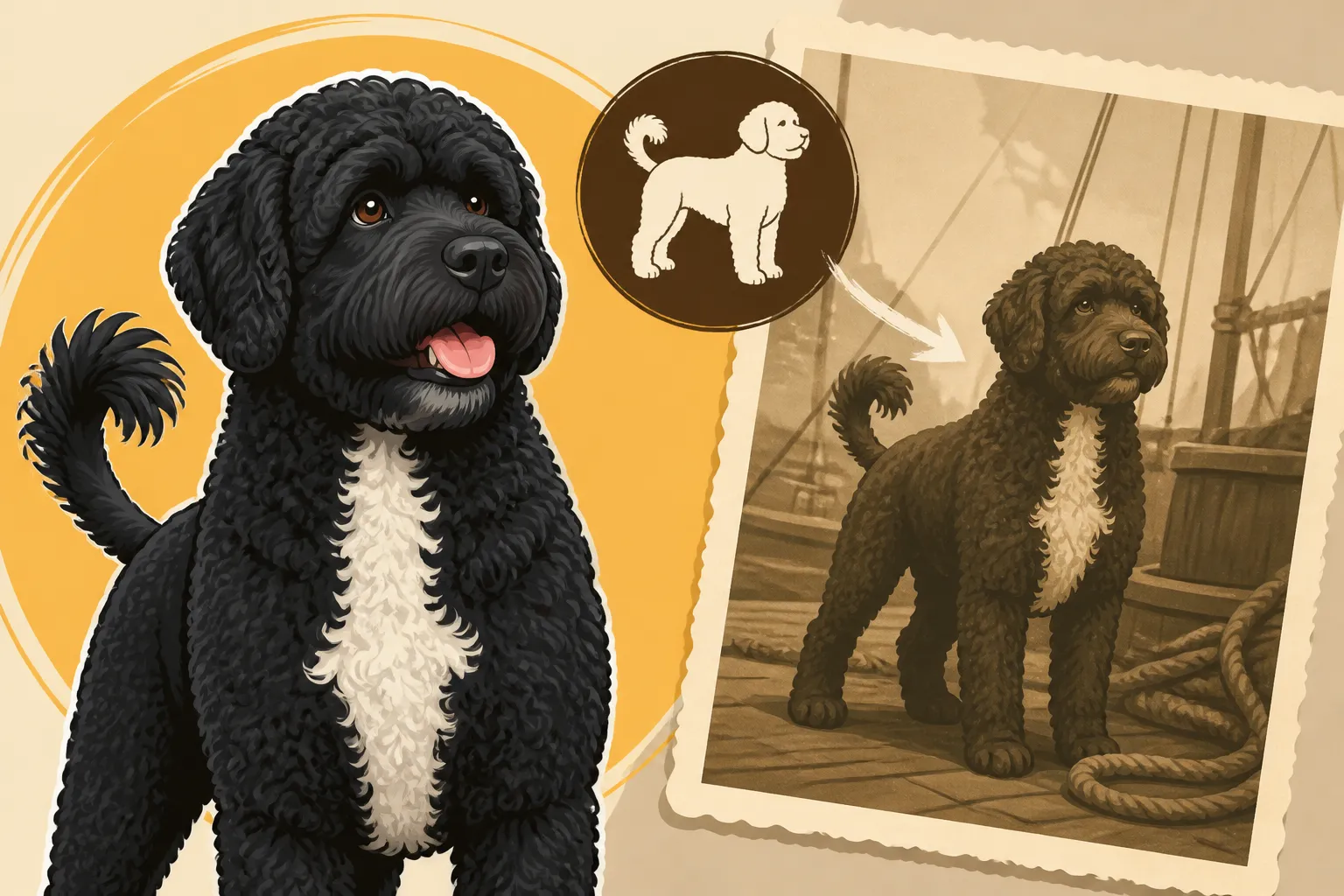
That gap matters when you search for an “old photo.” A written account, drawing, painting, or later reconstruction may depict the breed’s past without being a photograph taken during that earlier period. An image can be historically relevant while still offering no direct photographic evidence of what an individual dog looked like at the time.
The breed is associated with Portuguese coastal communities, but a photograph’s location alone cannot prove that the dog in it is a Portuguese Water Dog. A working dog beside a boat in Portugal may be plausible, yet it could belong to another local type or have no reliable breed identification at all. Background and setting are clues, not proof.
For context about the dogs’ traditional work, see What a Portuguese Water Dog Did for a Fishing Crew. It helps explain why a historical image of the breed might show a dog near boats or fishing gear, while also reminding us that the breed’s identity rests on more than a coastal backdrop.
The surviving photographic record becomes clearer during the breed’s revival
The Portuguese Water Dog came close to disappearing as fishing practices changed and fewer crews needed dogs for traditional water work. That decline makes the photographic record uneven: there may be fewer surviving images from the period when the breed was a routine working companion than a modern reader expects.
Interest in preserving the breed grew during the twentieth century. Vasco Bensaude played an important role in that effort, and the Algarbiorum kennel is closely associated with rebuilding the breed’s numbers. Photographs connected to breeders and preservation work are more likely to come with names, dates, or other documentation than an unattributed image shared online.
That does not mean every photograph from the revival period is easy to identify. Captions can be incomplete, old prints can be separated from their original notes, and a dog’s name may be recorded without enough information to confirm its ancestry. Still, a named dog in a documented breeding or preservation context gives researchers a stronger starting point than an anonymous picture.
For more background, read Who Vasco Bensaude Was to the Portuguese Water Dog and Whether the Algarbiorum Kennel Rebuilt the Portuguese Water Dog. The broader history in How Close the Portuguese Water Dog Came to Extinction also helps explain why a surviving image from the breed’s preservation era can be especially valuable.
What an old photograph can and cannot tell you
A picture may show appearance without proving identity
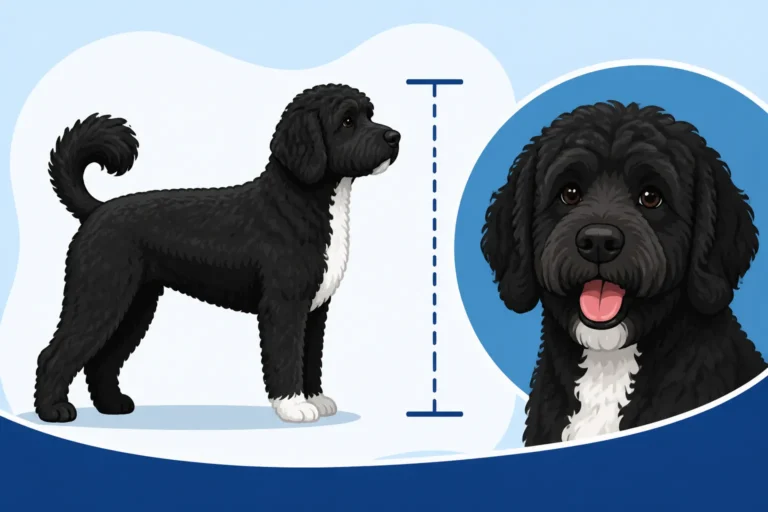
A photograph can offer a useful glimpse of coat texture, body shape, grooming, and the way a dog was presented. Depending on the image, you might see a curly or wavy coat, a long tail, a sturdy frame, or a traditional working clip. These details can be compared with descriptions of the breed, but none is a standalone identification test.
Coat and grooming can be especially misleading. A dog may look unlike the Portuguese Water Dogs people are used to seeing today because it is wet, clipped differently, poorly groomed, or photographed from an awkward angle. Conversely, a shaggy, dark-coated dog can look convincingly similar without having a documented connection to the breed.
Photographic limitations add another layer. Early prints may be faded, scratched, blurry, or monochrome. A black dog can lose detail against a dark background; a pale marking may disappear in a washed-out image. A sitting pose may hide the dog’s proportions, while a tight crop may exclude the boat, people, or setting that could help establish context.
Think of a photograph as one piece of evidence, not a complete record. It may support a historical claim when paired with a reliable caption, family papers, kennel records, or a known photograph of the same dog. By itself, it often cannot establish breed, date, or location with certainty.
Captions, provenance, and corroboration matter more than resemblance
When you find an image described as an old Portuguese Water Dog photograph, first ask where that description came from. Is there a dated original caption, an album with a known owner, a breeder’s record, or a published history that identifies the dog? Or is the claim simply repeated in a social media post without any explanation?
Then look for details that can be checked independently. A dog’s name may appear in a kennel record, while a person, boat, or location might be identifiable through family documentation. A date written on the back of a print can be helpful, but it should be treated cautiously if the handwriting or context is unknown. The back of a photo can be separated from the front, and dates may be added later.
It is also useful to distinguish “photograph of a Portuguese Water Dog” from “photograph said to show a Portuguese Water Dog.” The second phrase is more accurate when the image looks plausible but has no supporting documentation. That distinction protects both the breed’s history and the person sharing the image from overstating what is known.
| Image clue | Why it may help | Why it is not enough by itself |
|---|---|---|
| A dated caption naming the dog | Gives a starting point for checking the image’s history | The caption could have been added later or copied incorrectly |
| A connection to a known breeder or kennel | May link the dog to preservation records | A kennel connection still needs to be supported by records |
| A Portuguese coastal setting | Fits the breed’s working history | Many kinds of dogs lived and worked near the coast |
| A familiar coat or clip | Can be consistent with Portuguese Water Dog appearance | Grooming, angle, and image quality can create misleading similarities |
| Matching details across multiple records | Strengthens the identification | Records may repeat the same original error |
The breed’s geographic and working history can guide your questions without deciding the answer for you. Where the Portuguese Water Dog Comes From offers useful context, while Why Fishermen Stopped Needing the Portuguese Water Dog helps explain why images from different periods may show changing roles and settings.
How to look for historical images responsibly
Start with records that explain where an image came from
A good search begins with context rather than a broad image query. Look for historical books, breed histories, kennel materials, museum collections, family archives, or photo albums where an image is accompanied by a name or date. Even when a scan is available online, the surrounding text may provide details that are lost when the image is copied and reposted.
Search terms can include the breed’s Portuguese name, Cão de Água Português, as well as the English name. Adding terms connected to breeders, kennels, fishing, or a specific period may narrow the results. But search results are only a way to find leads: a page repeating an unsourced caption is not the same as a record that documents the photograph.
Pay attention to whether an image is an original photograph, a reproduction, or an illustration. Old books sometimes place photographs beside drawings or paintings, and a low-quality scan can make the distinction less obvious. If the image is reproduced in a publication, note the caption and publication context instead of saving only the picture.
If you are researching a particular dog or family collection, keep a simple record of what you find: the image’s location, its caption, any date, and the source that supplied those details. This makes it easier to separate confirmed information from a plausible guess when you compare material later.
Use a careful standard before sharing an identification
Before calling a picture a Portuguese Water Dog, ask whether the claim is based on documented identity or visual resemblance. If the evidence is incomplete, use careful language such as “possibly a Portuguese Water Dog” or “identified in the collection as a Portuguese Water Dog.” That wording is not fussy; it tells readers what the image can actually support.
It is also worth preserving the original caption exactly as it appears, including uncertainty or spelling variations. A caption that says “water dog” should not automatically be expanded into a specific modern breed name. Historical terms can be broader than today’s breed labels, and a modern identification may not match the original writer’s meaning.
Comparing several images may reveal recurring features, but it does not substitute for documentation. Similar-looking dogs can share coat and body traits, and photographic conditions can make different dogs seem alike. A compelling visual match is a reason to investigate further, not a reason to invent a pedigree.
For breed-history context, Whether Every Portuguese Water Dog Descends From a Few Dogs explains why preservation and ancestry questions matter. For the breed’s later spread beyond Portugal, When the Portuguese Water Dog Reached America provides a useful point of comparison when you encounter photographs from outside its original working setting.
What to take away from the historical record
Old photographs are part of the story, not the whole story
Yes, old photographs of Portuguese Water Dogs appear in historical material, particularly in connection with the breed’s preservation and later documentation. But “old” can mean different things: a photograph from the twentieth century may be old to a viewer while still coming long after the breed’s traditional working role began.
That distinction does not make the images less meaningful. A well-documented photograph can bring names, people, and breeding history into view in a way that a general description cannot. It can also show how grooming, presentation, and the breed’s public role changed over time.
At the same time, an image without a reliable caption should not be treated as definitive proof. The dog may resemble the breed, the setting may fit its history, and the photograph may be genuinely old, yet the identification can remain uncertain. Good historical research leaves room for that uncertainty rather than filling gaps with confident-sounding guesses.
The most useful way to appreciate these photographs is to read them alongside the breed’s written history and the records of the people who worked to preserve it. A picture can spark curiosity; careful documentation helps turn that curiosity into a more trustworthy account.
A simple checklist for evaluating a photograph
When you come across a photograph described as showing a Portuguese Water Dog, work through these questions:
- Is the image genuinely a photograph? Check whether it is an original print, a scan, a later reproduction, or an illustration.
- Is there an original caption or reliable record? Look for a dog’s name, date, owner, kennel, or collection information.
- Can the details be corroborated? Compare the caption with other records instead of relying on repeated online descriptions.
- Are you separating evidence from appearance? A coat, clip, or seaside background may be suggestive but cannot establish identity on its own.
- Are you describing uncertainty honestly? If documentation is missing, say so rather than presenting a tentative identification as fact.
Following these steps makes it easier to enjoy old photographs without accidentally turning speculation into breed history. It also helps preserve the value of genuine images: a carefully sourced picture tells a richer story than an attractive but unsupported claim.
Disclaimer
This article is for general informational purposes only and does not constitute professional advice. Laws, prices and regulations vary by location and change over time. Consult a qualified professional for guidance on your specific situation.