Whether a Portuguese Water Dog Beats a Labrador on Distance
One common question I get from water dog enthusiasts is about the ultimate endurance swimmers of the canine world, specifically when comparing two powerhouses: the Portuguese Water Dog and the ever-popular Labrador Retriever. If you've ever watched either of these breeds in the water, you know they're both built for it, but the thought often pops up: which one truly has the edge when it comes to covering serious distance? This guide will dive deep into their historical roles, physical attributes, and the factors that contribute to their incredible aquatic stamina, helping you understand what makes each breed a phenomenal swimmer and how they might stack up in a long-distance challenge.
Understanding the Portuguese Water Dog's Aquatic Prowess
The Portuguese Water Dog isn't just "good" at swimming; they were bred for it. Their entire history revolves around working in and around the water, making them true aquatic specialists. Their structure, temperament, and sheer drive are all perfectly tuned for maritime tasks.
Historical Context of the Portuguese Water Dog's Water Work
Imagine the rugged coastlines of Portugal, where fishing boats braved the Atlantic for centuries. That's where the Portuguese Water Dog, or Cão de Água Português, truly earned its stripes. These dogs weren't just passengers; they were integral crew members. Their job descriptions were varied and demanding, ranging from herding fish into nets – yes, herding fish – to retrieving lost tackle, carrying messages between boats, and even acting as four-legged lifeguards. This wasn't a leisurely paddle in a pond; this was serious, sustained work in often cold, choppy waters, sometimes for hours on end.
The fishermen relied on their PWDs for their tireless work ethic and their incredible ability to navigate the water. They needed a dog that wouldn't just jump in, but would stay in, focused on the task, regardless of how far the net had drifted or how elusive the fish were. This deep-seated instinct for water work and a remarkable endurance level is hardwired into their DNA. It’s what set them apart from other breeds and why they became so essential to the Portuguese fishing communities. You can learn more about their original purpose in What a Portuguese Water Dog Was Bred to Do on a Boat.
Physical Adaptations for Swimming Distance
When you look at a Portuguese Water Dog, you're seeing a canine athlete sculpted by generations of aquatic work. Every aspect of their physical makeup contributes to their swimming prowess. Let's break down some of their key adaptations.
Firstly, their coat. Unlike many breeds with a thick, insulating undercoat, the PWD has a single coat of either curly or wavy hair. This isn't just about being "hypoallergenic"; this unique coat structure is water-repellent and helps to prevent matting that could weigh them down when thoroughly saturated. It acts almost like a wetsuit, providing insulation without becoming waterlogged and heavy. This allows them to stay in cold water for extended periods without succumbing to hypothermia, which is crucial for long-distance efforts.
Secondly, their webbed feet are a marvel of natural engineering. These aren't just slightly webbed; they are significantly webbed between their toes, providing a larger surface area with each stroke. Think of it like a natural paddle, giving them incredible propulsion and efficiency in the water. This allows them to glide through the water with less effort than a dog with standard paws, conserving energy over longer distances. It’s a direct advantage when considering sustained swimming performance.
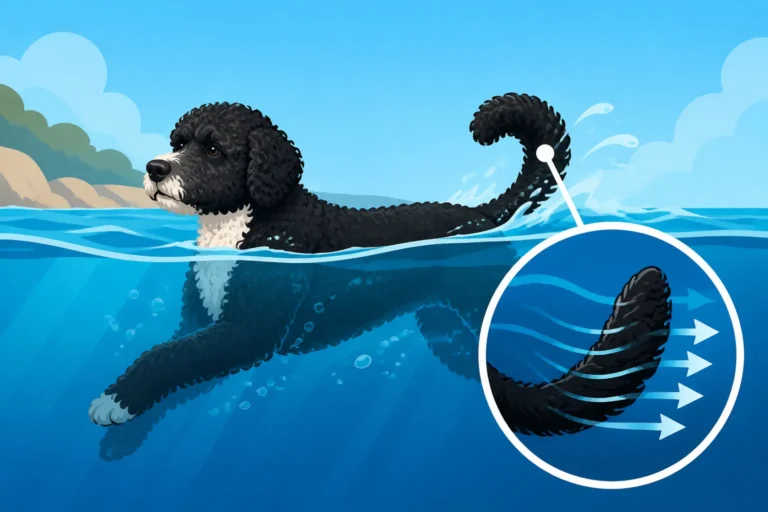
And then there's their tail. Often described as a "rudder," the PWD's thick, tapering tail is carried strongly and used expertly to steer and balance while swimming. It's not just for show; it's a critical component of their aquatic navigation system. This powerful tail allows for agile turns and corrections in the water, but more importantly for distance, it aids in maintaining a straight course and efficient movement, reducing wasted energy on unnecessary shifts in direction. These combined physical traits create a swimming machine designed for efficiency and endurance.
Natural Drive and Stamina
Beyond their physical tools, the Portuguese Water Dog possesses an almost insatiable love for the water. This isn't just a casual dip; it's a deep-seated passion that fuels their stamina. They often approach water with an enthusiasm that borders on obsession, splashing and diving with joyous abandon. This innate drive means they rarely need encouragement to enter the water; in fact, the challenge is often keeping them out of it!
Their stamina is legendary. A healthy, well-conditioned PWD can swim for extended periods, retrieving object after object, without showing signs of tiring quickly. This is partly due to their efficient swimming mechanics and partly due to their hardy constitution developed over centuries of demanding work. They have a "go-all-day" attitude when it comes to water activities, making them ideal companions for anyone looking to engage in water sports like dock diving, water trials, or just long swims at the lake or beach. Many owners find that even after a long session in the water, their PWD still has energy to burn, a testament to their incredible endurance. For more on their daily needs, check out What a Portuguese Water Dog Needs Every Day.
The Labrador Retriever's Water Heritage and Abilities
Now, let's turn our attention to the Labrador Retriever, another breed synonymous with water. Labs are widely loved for their friendly dispositions and versatility, but their roots as working retrievers firmly plant them in the category of excellent swimmers.
The Labrador's Origins as a Water Retriever
The Labrador Retriever's history is steeped in the cold, often icy waters of Newfoundland, Canada, where they were originally bred to assist fishermen. Much like the PWD, these dogs were working partners on fishing boats, but their primary role was different. They were expert retrievers, plunging into frigid waters to pull in fishing nets, lines, and, crucially, downed ducks and geese for hunters. Their name, "Labrador Retriever," perfectly encapsulates their purpose.
They weren't necessarily tasked with herding fish, but rather with retrieving heavy objects from the water with incredible speed and tenacity. This required a different kind of endurance – bursts of powerful swimming to reach a distant retrieve, then the strength to carry it back, often against currents. Their lineage is one of resilience in harsh conditions and an unwavering focus on bringing back what they were sent for. This working background ensures that a strong retrieve drive is a hallmark of the breed, often extending to anything thrown into the water.
Physical Traits Supporting Water Work
Labrador Retrievers also boast a range of physical attributes that make them exceptional in the water, honed by their retrieving heritage.
A key feature is their dense, double coat. This coat is incredibly water-resistant and insulating, providing protection against cold water. The outer coat is somewhat coarse and oily, shedding water effectively, while the soft, thick undercoat traps air, acting as a natural buffer against the cold. While it can hold a bit more water than a PWD's single coat, it's designed to keep them warm in very chilly environments, allowing them to stay comfortable and focused during waterfowl retrieval, even in winter conditions. This insulation is vital for prolonged exposure to cold water.
Their "otter" tail is another distinctive feature. Thick at the base and tapering, it's strong and powerful, acting as a propulsive rudder, much like an otter's tail helps it navigate water. This tail provides excellent steering and balance, giving them precision and agility in the water, especially when making quick turns to track a retrieve. The tail's strength is evident in the way a Lab powers through the water, using it almost like a fifth limb to drive forward.
Additionally, Labs possess strong, muscular bodies and robust chests, which provide excellent buoyancy and power. Their strong hindquarters are built for powerful propulsion, enabling them to launch into the water and cover distances quickly. Their paws, while not as overtly webbed as a PWD's, are still well-suited for paddling, contributing to their overall efficiency as swimmers. These combined physical traits make them formidable in aquatic environments.
Drive and Enthusiasm for Retrieving
If there's one thing a Labrador is known for, it's their enthusiasm and unwavering drive to retrieve. This isn't just about chasing a tennis ball in the park; it translates directly to their water work. A Lab will happily launch themselves into the water repeatedly, driven by their intense desire to please their owner and the pure joy of the retrieve. Their eagerness to work and their high energy levels make them incredible partners for water-based activities.
This drive, combined with their biddable nature, means they are highly trainable for complex water tasks. Whether it's retrieving a dummy from hundreds of yards away or working through specific water trials, a Lab's focus and determination are impressive. While a PWD might have an independent streak born from making decisions on a fishing boat, a Lab often thrives on working with their handler, eager for the next command. This inherent motivation means they will often swim until you tell them to stop, driven by that powerful retrieving instinct. You can find out more about their trainability in How Trainable a Portuguese Water Dog Is (comparing with PWDs).
Comparing Endurance and Distance Swimming
So, which breed "wins" when it comes to swimming distance? It's not a simple answer, as both breeds are truly exceptional in their own right. Instead of a clear victor, it's more about understanding their strengths and how various factors play into their performance.
Factors Influencing Distance Performance
Several elements contribute to how far and how effectively a dog can swim, going beyond just breed genetics.
First, individual conditioning and health are paramount. A highly athletic, well-muscled, and healthy Portuguese Water Dog or Labrador Retriever will naturally have greater endurance than one that is out of shape or has underlying health issues. Regular exercise, a balanced diet, and routine veterinary care all contribute to a dog's physical stamina. Just like human athletes, canine swimmers need to be properly conditioned to perform their best. This means building up their muscle strength, cardiovascular fitness, and overall endurance gradually.
Second, water conditions play a huge role. Swimming against a strong current, in choppy waves, or in very cold water requires significantly more effort and stamina than swimming in calm, warm lake water. A dog that excels in a still pond might struggle with the demands of an ocean swim. The PWD's historical background in open ocean waters might give them a slight psychological edge in rougher conditions, as they are accustomed to working in such environments. However, a well-trained Lab can also handle challenging water with determination.
Finally, motivation and training are critical. A dog that is highly motivated by a retrieve or a task, and has been properly trained for endurance swimming, will consistently outperform an unmotivated or untrained dog, regardless of breed. This includes teaching proper swimming technique, building confidence in the water, and gradually increasing the duration and distance of their swims. A program like BAXTER & Bella, for instance, focuses on positive reinforcement and building a strong foundation, which can be invaluable for developing a dog's confidence and focus, even in challenging environments like water. While they focus on obedience, the principles apply to any focused activity.
The "Beat" Question: Direct Comparison
When we consider the question of which dog "beats" the other on distance, it really comes down to their specific historical roles and physical nuances.
The Portuguese Water Dog, with their webbed feet, rudder tail, and single, non-water-logging coat, is arguably built for sustained, efficient propulsion over long durations. Their ancestral job demanded continuous movement in water, often covering significant distances to manage nets or retrieve floating objects over a wide area. They were marathon swimmers, designed for efficiency and insulation in the open sea. This means they are often less prone to tiring out quickly due to inefficient movement or excessive water absorption by their coat.
The Labrador Retriever, while also an incredible water dog, was historically bred for powerful, explosive retrieves. Their dense double coat is fantastic for warmth in freezing temperatures, but can become heavier with prolonged saturation. Their strength and drive for retrieving are unmatched, making them fantastic for repetitive, powerful sprints into the water and back. They are more like powerful sprinters with incredible stamina for repeated effort rather than continuous, long-haul swimming.
In a direct, pure endurance swim over a very long, continuous distance in moderately cold, calm water, a well-conditioned PWD might theoretically have a slight edge due to their specialized coat and highly efficient, webbed feet, allowing them to conserve energy more effectively. However, in scenarios involving powerful retrieves, especially in very cold water where insulation is paramount, or repeated, high-intensity swims, a Labrador would likely shine. It's less about one "beating" the other and more about their differing specialties within the aquatic realm. Both are champions; they just have slightly different competitive advantages.
Role of Training and Conditioning
No matter the breed, raw talent only gets a dog so far. The true secret to long-distance swimming prowess lies heavily in consistent training and proper conditioning. You can have the most naturally gifted Portuguese Water Dog or Labrador Retriever, but without the right preparation, they won't reach their full potential.
For instance, a dog needs to build up its cardiovascular endurance and muscle strength gradually. Just like a human runner wouldn't tackle a marathon without training, a dog shouldn't be expected to swim for miles without a progressive conditioning program. This involves regular, controlled swimming sessions that slowly increase in duration and intensity. It's not just about letting them splash; it's about structured exercise that strengthens their core, builds their stamina, and refines their swimming technique.
Moreover, training also encompasses mental preparedness. A well-trained dog understands commands, stays focused on the task, and learns to pace themselves. They learn to ignore distractions and concentrate on their handler, even in exciting environments like a beach or lake. For example, a PWD might naturally be independent, but teaching them recall and focus in water is crucial for safety and performance over distance. The mental aspect of training helps them to conserve energy by working smart, not just hard. Both breeds are incredibly intelligent and eager to please, making them excellent candidates for advanced water training, which ultimately enhances their distance capabilities significantly.
Maximizing Your Dog's Water Performance
Whether you have a Portuguese Water Dog, a Labrador, or another water-loving breed, there are concrete steps you can take to ensure they enjoy their time in the water safely and perform at their best.
Training for Stamina and Safety
When you're thinking about helping your dog achieve long-distance swimming potential, safety and stamina go hand-in-hand. Never push your dog past their limits. Start with short, fun sessions and gradually extend the duration and distance. It's about building confidence and enjoyment, not just performance. Teaching them to swim alongside you, perhaps from a kayak or paddleboard, can be a wonderful way to build their endurance while you can closely monitor them. Always supervise them closely, especially in unfamiliar waters.
Think about incorporating varied activities. While swimming is key, land-based exercises like running, hiking, or even Agility Classes for a Portuguese Water Dog can build overall fitness and muscle strength, which translates directly to better stamina in the water. Remember, swimming is a full-body workout, so a strong, fit dog on land will be a strong, fit dog in the water. Focus on quality over quantity initially, ensuring good technique before increasing the workload. Also, always ensure your dog is properly warmed up before strenuous activity and cooled down afterward.
Essential Gear and Resources
Having the right gear isn't just about convenience; it's about safety and enhancing your dog's performance. A well-fitting life jacket is absolutely non-negotiable for any dog spending significant time in the water, especially for long distances or in rough conditions. Even the strongest swimmers can get tired, caught in a current, or encounter an unexpected obstacle. A bright-colored life jacket with a sturdy handle, like many found on Amazon, provides buoyancy, increases visibility, and allows you to easily assist your dog if needed. It's a small investment that offers enormous peace of mind.
For training, having a variety of water-specific retrieving toys is also helpful. Toys that float well and are highly visible, again, readily available on Amazon, keep your dog engaged and motivated during training sessions. Furthermore, consider resources that go beyond just physical training. Online dog training programs, such as BAXTER & Bella, while not specifically water-focused, offer structured positive reinforcement techniques that can be applied to any training scenario. Developing a strong foundation of obedience and responsiveness on land will carry over to the water, making your dog a more attentive and safer swimming companion. This foundational training builds communication and trust, which are vital for any advanced activity.
And don't forget the practicalities for after-swim care! A good set of super-absorbent towels and even a force dryer (if your dog tolerates it) are invaluable for preventing skin issues and mats after a long swim, especially for a dense-coated breed like the Lab or the tightly curled PWD. Drying a Portuguese Water Dog After Every Swim is a whole topic in itself!
Enjoying Water Sports Responsibly
Ultimately, the goal is to enjoy the water with your canine companion responsibly. Both Portuguese Water Dogs and Labrador Retrievers are magnificent athletes, but they are also living creatures with individual limits and needs. Always be mindful of the temperature of the water and the air, watching for signs of overheating or hypothermia. Fresh, clean drinking water should always be available, especially after swimming, as dogs can accidentally ingest pool or saltwater.
Pay close attention to your dog's body language. Signs of fatigue, such as lagging behind, excessive panting, or struggling to keep their head above water, mean it's time for a break. Never force a dog into the water if they seem hesitant or scared. Building a positive association with water, starting slowly and making it a fun experience, is key. Whether you're engaging in competitive water trials, dock diving, or simply enjoying a refreshing swim at the lake, the bond you share with your dog should always be at the forefront. Celebrate their incredible natural abilities, but prioritize their health and happiness above all else. They are, after all, our best friends.
Breed Comparison: Water Adaptations
| Feature | Portuguese Water Dog | Labrador Retriever |
|---|---|---|
| Coat Type | Single, curly or wavy, water-repellent | Dense double coat, water-resistant & insulating |
| Paws | Strongly webbed for efficient propulsion | Well-padded, strong, good for paddling |
| Tail | Thick, powerful, rudder-like for steering | "Otter" tail, thick at base, strong rudder |
| Historical Role | Herding fish, retrieving nets, message carrying, long duration work in open sea | Retrieving waterfowl, fishing lines, powerful bursts of effort in cold water |
| Buoyancy/Insulation | Excellent buoyancy, insulation via coat structure | Excellent insulation from double coat |
| Energy Conservation | High efficiency from webbed feet and coat helps for long distances | Powerful propulsion, but dense coat can become heavier over long, continuous periods |
This table summarizes some of the key physical and historical differences that influence their swimming styles and endurance capabilities. Both are superb, but their specific adaptations lean towards different kinds of aquatic challenges.
Disclaimer
This article is for general informational purposes only and does not constitute professional advice. Laws, prices and regulations vary by location and change over time. Consult a qualified professional for guidance on your specific situation.