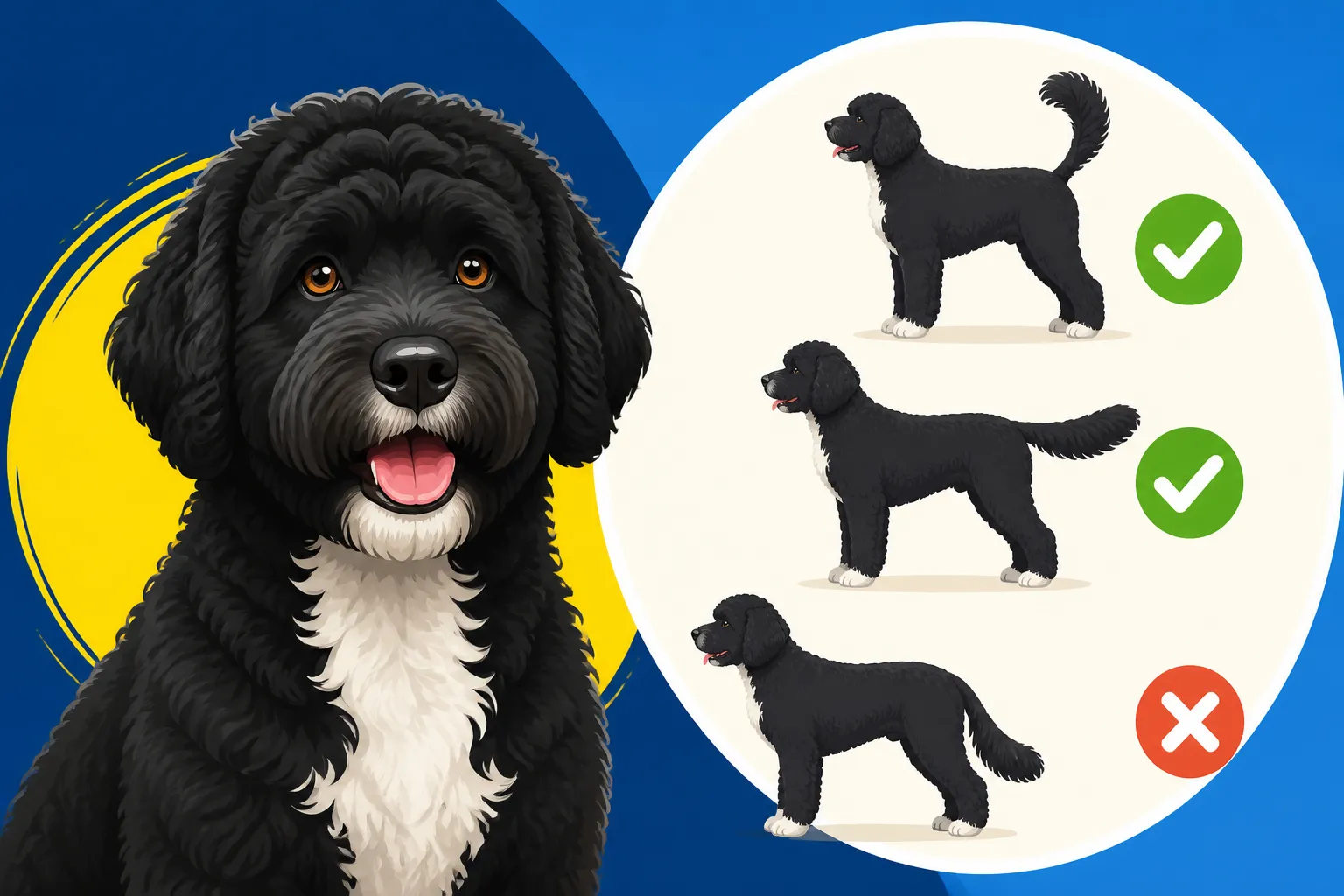
How a Portuguese Water Dog’s Tail Should Be Carried
A Portuguese Water Dog’s tail is one of the clearest parts of its outline: it is naturally long, thick at the base, and often carried above the back when the dog is alert or working. But tail position changes with mood, movement, and context. This guide explains the breed’s typical tail carriage, what is normal variation, and when a change deserves attention.
The Portuguese Water Dog’s Typical Tail Carriage
How the tail sits on a Portuguese Water Dog
A Portuguese Water Dog has a natural, undocked tail that tapers toward the tip. In the breed’s traditional outline, it is set at a medium height and carried above the topline when the dog is alert or moving with purpose. The tail may curve, but it should not be tightly curled over the back.
That description is a guide to the dog’s structure, not a pose it must hold every moment. A relaxed dog may carry its tail lower, particularly while resting or walking casually. A dog watching a squirrel, greeting someone, or anticipating a game may lift it. Just as a person’s posture changes through the day, a dog’s tail carriage changes with what is happening around it.
The tail also needs to be considered as part of the dog’s whole shape. A high tail on a Portuguese Water Dog is not automatically a sign of a problem, and a low tail in one photograph does not, by itself, tell you that the dog is poorly built. Compare the tail with the dog’s back, hindquarters, and movement rather than judging a single moment. For a broader view of the breed’s proportions, see What a Correct Portuguese Water Dog's Outline Looks Like.
What the breed standard does and does not mean
A breed standard describes the features used to assess a dog’s conformation. It is not a checklist of expressions or movements that a pet dog must display constantly. The tail is meant to be natural, carried in a way that fits the dog’s alertness and action, and balanced with the rest of the body.
In a show ring, the dog may be excited, focused on its handler, or moving at a brisk pace. Those conditions can make the tail look higher than it does at home. A judge evaluates the dog in context, including how it is built and moves. The same tail can look different when the dog is standing quietly, trotting, or turning to follow a treat.
If you are choosing a puppy, ask the breeder to show you the puppy moving as well as standing. Watch how the tail is carried across several moments, but do not expect a young dog to hold one polished posture. Puppies are still growing, and their attention shifts quickly. A useful companion topic is How a Portuguese Water Dog Should Move, since the tail is part of the dog’s overall balance in motion.
Why the Tail Moves and Changes Position
Tail carriage reflects the moment
Dogs use their tails as part of their body language, but a tail is not a simple mood meter. A raised, moving tail may accompany excitement or alertness, while a lower, loose tail may appear during a calm moment. The meaning depends on the rest of the dog: facial expression, ears, posture, pace, and the situation all matter.
For example, a Portuguese Water Dog waiting at the edge of a lake may raise its tail because it is anticipating a swim. The same dog might lower it while resting after a long walk. A dog greeting a familiar person could wag broadly, while a dog unsure about an unfamiliar situation might hold its tail still or close to its body. None of those positions should be interpreted in isolation.
This is especially useful for families with children. A wagging tail does not automatically mean a dog wants to be approached or handled. Teach children to give the dog space when it is resting, eating, or trying to move away, and to read the whole body rather than reaching for the tail. The tail is sensitive, and grabbing or pulling it can frighten or hurt a dog.
The tail helps with movement in water
Portuguese Water Dogs were developed as working dogs around fishing boats and coastal waters. Their bodies are built for swimming, and their strong tail contributes to balance and steering. It can help the dog adjust direction as it swims, much like a rudder helps guide a boat, although the tail is only one part of how the dog moves through water.
A dog that swims confidently may carry its tail differently on land and in the water. Watch the dog’s comfort and coordination rather than expecting a particular tail position during every swim. A puppy should be introduced to water gradually, with a safe exit and close supervision. Never assume that breed history makes every individual dog a natural or tireless swimmer.
After swimming, check the tail and the surrounding coat for tangles, debris, or irritation, especially if the dog has a full plume. A wide-toothed comb and gentle, regular grooming can help you notice small problems before they become uncomfortable mats. If you are gathering coat-care supplies, retailers such as Chewy carry combs and grooming tools, but choose tools suited to your dog’s coat and work gently rather than tugging at knots. For more on the tail’s role in the water, read Why a Portuguese Water Dog's Tail Works as a Rudder.
Tail Appearance, Grooming, and Everyday Care
The tail is not meant to be docked
A Portuguese Water Dog’s tail is naturally long. It should not be confused with breeds whose traditional appearance includes a docked tail. The tail is part of the dog’s outline and contributes to its movement and communication. A puppy with a full natural tail is normal.
This can be confusing when comparing photographs, especially if the dog’s tail is tucked, hidden by coat, or partly outside the frame. Coat length can also change how prominent the tail looks. A long plume may visually soften the tail’s shape, while a shorter trim can make its taper easier to see. Neither appearance changes the underlying tail structure.
If you are looking at a puppy advertisement and cannot tell whether the tail is natural, ask the breeder directly and request a clear view of the puppy from behind and from the side. A responsible breeder should be comfortable discussing the dog’s structure and showing the puppy in ordinary, relaxed movement. Why a Portuguese Water Dog's Tail Is Never Docked provides more background on the breed’s natural tail.
Keeping the tail plume comfortable
The Portuguese Water Dog’s coat can tangle, and the tail plume is easy to overlook during a quick brush. Check the hair from the base to the tip, especially after swimming, play in brush, or wearing a harness that may rub nearby. Work in small sections and use your fingers to separate tangles before using a comb. If a mat is tight against the skin, do not yank it; a groomer or veterinarian can advise on the safest way to remove it.
A practical routine is to include the tail whenever you check the ears, feet, and other areas that are easy to miss. Look for burrs, small twigs, damp clumps, and skin redness. After swimming, rinse away salt, pool chemicals, or lake debris as appropriate, then dry the coat thoroughly. A full tail plume can stay damp longer than it appears from the outside.
For basic grooming supplies, Chewy is one place owners may look for coat combs or dog-safe shampoo; the important part is selecting products appropriate for the dog and following the product directions. If a groomer trims the tail, explain the look you prefer and ask how much length will remain. A trim should keep the coat manageable without making the dog’s tail look like a different structure. See Whether a Portuguese Water Dog's Tail Plume Is Left for more about how the plume is handled.
| What you notice | Often ordinary | Worth a closer look |
|---|---|---|
| Tail carried lower while resting | A relaxed posture or a change of activity | A sudden, persistent change paired with discomfort |
| Tail raised when alert | Interest, excitement, or attention | A stiff posture with signs of fear or distress |
| Tail moving during a greeting | Social excitement, depending on the rest of the body | A dog that is tense, retreating, or guarding space |
| Coat tangled around the plume | A grooming issue that may need gentle detangling | A tight mat, irritated skin, or a painful reaction to touch |
| Tail suddenly hanging limp | Not typical if it is a new change | Pain, swelling, injury, or difficulty moving it |
When a Change in Tail Carriage Needs Attention
Look for changes from your dog’s normal pattern
The most useful comparison is usually your own dog’s usual behavior. If a dog has always carried its tail lower while relaxed and raises it during play, that pattern may simply be its normal range. A sudden change is more meaningful than a single position observed without context.
Pay attention if your dog avoids having the tail touched, cries when it moves, has visible swelling or a wound, or seems reluctant to sit, walk, or swim. A tail that suddenly hangs limp or stays tucked may also be a reason to contact a veterinarian, especially when it appears alongside lethargy or other signs of pain. These observations cannot identify the cause, but they help you describe what changed.
Try to note when you first saw the change and what happened beforehand. Did it appear after a rough play session, a long swim, a fall, or a period of vigorous activity? Is the dog still eating and moving normally? Clear details can help a veterinary professional decide what examination is appropriate. Do not pull, massage, or repeatedly lift a sore tail to test it.
Don’t confuse a single pose with a diagnosis
A dog may tuck its tail briefly when startled, uncertain, cold, or trying to settle in a new place. A low tail after a demanding swim or an unusually active day does not automatically indicate injury, but persistent discomfort should not be dismissed as ordinary tiredness. Context, duration, and accompanying symptoms matter.
Some owners hear the term “swimmer’s tail” and assume that any low or limp tail after swimming must be that condition. That is not a safe assumption. Several issues can affect how a dog holds its tail, and a veterinarian is the right person to assess a new or painful change. If the tail position is unusual and the dog appears distressed, arrange veterinary advice rather than trying home treatment. You can also read Whether a Portuguese Water Dog Gets Swimmers Tail and How a Portuguese Water Dog Hides Pain for related signs to watch for.
For normal everyday outings, prioritize safe handling and a comfortable fit. A harness or leash should not press painfully against the tail base, and children should be taught not to pull or swing the tail. If you are shopping for reflective walking gear, Chewy may offer options, but check that any item fits securely without restricting the dog’s movement. The goal is not to make the tail stay in a particular position; it is to let the dog move naturally and comfortably.
Disclaimer
This article is for general informational purposes only and does not constitute professional advice. Laws, prices and regulations vary by location and change over time. Consult a qualified professional for guidance on your specific situation.