What a Correct Portuguese Water Dog’s Outline Looks Like
A Portuguese Water Dog can look dramatically different in a long coat, a short pet trim, or the traditional Lion Clip, which makes its true shape surprisingly easy to misread. This guide explains the breed’s correct outline from head to tail, what proportions matter, and how to separate sound structure from grooming, posture, and puppy growth.
The overall shape of a Portuguese Water Dog
A balanced, nearly square outline
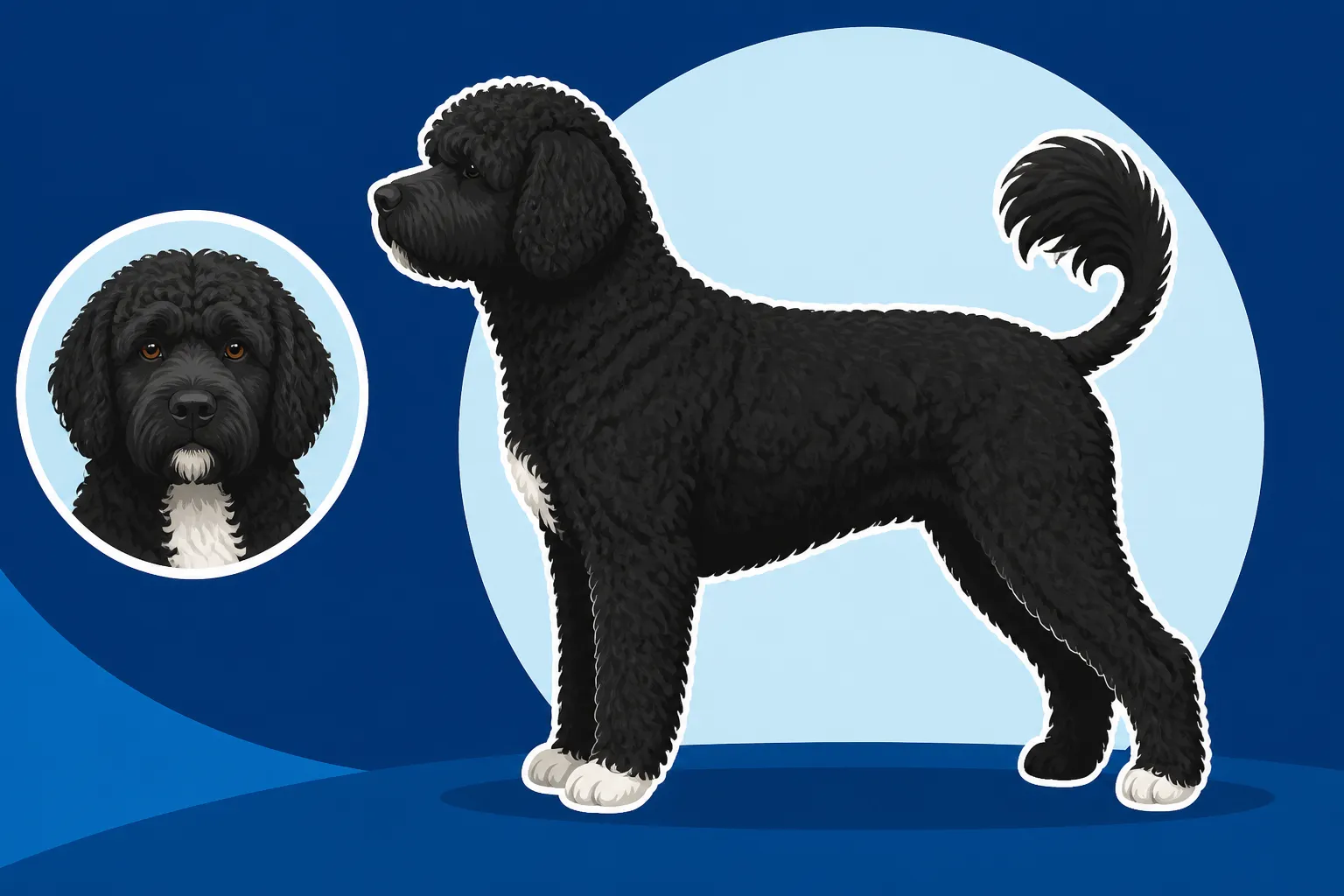
The first impression should be of a strong, athletic dog whose parts fit together—not a dog that looks stretched out, squat, or exaggerated. In profile, the Portuguese Water Dog is generally described as nearly square: the distance from the front of the chest to the rear of the body is close to the height from the ground to the top of the shoulders, or withers.
“Nearly square” is a guide to proportion, not a demand for a perfect geometric shape. Coat length, stance, camera angle, and even whether the dog is standing naturally can change the way its outline appears. A dog leaning forward to greet someone may look longer in front; one standing with its hind feet tucked under may appear shorter behind. Look at the whole animal standing comfortably, rather than judging a single snapshot.
The outline should suggest strength and usefulness. Portuguese Water Dogs were developed as working dogs around boats and water, so a correct silhouette needs to look capable of moving, swimming, and changing direction—not simply decorative. The body should be substantial without appearing heavy or coarse, and the limbs should support it in a way that looks balanced.
Height is only one part of proportion
A dog can fall within an expected height range and still look poorly balanced. Height should be considered alongside body length, bone, chest depth, leg length, and the way the front and rear assemblies fit together. For the breed’s size measurements, see What Height a Portuguese Water Dog Standard Asks For and What Weight a Portuguese Water Dog Should Fall In.
A helpful visual check is to step back and look at the dog from the side, then from the front and rear. From the side, ask whether the body looks compact and balanced. From the front, look for a chest and limbs that appear strong and orderly rather than narrow, weak, or awkwardly set. From behind, the hindquarters should look powerful enough to drive the dog forward without giving an impression of excessive bulk.
These observations are not a substitute for a hands-on evaluation. A thick coat can make a lean dog appear broader, while a close trim can reveal the underlying proportions more clearly. If you are assessing a puppy, remember that growth happens unevenly: a youngster may temporarily look leggy, rangy, or out of proportion while different parts of the body develop at different rates.
The outline should look athletic, not extreme
A correct Portuguese Water Dog should not look delicate, overly long, or low to the ground. It should also not look excessively massive or short-legged. The goal is a moderate, functional balance: enough substance to look strong, with enough leg and body proportion to move freely.
This is one reason a single photo can be misleading. A low camera angle may make the legs look shorter; a dog standing on a slope may appear to have an uneven topline; a fluffy coat may soften the waist and make the body seem longer. When possible, assess a dog standing on level ground, with its feet placed naturally and its head held in a relaxed, alert position.
Reading the body from front to rear
Chest, ribs, and topline
The chest should be broad and deep enough to support an athletic body, reaching down toward the elbows without making the dog look barrel-shaped. The ribs should provide room for the heart and lungs while maintaining a shape that tapers into the waist. Seen from above, the body should not be a straight-sided tube; there should be a visible transition from rib cage to loin.
The topline—the line running along the back from the shoulders toward the hindquarters—should look firm and steady when the dog is standing naturally. A relaxed dog may shift its weight or lower its head, so don’t mistake a momentary posture for a structural feature. What matters is whether the dog’s back and body appear supported and balanced rather than weak or excessively arched.
The loin, the area behind the rib cage and before the pelvis, should look strong and relatively short in proportion to the body. A weak-looking middle can make a dog appear disconnected between front and rear, while an overly long body may change the overall impression from compact and powerful to stretched out. The shape should flow smoothly from chest through loin to hindquarters.
Shoulders, legs, and feet
The shoulders and forelegs influence both the front view and the side outline. The front should appear strong and coordinated, with the legs supporting the body rather than seeming too close together, too wide apart, or turned noticeably out of alignment. A dog that is standing squarely can show this more clearly than one bracing on a slippery floor or shifting toward a person holding a treat.
The legs need to look substantial enough for the body, but not heavy in a way that makes movement seem laborious. A correct outline is not created by leg length alone. The shoulder, upper arm, elbow, and foot all contribute to how the dog stands and moves. For more on the breed’s feet and their role, see What a Portuguese Water Dog's Feet Should Look Like and Why a Portuguese Water Dog Has Webbed Feet.
Hair can blur the lines around the feet and lower legs, especially when it grows long between trims. For a fair comparison, look at the dog’s actual stance and foot placement, not only the silhouette made by its coat. A groomer can help reveal the feet without changing the dog’s underlying structure.
Hindquarters and tail
The hindquarters should look strong and capable of providing forward drive. From the side, the rear should connect smoothly to the body rather than appearing abruptly high, weak, or excessively steep. From behind, the legs should support the dog in a stable, balanced way. A dog standing with one hind leg relaxed may look uneven, so give it time to settle before making a judgment.
The tail is part of the outline, too. It should appear naturally attached to the body and should be carried in a way that suits the dog’s mood and activity. An alert dog may hold its tail higher than a relaxed dog. A tail position in one photograph doesn’t tell you everything about structure, and a plume of coat can make the tail look heavier or more dramatic than it is.
A useful way to assess the rear is to watch the dog walk away and then return at a comfortable pace. Look for a coordinated, balanced action rather than focusing on one step or one tail position. The breed’s outline should make sense in motion as well as while standing; How a Portuguese Water Dog Should Move explains what to watch for when assessing gait.
How coat and presentation affect what you see
Coat length can change the silhouette
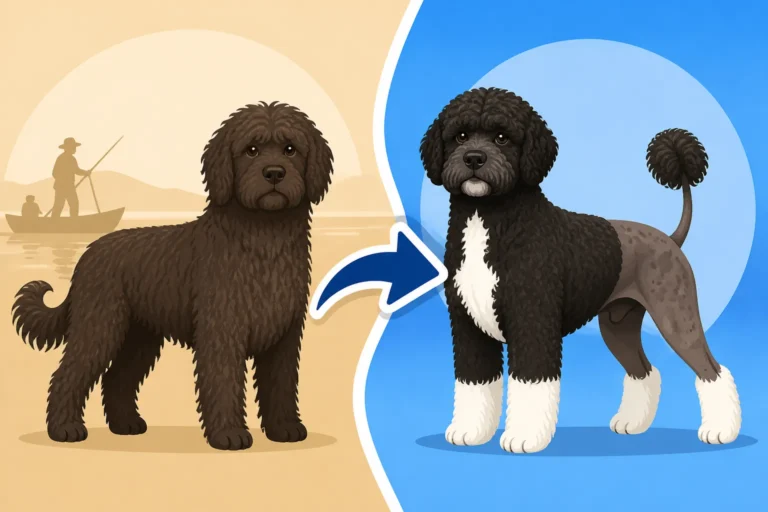
Portuguese Water Dogs have curly or wavy coats, and both coat type and length can change the apparent outline. Long hair can make the body look deeper, the legs look thicker, and the back seem less defined. A close trim can reveal the dog’s proportions more clearly, but a haircut cannot improve or worsen the dog’s underlying structure.
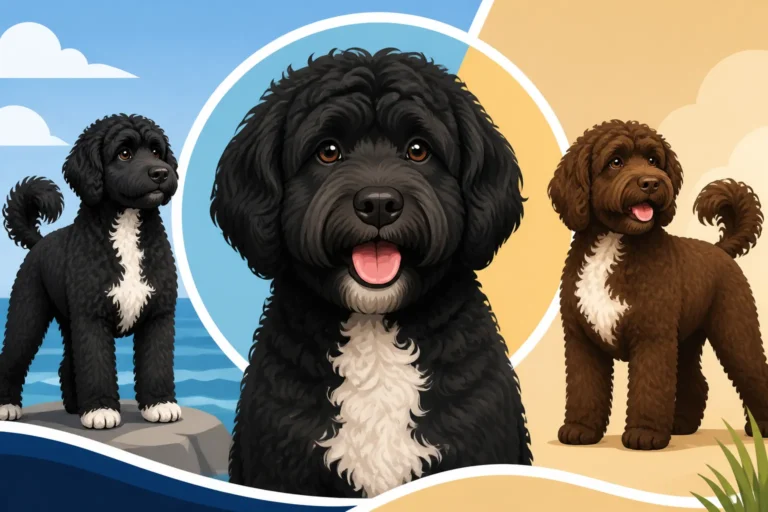
If you are comparing dogs, try to account for how each has been groomed. A heavily coated dog and a closely clipped dog may have similar body proportions but look quite different in photographs. For a fuller explanation of the breed’s appearance, see Curly or Wavy, Black or Brown: What a Portuguese Water Dog Looks Like.
Grooming should make the dog comfortable and manageable, not trick the eye into seeing a different body shape. A practical pet trim may emphasize a tidy, compact look, while a longer coat can soften the outline. The traditional Lion Clip changes the apparent balance even more because hair is removed from much of the hindquarters and retained on selected areas. To compare everyday grooming choices, see Which Clip Suits a Pet Portuguese Water Dog.
Coat condition and a fair visual check
Mats can hide the body and make a dog look lumpy or uneven. Before a visual assessment, gently brush and comb the coat so you can see its natural fall. Don’t pull at tight mats or try to force a comb through them; that can hurt the dog and make grooming stressful. If the coat is badly tangled, a professional groomer can advise on a comfortable way to address it.
A small grooming kit can make routine coat care easier. For example, some owners look to Chewy when shopping for a suitable comb or brush, but the tool should fit the individual coat and the dog’s comfort level. Short, calm grooming sessions are often more useful than trying to do everything at once—especially if the dog is young or still learning to stand for handling.
For a consistent comparison, assess the dog on level ground, in good light, and without forcing it into a rigid pose. Take a side view and a front view if you are keeping notes, and try to use similar positioning each time. A tape measure or a simple written record can help track changes as a puppy grows; Chewy is one place owners may browse for basic grooming or measuring supplies, though the dog’s comfort and accurate handling matter more than any particular product.
A practical outline checklist
What to look for at a glance
Use the following checklist as a starting point, not as a scorecard. No single feature tells the whole story, and a dog’s age, posture, coat, and condition all affect what you see.
| Area to assess | What a balanced outline tends to show | What can distort the impression |
|---|---|---|
| Overall proportion | A strong, compact, nearly square appearance | Camera angle, uneven ground, or a stretched stance |
| Chest and ribs | Depth and substance with a transition into the waist | Long coat, excess weight, or a barrel-shaped pose |
| Back and loin | A firm-looking topline and supported middle | Head held low, shifting weight, or coat mats |
| Front assembly | Limbs that appear strong and coordinated beneath the body | Slippery floors, uneven stance, or long leg furnishings |
| Hindquarters | A powerful, balanced rear that connects smoothly to the body | One relaxed leg, a sloping surface, or a fluffy trim |
| Tail | A natural part of the dog’s overall balance | Excitement, movement, and a full tail plume |
For example, imagine meeting two adult Portuguese Water Dogs at a park. One has a long, shaggy coat and is leaning toward its handler; the other has a short trim and is standing squarely. The second dog may look more obviously compact, but that alone does not prove it has better proportions. Give both dogs time to stand naturally, consider their body shape beneath the coat, and watch them move before drawing conclusions.
A quick visual review can tell you what to look at next, but it cannot tell you whether a dog is healthy, sound, or suitable for a particular activity. For those questions, consider the dog’s overall condition, comfort, and movement, and ask a veterinarian or qualified breed professional when you need an individual assessment.
Common outline mistakes to avoid
One frequent mistake is treating the grooming outline as the dog’s actual shape. A long topknot, a full tail plume, or clipped hindquarters can change the silhouette substantially. Another is judging a puppy against an adult. Young dogs often pass through awkward stages, and temporary legginess or a narrow-looking chest does not necessarily predict the finished adult outline.
It is also easy to confuse “strong” with “heavy.” The breed should look capable and well-built, but extra weight can obscure the waist and make the body look less balanced. A thick coat can create a similar effect. If the outline seems unusually broad, feel the dog gently through the coat and ask a veterinarian to help assess body condition rather than relying on appearance alone.
Finally, avoid judging structure from a posed show photograph without context. A practiced stance can help display a dog’s proportions, but it is only one moment. A relaxed side view, a front view, and a few steps of natural movement offer a more rounded picture. If you are choosing a puppy, learn about the parents and ask the breeder how they evaluate structure as well as temperament and health. What Height a Portuguese Water Dog Standard Asks For can provide useful context for size, while the dog’s complete appearance is covered in How Tall a Portuguese Water Dog Stands.
Questions to ask when evaluating a dog
If you are assessing a puppy or adult dog, ask how its body proportions are expected to change with age, and whether the dog has been evaluated standing and moving. A responsible breeder should be comfortable discussing the strengths and limitations of their dogs without promising that every puppy will develop into a show-quality adult. For broader questions about finding and evaluating breeders, see What a Portuguese Water Dog Club's Health Program Covers.
If you are looking at an adult dog, consider how coat length, weight, and posture might be affecting your first impression. Ask whether the dog has any movement limitations or discomfort that could affect how it stands. For a pet home, a useful outline is one part of the picture; daily care, temperament, grooming needs, and health also matter.
Chewy may be useful for browsing routine coat-care items if you are preparing for a new dog, but the most important “tool” is a calm, patient observation. Stand back, look at the whole dog, and give it a chance to move naturally. A correct outline is not a perfectly posed shape—it is the visible balance of a strong, functional dog.
Disclaimer
This article is for general informational purposes only and does not constitute professional advice. Laws, prices and regulations vary by location and change over time. Consult a qualified professional for guidance on your specific situation.