Whether a Portuguese Water Dog Herds a Child Away From Water
It’s a common scenario that makes many Portuguese Water Dog owners, especially those with young children, a little anxious: you’re by the lake or pool, the kids are splashing, and your PWD starts acting… different. You might wonder if their famous herding instinct will kick in and they’ll try to 'herd' your child away from the water. This guide aims to unpack that concern, distinguish instinct from learned behavior, and offer practical advice for a harmonious, water-filled family life.
Understanding the Herding Impulse in Portuguese Water Dogs
Many people hear "herding breed" and immediately picture Border Collies expertly rounding up sheep. While Portuguese Water Dogs definitely have a strong working drive, their "herding" manifests a bit differently, rooted in their historical role on fishing boats. They weren't herding sheep; they were herding fish, retrieving broken nets, and acting as loyal companions to the fishermen. This unique history shapes how their natural instincts might present themselves around your family, especially near water.
What is "Herding" in a Portuguese Water Dog?
When we talk about a PWD's "herding" instinct, it's not always about nipping heels or circling like a traditional sheepdog. For a Portuguese Water Dog, this instinct is more about control, grouping, and retrieval. On the fishing boats, they were tasked with keeping fish near the nets, retrieving lost equipment, or even carrying messages between boats. This translates to an innate desire to keep things (and people, in their eyes) together, to bring back what's "lost," and to engage with moving objects or individuals. It’s less about a forceful push and more about a persistent engagement, often using their body or mouth to guide.
Imagine your PWD puppy, even before formal training, trying to "gather" stray toys into a pile, or nudging you gently to move in a certain direction. This is a subtle manifestation of that deep-seated working drive. It's a desire for order and involvement. They want to be part of the action, and if the action involves movement and a "resource" like water, their instincts will absolutely be piqued. Understanding this nuance is crucial; they aren't trying to boss your child around, but rather respond to an internal urge to manage the situation.
Why Water is Different from Sheep
It's important to remember that while the instinct for control and movement is there, a child splashing in water is a vastly different stimulus than a flock of sheep. Sheep move as a group, have predictable patterns, and respond to pressure. Children, especially small ones, are erratic, joyful, and often see the dog as a playmate rather than a coworker. This can create confusion for a PWD whose instincts are geared towards a specific type of 'work.' They might perceive a child struggling or playing boisterously in water as something needing to be "retrieved" or "managed" rather than "herded away" in the traditional sense.
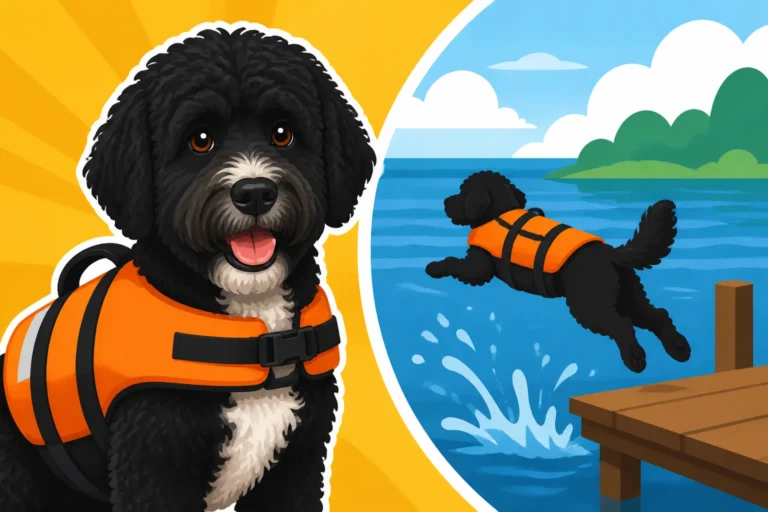
Their webbed feet and water-resistant coat mean they are built for the water, not to avoid it. So, a PWD’s natural inclination is to enter the water, not to keep others out of it. If a child is in the water, a PWD's first thought is often to join them, to engage in play, or perhaps even to "rescue" them if they perceive distress. This "rescue" behavior can sometimes look like trying to pull a child by their clothing or arm, which, while well-intentioned from the dog's perspective, can be startling or even dangerous for a small child. It's not about driving them off but engaging them within the water.
The Line Between Instinct and Training
Instinct is powerful, but it's not an uncontrollable force. Training and consistent guidance can shape how these natural drives are expressed. A well-socialized and trained Portuguese Water Dog learns appropriate behaviors around children and water. This means teaching them that humans, especially small ones, are not objects to be retrieved or bossed around. It's about channeling their intelligence and desire to work into positive interactions.
Without proper training, however, those strong instincts can lead to misunderstandings. A PWD that isn't taught boundaries might jump on a child splashing, mouth their arm, or even try to "herd" them by pushing with their nose, simply because they're trying to figure out their job in the situation. This is where early and consistent training, perhaps through a program like BAXTER & Bella, really shines. It helps you, the owner, understand how to communicate effectively with your PWD and give them a clear job that aligns with your family's needs, rather than letting them invent their own. You want them to be a vigilant companion, not an accidental lifeguard.
The "Protective" Water Dog: A Misconception?
It's natural to want to believe our dogs are always looking out for us, especially our children. The idea of a "protective" dog herding a child away from danger is a comforting one. However, with Portuguese Water Dogs and water, this interpretation can often be a misconception, potentially leading to owners misreading their dog's signals and actions.
Interpreting PWD Actions Around Children
When a Portuguese Water Dog interacts with a child near water, their actions might appear "protective" at first glance. They might bark, nudge, or even try to block the child's path. But what's truly going on in their mind? Often, it's a mix of their inherent drive to interact with moving things, their desire to be involved, and sometimes, simply over-excitement. A PWD might see a child running towards the pool as an invitation to a game of chase, or perceive excited splashing as a fun opportunity to retrieve.
Consider the context: is the dog showing signs of genuine distress, like growling or a stiff body, which would indicate a truly protective or guarding behavior? Or are they displaying typical PWD enthusiasm – a wagging tail, bouncy movements, soft mouthing? Most often, with children, it's the latter. They're intelligent dogs who want to participate. If they haven't been given a clear role or taught boundaries, they will try to invent one, and that can involve trying to "manage" the child's movement around their beloved water.
Are They Protecting, or Just Excited?
This is the million-dollar question for many owners. Is my PWD trying to save my child, or just getting a thrill from the chaos? In most cases, it's excitement, exuberance, and that deep-seated working drive coming to the forefront. A Portuguese Water Dog thrives on activity and having a "job." A child playing near or in water presents a dynamic, engaging scenario that screams "opportunity for work!" to a PWD. They might view a child's flailing arms or splashing legs as an object to retrieve or a game to join.
It's a huge distinction. True protection usually involves a perceived threat and a defensive response. What you're more likely seeing is an enthusiastic dog trying to engage with a highly stimulating environment. They are bred to work in water, so their inclination is to be in the water, or right at the edge, participating. This can lead to jumping in with children, trying to mouth clothing, or pushing them in playful ways, all born out of a desire to interact, not to ward off danger. This is why strict supervision and clear training are so vital.
The Difference Between Herding and Resource Guarding (of the water)
Another important distinction to make is between a "herding" action and resource guarding. While a PWD's herding drive is about control and movement, resource guarding is about possessiveness over an item or location. Could a PWD see the water as a resource they want to guard from children? It's less common, but certainly possible, especially if the dog has not been properly socialized or has prior negative experiences.
A dog guarding the water might posture, growl, or even snap if a child approaches "their" water. This is distinct from the playful nudging or retrieval attempts seen in herding. Resource guarding is a serious behavioral issue that requires professional intervention. However, the more common scenario is a PWD trying to engage with the child in relation to the water, not keep them away from it out of possessiveness. They want to work it, play in it, and sometimes, 'manage' the little humans who are also enjoying it. Training for polite interactions around water, using positive reinforcement for calm behavior, is crucial to prevent either scenario from developing.
Managing PWD Behavior Around Children and Water
Ensuring safety and enjoyment for both your child and your Portuguese Water Dog around water requires proactive management and consistent training. You can't just rely on instinct; you need to shape it.
Supervision is Key, Not Just Instinct
The absolute, non-negotiable rule when children and Portuguese Water Dogs are near water is constant, active supervision. Relying on your dog's "instinct" to protect or herd is a dangerous gamble. While their intentions are almost always good, their methods can be overwhelming or even accidentally harmful to a small child. A PWD might bump a toddler while trying to "herd" them, or accidentally pull them down by their swimwear during a retrieval attempt.
Think of yourself as the ultimate supervisor, not the dog. You need to be present, vigilant, and ready to intervene. This isn't just about preventing accidents; it's about teaching your dog appropriate behavior. Every interaction is a learning opportunity. If your PWD starts getting too boisterous around a child near the water, a calm, immediate intervention from you—redirecting the dog, putting them on a leash, or giving them a different, appropriate job—teaches them what is and isn't acceptable. This means having eyes on both dog and child at all times, making sure you're ready to step in before an issue arises.
Creating Safe Zones and Boundaries
To avoid situations where your PWD's natural enthusiasm turns into an unwanted "herding" attempt, establish clear boundaries and safe zones. This might mean having a physical barrier, like a gate around a pool, or teaching your dog a "place" command away from the water's edge when children are playing. For example, a designated mat or bed where your dog can relax and observe quietly, rather than feeling the need to be in the thick of the action, can be invaluable.
Consider using a long line attached to a sturdy stake (if safe for the environment and the dog) to keep your PWD in a controlled area when children are playing in the water, allowing them to still be present but not directly interfering. This is not punishment, but a management tool. It teaches them that there are times for active play, and times for calm observation. You can also teach your child to respect the dog's space and not to tease or encourage over-excitement, creating a safer dynamic for everyone.
Consistent Training and Socialization
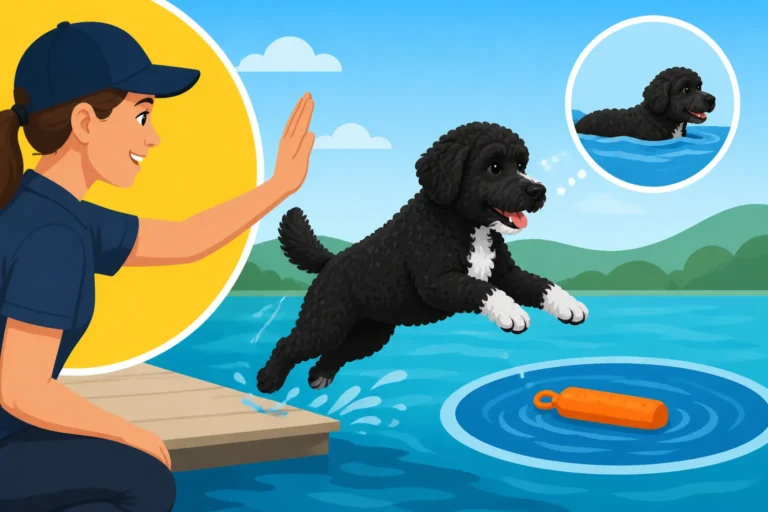
Early and consistent training is paramount. From puppyhood, a Portuguese Water Dog needs to learn bite inhibition, impulse control, and polite greetings. This is especially true for interactions with children. Teach your PWD a solid "leave it" command for when they are interested in a child's toy or body, and a strong "recall" to bring them back to you immediately, even from exciting water play. The First Year With a Portuguese Water Dog Puppy is a critical time for establishing these foundational behaviors.
Socialization is also vital. Expose your PWD puppy to children of various ages in controlled, positive environments. Teach them that children are to be respected, not herded or played with roughly. Enroll in puppy classes and then advanced obedience classes that focus on real-world scenarios. A well-trained PWD is a joy, capable of discerning when it's appropriate to engage playfully and when it's best to stay calm and observe. Remember, consistency across all family members is key; everyone needs to enforce the same rules and boundaries.
Training and Environment: Setting Everyone Up for Success
Success with a Portuguese Water Dog around children and water isn't about curbing their natural instincts entirely, but rather redirecting and refining them into acceptable behaviors. It's about providing the right environment and the right tools for both you and your dog.
Teaching Calmness Near Water
One of the most valuable things you can teach your PWD is calmness around exciting stimuli, especially water and children. Instead of allowing them to get over-aroused every time someone splashes, practice calm observation. Start with short sessions where your dog is on a leash, perhaps tethered to you, while children are calmly near the water. Reward your PWD for sitting, lying down, or simply watching without barking or lunging. Gradually increase the excitement, always rewarding calm behavior.
This can involve structured play sessions where you initiate the water play with your dog and children separately, teaching your dog that water time with kids is your lead. Use a calm voice, clear signals, and positive reinforcement. If your dog shows any signs of becoming too boisterous, redirect them with a favorite toy or a simple "sit" command, then praise them for complying. This repeated practice helps them understand that "calm" is the desired state around the water and children. You might consider using a waterproof mat from a retailer like Amazon that they associate with their "place" command, even by the pool.
Tools and Resources for Training
Having the right tools can make all the difference in managing your Portuguese Water Dog's energy and instincts around children and water. A sturdy, waterproof leash and collar are essential for control near water. A long line can be useful for practicing recall in open areas near water while maintaining a safety tether. High-value, waterproof treats are excellent for rewarding desired behaviors, especially in a distracting environment like a beach or pool.
Beyond physical tools, educational resources are invaluable. Online training programs or specialized courses can provide structured guidance. For instance, programs designed for positive reinforcement training can offer strategies for managing high-energy breeds and teaching boundaries. Tools like clickers, treat pouches, and durable chew toys can all contribute to successful training. Remember that mental stimulation is just as important as physical; a tired dog is often a well-behaved dog. Puzzle toys, especially those that float, can be a great way to engage your PWD without them solely focusing on the children.
The Importance of Exercise Beyond the Water
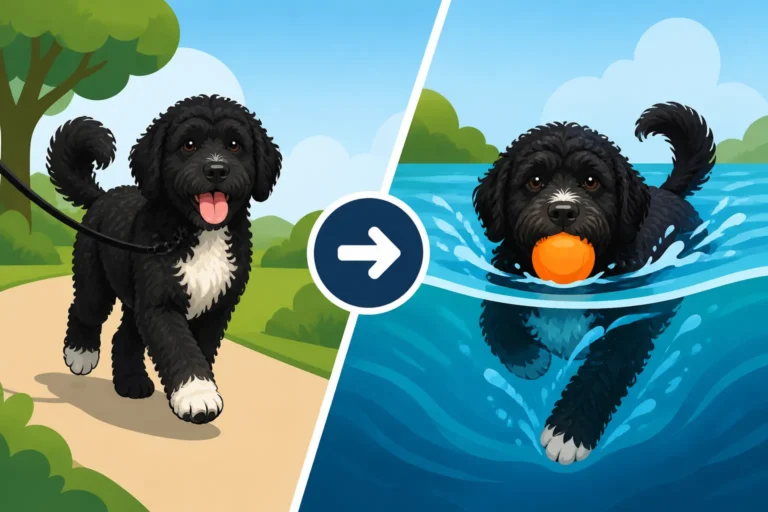
While Portuguese Water Dogs adore water, it's crucial that their exercise needs are met through a variety of activities, not just endless swimming with children. An under-exercised PWD is a PWD more likely to create their own "job" – and that job might involve trying to manage your children! Regular walks, runs, hikes, and engaging in other dog sports like agility or obedience provide both physical and mental stimulation. What a Portuguese Water Dog Needs Every Day delves into their daily requirements.
A dog that has had ample opportunity to burn off energy in appropriate ways is often calmer and more receptive to training when novel situations arise. This means dedicated exercise time for your PWD, separate from your children's water play. Taking them for a long hike, playing an intense game of fetch in a field, or even some focused training sessions can make a huge difference in their overall behavior. When they are by the water with children, they will be less likely to be overstimulated and more capable of following your cues. Why Swimming Protects a Portuguese Water Dog's Joints is a great article to read if you're looking for low-impact exercise ideas.
Ultimately, a Portuguese Water Dog can be a wonderful, playful companion for children around water. It just requires understanding their unique instincts, setting clear expectations through consistent training, and providing vigilant supervision to ensure everyone's safety and enjoyment.
| Behavior Observed | Likely PWD Motivation | Appropriate Owner Response |
|---|---|---|
| Nudging a child with nose | Engagement, attempting to "herd" or solicit play | Redirect, "leave it" command, provide own toy |
| Mouthing child's hand/arm | Play, retrieval instinct, seeking attention | Interrupt, redirect to appropriate chew toy, consistent "no bite" training |
| Barking at splashing child | Excitement, wanting to join play, seeking attention | "Quiet" command, reward calm, increase dog's distance from water |
| Jumping in with child | Play, retrieval instinct, desire to be involved | "Wait" command, ensure child is safe, controlled entry to water for dog |
| Trying to block child's path | Herding instinct, trying to "control" movement | Step in, physically block dog if needed, enforce "stay" or "place" |
| Bringing toys to child in water | Retrieval instinct, offering play | Engage in supervised play, reinforce dog's polite interactions |
Disclaimer
This article is for general informational purposes only and does not constitute professional advice. Laws, prices and regulations vary by location and change over time. Consult a qualified professional for guidance on your specific situation.