How the Portuguese Water Dog Standard Has Changed
A Portuguese Water Dog you see in a show ring may look very different from the strong, practical dog that once worked aboard fishing boats. That difference can make the breed standard feel like a moving target. This guide explains what a breed standard describes, how the Portuguese Water Dog standard developed, and how to tell genuine changes in written rules from shifts in grooming and show fashions.
Why the Portuguese Water Dog standard exists
From working dog to written description
A breed standard is a written description of the ideal dog for that breed. It gives breeders and judges a shared framework for evaluating structure, movement, coat, size, and temperament. It is not a promise that every dog will look exactly alike, nor a checklist that makes an individual dog’s worth depend on show-ring success.
The Portuguese Water Dog began as a practical working breed, not as a dog designed around a show table. Its history is closely tied to Portuguese fishing communities, where dogs helped with tasks around the water. For a fuller picture of that background, see The Portuguese Water Dog Worked the Algarve Fishing Fleet and Where the Portuguese Water Dog Comes From. The name itself points to the breed’s relationship with water: What Cao de Agua Means in the Portuguese Water Dog's Name.
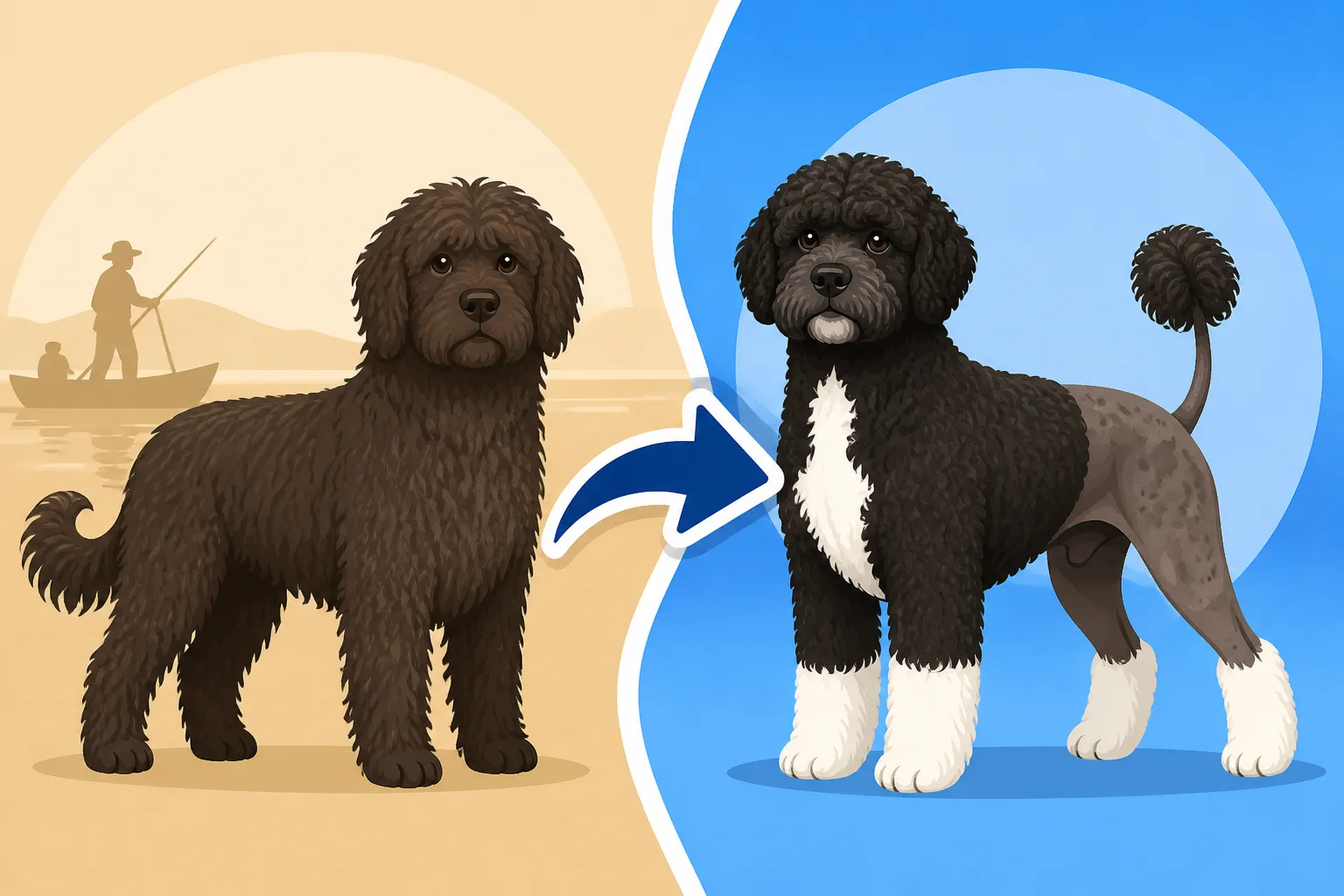
Once the breed became less essential to traditional fishing work and gained a wider following, a written standard became increasingly important. It helped establish which traits were considered characteristic of the breed, even as the dogs’ everyday roles changed. That shift from working partner to companion and show dog is part of the story behind Why Fishermen Stopped Needing the Portuguese Water Dog.
How a standard differs from a breed’s history
A breed’s history tells us what dogs did and why particular traits were useful. A standard describes the desired dog in the context of organized breeding and judging. Those two things are related, but they are not interchangeable.
For example, webbed feet and a strong, athletic body make sense in a breed associated with swimming. The standard preserves the physical picture of a capable, balanced dog, while the historical account explains why water-related traits mattered in the first place. Why a Portuguese Water Dog Has Webbed Feet offers more detail on one of those recognizable features.
A standard also does not mean that every historical working dog matched today’s show ideal. Working dogs were valued for being useful, healthy, and capable of doing their jobs. A modern judge, by contrast, evaluates a dog against the written standard and the rules of the particular show organization. Those perspectives overlap, but they answer different questions.
How the written standard developed
Early breed preservation and formal recognition
The Portuguese Water Dog came close to disappearing as its traditional work declined. Breed preservation efforts helped maintain a population and establish the breed beyond its original setting. Who Saved the Portuguese Water Dog covers that part of the breed’s history.
As the breed spread internationally, kennel clubs and breed organizations needed a formal description for registration and judging. In the United States, the American Kennel Club first approved a Portuguese Water Dog standard in 1983. The American standard was later revised in 2008. Those milestones show that the standard has been formally revisited, but they do not mean the breed was reinvented between those dates.
It is worth being cautious when someone describes a standard revision as a dramatic change. A revision can clarify language, improve consistency, or make a description easier to apply in judging. Without comparing the exact earlier and later wording, it is better not to assume that a revision changed a particular physical feature or that breeders suddenly began producing a different kind of dog.
What can change without changing the standard
A standard is only one influence on what people notice in a breed. Grooming fashions, show presentation, breeding priorities, and the kind of dogs most often photographed can all affect how the public thinks a Portuguese Water Dog “should” look.
The lion clip is a good example. It has historical associations with the breed and is one of the recognized presentation styles, but seeing a dog in that clip does not mean the written standard has just changed. The shorter hindquarters and fuller front can make the dog’s outline look markedly different from a pet kept in a practical, even trim. For related context, see Whether Both Portuguese Water Dog Clips Are Allowed in the Ring.
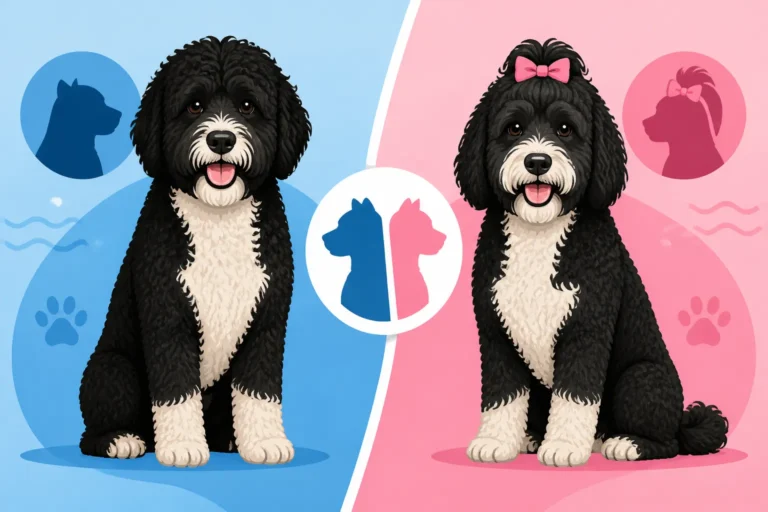
Coat type and color can also shape public perception. A curly-coated black dog in a traditional clip may look quite unlike a wavy-coated brown dog kept longer, even though both can fit within the breed’s accepted appearance. Curly or Wavy, Black or Brown: What a Portuguese Water Dog Looks Like explains those visible variations. A change in what is popular in grooming or breeding is not automatically a change to the standard itself.
What the standard describes today
Structure, coat, and overall balance
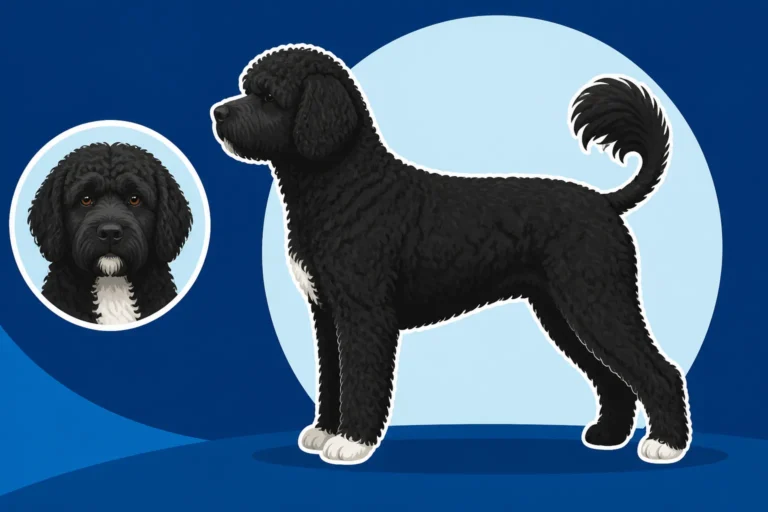
The standard describes the Portuguese Water Dog as a medium-sized, robust, athletic dog. The overall picture matters: a dog should look capable and balanced, not exaggerated in one feature. A very impressive coat cannot compensate for poor movement or an unbalanced outline, just as a dog’s color alone does not determine whether it conforms to the standard.
Coat is one of the most noticeable parts of the description. Portuguese Water Dogs may have curly or wavy coats, and the standard recognizes more than one coat color and pattern. Their coat is not simply decorative; it is part of the breed’s identity and connects to its working history. At the same time, a dog’s grooming style can make coat texture, body proportions, and outline easier or harder to assess.
The standard also addresses features such as the head, ears, tail, feet, and movement. Those details matter because the standard is meant to describe the dog as a whole. A judge looks at how the pieces fit together, rather than rewarding one striking trait in isolation.
| What the standard describes | What that means in practice | What can be mistaken for a standard change |
|---|---|---|
| General appearance and balance | The dog should present as a capable, proportionate whole | A different trim that changes the apparent outline |
| Coat texture and presentation | Curly and wavy coats are part of the breed’s recognized variation | A coat style becoming more fashionable |
| Color and markings | More than one accepted appearance is possible | One color appearing more often in photos or shows |
| Structure and movement | The dog should move in a sound, functional way | A dramatic pose or grooming choice drawing attention |
| Breed character | The dog should retain the qualities associated with the breed | Assuming every individual must behave identically |
Why grooming creates so much confusion
Portuguese Water Dog coats can be clipped in different ways, and those choices change the dog’s appearance considerably. A lion clip leaves the rear portion shorter and the front coat fuller. A retriever clip keeps the coat more evenly trimmed. Neither look, by itself, tells you whether a written standard has been amended.
For a pet owner, the practical question may be less about show rules and more about upkeep. A longer coat can need more frequent brushing and careful attention to tangles, especially around areas where a collar or harness rubs. If you are assembling basic grooming tools, Chewy is one place owners may encounter combs and coat-care supplies; the important thing is choosing tools that suit the individual dog’s coat and using them gently.
A groomer can also help translate the standard’s clip names into an achievable trim for a family dog. If you are comparing styles, ask what the maintenance will involve between appointments, how much coat will remain, and whether the dog’s coat condition calls for a shorter practical cut. Chewy may have general grooming items, but a product listing cannot replace advice from a groomer familiar with dense, curly, or wavy coats.
How to read claims about changes
Separate rule changes from variation between kennel clubs
The phrase “the standard changed” can mean several different things. It might refer to a formal revision by a kennel club, a difference between the standards used by two countries, or simply a change in the way dogs are groomed and presented. Those are not the same.
Different organizations can use their own standards and wording. A dog evaluated under one country’s rules may not be judged in exactly the same way as a dog in another country, even when both are Portuguese Water Dogs. That difference does not necessarily mean one organization has changed its standard over time. How Portuguese Water Dog Standards Differ Between Countries is useful background when you are comparing international descriptions.
When you read a claim about a revision, look for three pieces of information: which organization made it, when the revision took effect, and what exact wording changed. Without those details, a statement such as “the breed standard now requires a different look” may actually be referring to a grooming trend or a comparison across organizations.
A practical checklist for evaluating a claimed change
If a breeder, exhibitor, or online discussion says the standard has changed, start by asking what part of the description is meant. Is the claim about height, coat, color, structure, movement, or temperament? A specific question is easier to verify than a broad statement that “the breed has changed.”
Next, distinguish the written rule from the dog’s appearance. A coat clipped close can make a dog appear smaller or more angular; a longer coat can make the same dog look heavier or less defined. Good lighting, camera angle, and posture can add to the confusion. For example, comparing a freshly groomed show dog with an untrimmed family dog is not a reliable way to identify a change in the written standard.
Finally, remember that standards describe an ideal, not a guarantee of uniformity. Individual dogs vary in coat texture, markings, build, and personality. A responsible discussion of the Portuguese Water Dog standard leaves room for that variation while still explaining the traits the standard aims to preserve. For ordinary grooming questions, Chewy’s product categories can help you see what kinds of supplies are available, but the standard itself—not a product listing or a popular photo—is the reference point for judging breed description.
Disclaimer
This article is for general informational purposes only and does not constitute professional advice. Laws, prices and regulations vary by location and change over time. Consult a qualified professional for guidance on your specific situation.