How Portuguese Water Dog Is Related to the Barbet
Portuguese Water Dogs and Barbets share a strikingly similar look: dense, water-resistant coats, sturdy frames, and a history connected to working around water. That resemblance naturally raises the question of whether one breed came directly from the other. The short answer is that they may share older water-dog ancestry, but a direct, proven parent-and-offspring relationship is not established.
How Portuguese Water Dogs and Barbets Are Connected
A shared type does not prove a direct ancestor
The Portuguese Water Dog and the Barbet belong to a broad family of water-working dogs with traits suited to swimming and retrieving. Both have substantial coats, strong bodies, and an association with aquatic work. Those similarities make a historical connection plausible, but they do not, by themselves, show that the Barbet is the Portuguese Water Dog’s direct ancestor—or vice versa.
Dog breeds often developed over long periods through the movement and exchange of working dogs. Fishermen, traders, and other travelers could bring useful dogs from one region to another, where they might be crossed with local dogs. Over generations, those dogs could contribute to breeds that later became distinct. That kind of shared background is different from a documented claim that one named breed was created from another.
The historical record for many old working breeds is incomplete. Written descriptions, pedigrees, and formal breed organizations often appeared long after dogs had already been doing practical work. So a responsible account distinguishes between what is plausible and what is documented. The Barbet may be part of the wider ancestry story for water dogs, but the exact route from older European dogs to the modern Portuguese Water Dog is not certain.
For the broader Portuguese history, see Where the Portuguese Water Dog Comes From and How Old the Portuguese Water Dog Breed Is. These topics help explain why breed origins can be harder to pin down than a simple family tree suggests.
Why people compare the breeds
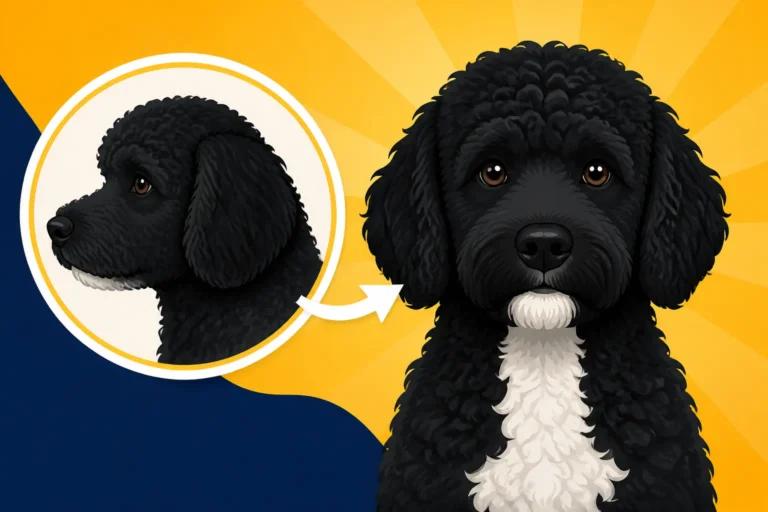
The comparison is easy to understand when you see the dogs side by side. Both can have a shaggy, curly appearance, and both are associated with water. A person browsing photographs might reasonably assume that the breeds are close relatives or even that one is a variety of the other. They are, however, recognized as separate breeds, with their own standards, histories, and breeding communities.
Appearance can be shaped by similar working needs. A coat that provides some protection in wet conditions, a strong body, and a willingness to retrieve are useful traits for many dogs working around water. When different populations of dogs are selected for similar tasks, they may come to look alike without being recently descended from one another.
That distinction matters if you are choosing a dog, researching pedigrees, or trying to understand a breed’s health and temperament. Similar looks do not mean identical care needs, and a presumed historical connection should not be used to predict a particular dog’s personality or health. For a visual guide to the Portuguese Water Dog’s coat and colors, read Curly or Wavy, Black or Brown: What a Portuguese Water Dog Looks Like.
What Their Working Histories Tell Us
Portuguese Water Dogs worked with fishing crews
The Portuguese Water Dog is closely associated with the fishing communities of Portugal, where dogs worked alongside people on boats and near the coast. Accounts of their tasks include retrieving objects, carrying items between boats, and helping with activities connected to fishing. Their work called for a capable swimmer, a responsive partner, and a dog able to function in a lively, demanding environment.
That working background helps explain why modern Portuguese Water Dogs often enjoy retrieving, carrying objects, and staying involved in whatever their people are doing. A family may discover that a dog happily brings a toy back again and again, but also steals a sock or relocates a child’s ball when nobody has given it a job. These behaviors are not proof of a direct relationship with the Barbet. They reflect the Portuguese Water Dog’s own history as an active working breed.
For more about those historic duties, see What a Portuguese Water Dog Did for a Fishing Crew. Understanding the job also helps owners provide suitable outlets today, whether that means structured retrieving, training games, or safe time around water.
The Barbet belongs to a different regional story
The Barbet is a French water dog with its own historical identity. Like the Portuguese Water Dog, it is associated with retrieving and working in wet environments. Its history adds context to the wider European tradition of water dogs, but it should not be treated as a substitute name for the Portuguese breed.
It is tempting to make a neat map of breed development: one dog travels from one country to another, becomes a local working dog, and eventually turns into a modern breed. Sometimes history supports a clear sequence like that. In this case, the connections are better described as possible shared influences within a broad group of water-working dogs, rather than a fully documented, direct line from Barbet to Portuguese Water Dog.
This is why careful breed histories use words such as “may,” “likely,” and “related through older stock” when the records do not establish an exact lineage. Those terms are not evasions; they are a way to avoid presenting an appealing theory as settled fact.
| Feature | Portuguese Water Dog | Barbet |
|---|---|---|
| Breed identity | A distinct Portuguese breed | A distinct French breed |
| Historical association | Fishing and work around Portuguese waters | Water work and retrieving in France |
| Common visual impression | Dense coat and athletic, sturdy build | Dense, often curly coat and sturdy build |
| Relationship status | Possible connection to older European water-dog stock | Possible connection to broader water-dog ancestry |
| What is not established | A definitive direct descent from the Barbet | A definitive role as the Portuguese Water Dog’s direct ancestor |
What Similarities Can and Cannot Tell You
Coat and body traits reflect function as well as ancestry
Both breeds’ coats can make people think of a close family link. But coat texture and overall appearance are influenced by selection over time. If people value a dog’s ability to work in wet conditions, they may favor a coat and body that suit that job. Similar selection pressures can lead to similar-looking dogs, even when their recent ancestry is different.
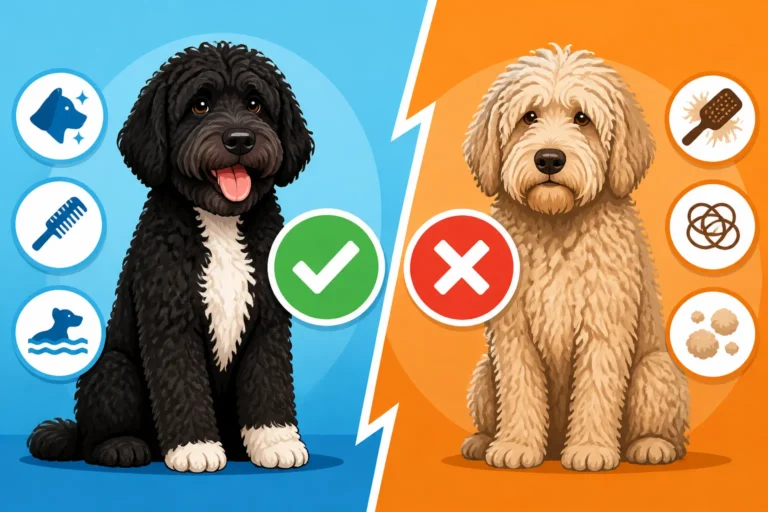
Portuguese Water Dogs have curly or wavy coats, and those coat types can need regular care to prevent tangles and mats. A dog that swims often may need a thorough rinse and careful drying, particularly around areas where moisture and friction can contribute to knots. The coat is part of the dog’s care routine, not just a clue to its history. The article What a Portuguese Water Dog's Coat Is Made Of explains more about the structure behind that distinctive coat.
If you are assembling basic grooming supplies, you might compare combs, brushes, and detangling tools at a pet retailer such as Chewy, then choose items suited to your dog’s coat and your own grooming routine. A tool that works well for one coat length or texture may not be the best choice for another.
Water ability is not proof of shared breed identity
Portuguese Water Dogs are often enthusiastic swimmers, but individual dogs differ. Some take to water readily; others need patient introductions or simply prefer staying on shore. A dog’s confidence depends on temperament, experience, health, and the conditions around the water. Breed history can help explain why swimming and retrieving are familiar activities for many Portuguese Water Dogs, but it cannot guarantee that every dog will love them.
The same caution applies to the Barbet. Breed-level tendencies describe patterns, not promises about every individual. A dog’s behavior is shaped by its genetics, early experiences, training, and environment. If a Portuguese Water Dog is hesitant in the water, forcing it in because “the breed is supposed to swim” can create fear rather than confidence. A gradual approach in a safe, shallow place is kinder and more useful.
If you want to learn how the Portuguese breed’s physical features support swimming, see Why a Portuguese Water Dog Has Webbed Feet. For practical preparation, Chewy can be one place to look for basics such as a well-fitting life jacket or drying towels; check that any gear fits your individual dog and suits the activity.
What the Relationship Means for Owners and Breed Research
Choose a dog by its own breed and individual needs
A possible historical relationship with the Barbet does not make the Portuguese Water Dog a “Barbet mix,” nor does it mean the two breeds have interchangeable temperaments or care requirements. If you are considering a Portuguese Water Dog, focus on the breed’s recognized characteristics, the dog’s individual personality, and the breeder’s health and socialization practices.
Ask for clear information about the parents, health screening, and the puppy’s early environment. A breeder should be willing to talk through the realities of grooming, exercise, training, and daily life—not just the breed’s water-dog image. The Portuguese Water Dog’s working heritage can show up as intelligence, enthusiasm, and a desire to participate, which can be wonderful but may also be a handful for someone expecting a low-key companion.
Researching other breeds can clarify what you are looking for, but avoid treating a shared coat or job as a guarantee of shared behavior. For a related comparison, How Portuguese Water Dog Is Related to the Irish Water Spaniel looks at another breed people may associate with water work. The useful question is not simply “Are they related?” but “What does this dog need, and does that fit my household?”
Read breed history as a careful reconstruction
When researching the Portuguese Water Dog and Barbet, separate three kinds of claims: documented breed history, reasonable historical interpretation, and speculation. A breed’s recorded work and formal identity may be clearer than its distant origins. Similarities between breeds can support a theory of shared ancestry, but they cannot settle the question without stronger historical or genetic evidence.
You may see confident statements online that the Barbet “created” the Portuguese Water Dog or that one modern breed is the other’s closest relative. Treat those claims cautiously unless they explain what evidence supports them. A sound account should acknowledge that old working dogs moved across borders and that their descendants may have contributed to multiple regional breeds, while also recognizing that the precise family tree is not fully known.
The same careful approach helps with practical questions. If you buy grooming items through Chewy or another retailer, choose them for the coat and routine your dog actually has, not because a historical theory suggests the breeds are identical. If your dog swims regularly, talk with your veterinarian or groomer about suitable ear and coat care rather than assuming that every water dog needs exactly the same routine.
The most balanced conclusion is straightforward: the Portuguese Water Dog and Barbet are separate breeds with parallel water-working histories and a plausible connection through older European water-dog stock. Their resemblance makes comparison worthwhile, but available breed history does not establish the Barbet as the Portuguese Water Dog’s direct ancestor. Knowing that distinction gives you a more accurate picture of both breeds—and keeps a fascinating possibility from being mistaken for a proven family tree.
Disclaimer
This article is for general informational purposes only and does not constitute professional advice. Laws, prices and regulations vary by location and change over time. Consult a qualified professional for guidance on your specific situation.