Whether the Portuguese Water Dog Has a Nickname in Portugal
If you ask someone in Portugal what a Portuguese Water Dog is called, the clearest answer is its Portuguese breed name: Cão de Água Português. “Portie” is a familiar English-language nickname, but it is not the standard Portuguese name. Here’s what the name means, how people may shorten it in conversation, and why the distinction can be confusing.
The Portuguese Water Dog’s name in Portugal
The formal breed name is Cão de Água Português
The Portuguese name for the breed is Cão de Água Português. In broad terms, it translates as “Portuguese water dog”: cão means dog, água means water, and português means Portuguese. You may see the words capitalized differently depending on the context, but the name refers to the same breed.
For a rough English-friendly pronunciation, try “cowng duh AH-gwah poor-too-GESH.” It won’t reproduce every feature of European Portuguese pronunciation, which varies by speaker and region, but it can help you recognize the name when you hear it. If you’re speaking with a Portuguese breeder or veterinarian, using the written name is often more useful than trying to perfect the pronunciation.
The name describes the dog’s connection with water and Portugal, but it is not really a nickname. It is the breed’s Portuguese name. If you’re curious about the history behind those words, What Cao de Agua Means in the Portuguese Water Dog's Name takes a closer look at their meaning.
People may shorten the name in conversation
In everyday conversation, someone may use cão de água—literally “water dog”—when the context makes it clear which breed they mean. That is a shorter way of referring to the dog, rather than a special nickname comparable to “Portie.” As with any shorthand, the precise meaning depends on who is speaking and what they are discussing.
This can be confusing because a descriptive phrase may not always identify one breed on its own. If someone is talking about Portuguese breeds, or about a particular dog they know, “cão de água” may be enough. In a conversation about dogs more generally, adding português makes the reference clearer.
| Name or phrase | How it is used | Is it a nickname? |
|---|---|---|
| Cão de Água Português | The Portuguese name of the breed | No, it is the breed name |
| Cão de água | A shortened descriptive reference when context is clear | Usually shorthand, not a distinct nickname |
| Portuguese Water Dog | The breed’s English name | No, it is the English breed name |
| Portie | An affectionate English-language nickname | Yes, primarily in English-speaking contexts |
A nickname usually belongs to the dog, not the breed
In Portugal, as elsewhere, an individual dog is likely to be called by its own name at home. A family might call its dog a short form of that name, a term of affection, or something that came about through daily life. That personal nickname does not necessarily have anything to do with the breed’s official name.
So if you meet a Portuguese Water Dog in Lisbon, Porto, or along the Algarve coast, it would be a mistake to expect its family to use one universal Portuguese equivalent of “Portie.” They might refer to the breed by its full name when explaining what kind of dog it is, shorten it when the context is obvious, and use the dog’s own name the rest of the time.
Is Portie used in Portugal?
Portie is an English-language nickname
Portie is an informal nickname used by some English speakers for the Portuguese Water Dog. It is convenient, affectionate, and easy to say, especially among owners and breed enthusiasts. But a nickname that feels natural in an English-language dog club or online group does not automatically become the everyday name used by Portuguese speakers.
That distinction matters when you’re reading discussions, searching for breed information, or meeting owners from different countries. An English-speaking owner may say “my Portie,” while a Portuguese speaker may say o meu Cão de Água Português—“my Portuguese Water Dog”—or simply use the dog’s name. Both expressions can point to the same dog without being equivalent cultural nicknames.
You may encounter “Portie” in English-language breed communities, including conversations with owners who live in Portugal. That tells you the word is used by some individuals there, not that it is a widespread or traditional Portuguese nickname. It is safest to understand it as an English-language informal term.
Don’t assume there is one traditional local nickname
It is tempting to look for a single short Portuguese word that everyone uses for the breed. But languages don’t always create a neat one-word counterpart to an English nickname. The full breed name may be the ordinary, natural way to identify the dog, while a shortened phrase works when the conversation already supplies the context.
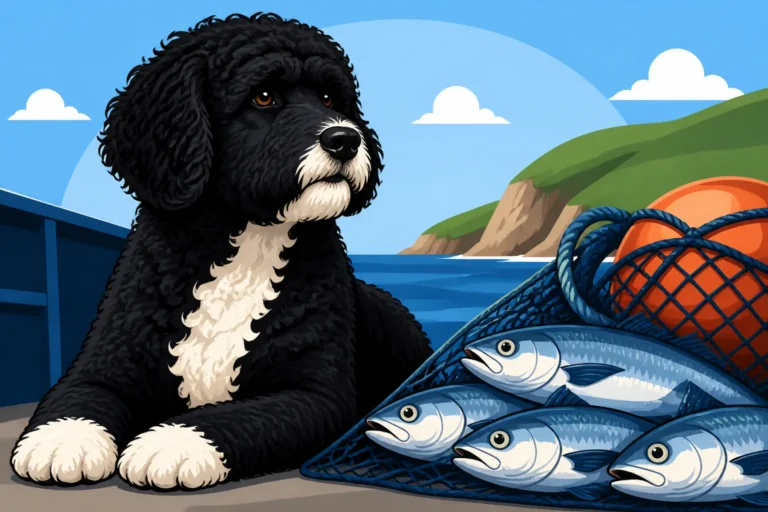
The breed’s historical role helps explain why its name is descriptive. Portuguese Water Dogs worked alongside fishing crews, and their work was tied to the water. What a Portuguese Water Dog Did for a Fishing Crew explains that working relationship in more detail. For the breed’s broader background, see Where the Portuguese Water Dog Comes From.
That history does not prove that a particular nickname was used by fishermen or is still common today. A traditional job, a formal breed name, and an affectionate household nickname are different things. Without a clear reason to treat a term as a widely established local nickname, it is better not to present it as one.
Breed names can sound more formal in translation
English speakers often use short, familiar breed labels: “Portie,” “Poodle,” or “Lab.” The Portuguese breed name can sound more formal to an English-speaking ear because it is a full descriptive phrase. That does not mean Portuguese speakers always use an elaborate title in casual conversation; they may shorten it when it is clear what they mean.
Translation also makes the name feel more complicated than it is. Cão de Água Português is not a mysterious ceremonial title. It is a straightforward breed name whose components describe the dog. You can use the full name when clarity matters and recognize that everyday conversation may be less formal.
How to refer to a Portuguese Water Dog naturally
Use the full name when you want to be precise
If you are introducing the breed to a Portuguese speaker, asking about a dog’s breed, or searching for local information, Cão de Água Português is a clear place to start. It avoids the ambiguity that can come with a shortened phrase and makes clear that you mean the Portuguese breed.
For example, if you are asking whether someone’s dog is a Portuguese Water Dog, you could use the breed name rather than assume that “Portie” will be understood. If the conversation is in English, “Portuguese Water Dog” is clear; if it is in Portuguese, the Portuguese name is the more direct choice.
A simple approach is to follow the other person’s lead. If they use the full name, use it too. If they shorten it after the context is established, you can follow that wording. That small adjustment is usually more natural than insisting on a nickname that the other person may not use.
Use Portie when speaking with English-speaking owners
Among English-speaking owners, Portie can be a warm, familiar shorthand. It works well in an English-language conversation where the other person already knows the breed. If you are writing for a general audience, though, spell out “Portuguese Water Dog” the first time and explain that “Portie” is an informal nickname. That way, readers who are new to the breed aren’t left guessing.
The same care is useful in online searches. A person researching the breed in English may get useful results from “Portie,” while a person looking for Portuguese-language material may have better luck using Cão de Água Português. If you search only for “water dog,” you may get results about other water-loving dogs or breeds with similar descriptions.
When shopping online, the same difference between conversational names and search terms can crop up. A retailer such as Chewy may list food, grooming tools, or accessories by product type rather than by a Portuguese nickname, so searching for the item you need is often more helpful than searching for “Portie” alone. The product label is about finding supplies, not evidence that a nickname is common in Portugal.
Don’t read too much into a label on a website
A website might use “Portie” to sound friendly, while a kennel, breed club, or veterinary office might prefer the full breed name. Those choices reflect the audience and purpose of the page. They don’t necessarily tell you what Portuguese families call the breed at home.
If you see a term that you’re unsure about, check whether the page is in English or Portuguese and whether it is discussing the breed formally or casually. For example, an English-language owner forum is more likely to use “Portie” than a Portuguese description intended to identify the breed precisely. Online stores such as Chewy are organized around browsing and buying products, so their categories and search wording may be practical rather than culturally representative.
You might also encounter claims about the breed’s national status while researching its identity. The dog is strongly associated with Portugal, but that is separate from the question of what people call it day to day. How Portuguese Water Dog Is Portugal's National Dog explores that claim, and When the Portuguese Water Dog Reached America traces part of the breed’s history beyond Portugal. The breed’s age and development are covered in How Old the Portuguese Water Dog Breed Is.
What to remember about the Portuguese nickname question
There is no need to hunt for a secret Portuguese nickname to sound knowledgeable. Cão de Água Português is the clear Portuguese breed name. Cão de água may be used as a shorter reference when everyone understands the context. Portie is an English-language informal nickname, and an individual dog may have its own household name or affectionate nickname.
If you are speaking with someone in Portugal, use the full breed name when you want to be precise, then listen for the words they use. If you are talking with English-speaking owners, “Portie” will often be understood. And if you are researching the breed, choose the search term that fits the language and purpose of the material you want.
The distinction is small, but it prevents a common mix-up: a breed name is not always a nickname, and a nickname used by English-speaking enthusiasts is not automatically the everyday Portuguese term. For a Portuguese Water Dog, the most reliable name to recognize is the straightforward one: Cão de Água Português.
Disclaimer
This article is for general informational purposes only and does not constitute professional advice. Laws, prices and regulations vary by location and change over time. Consult a qualified professional for guidance on your specific situation.