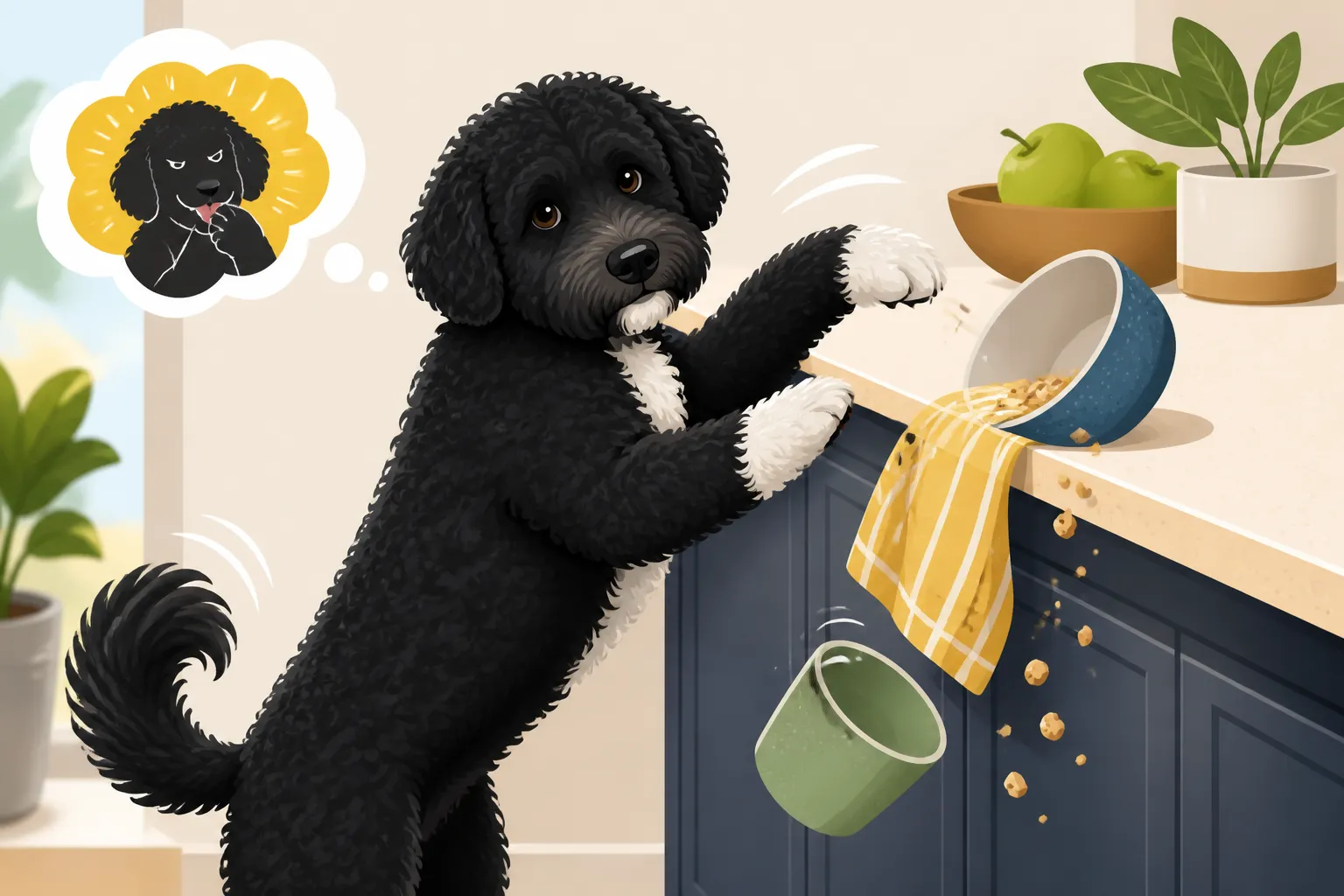
Why a Portuguese Water Dog Takes Things Off Counters
It's a familiar scene for many Portuguese Water Dog owners: you step away from the kitchen counter for just a moment, only to return and find a half-eaten sandwich or missing remote control. The frustration is real, and it often feels like your clever companion is deliberately trying to outsmart you. This guide is here to dive deep into why your Portuguese Water Dog might be taking things off counters, and more importantly, how you can lovingly and effectively address this often-maddening behavior.
The Instinctual Roots of Counter Surfing in Portuguese Water Dogs
Understanding your Portuguese Water Dog's inherent nature is the first step to deciphering their counter-surfing habits. These aren't just cute, curly-coated companions; they are dogs with a rich working history, and many of their behaviors stem directly from that heritage. What might seem like naughtiness to us is often simply them acting on deep-seated instincts.
Bred for Retrieval and Exploration
Let's cast our minds back to the fishing boats off the coast of Portugal. The Portuguese Water Dog wasn't just there for moral support; they were vital members of the crew. Their job involved retrieving lost tackle, driving fish into nets, and even carrying messages between boats. Think about that for a moment: retrieval was literally in their job description. When your PWD snatches an item off the counter, they are, in a very real sense, retrieving something. Their powerful drive to pick things up, carry them, and explore them with their mouths is not a flaw; it's a feature. This isn't just about fetching a ball; it's about interacting with their environment in a very tactile, oral way. Their curious nature pushes them to investigate new objects, and what better way to do that than to pick it up and examine it closely?
A History of Problem-Solving with Their Mouths
Beyond simple retrieval, these dogs were also problem-solvers. They had to be adaptable and smart to work on a bustling boat, often without direct instruction from their human counterparts. This means they are inherently intelligent and capable of figuring things out. If they see something interesting on the counter, their brain quickly goes to work: "How do I get that?" Their strong jaws and keen noses were tools for their trade. So, when they manage to snag that errant sock or a tasty crumb, they're not just being disobedient; they're engaging that problem-solving drive that has been honed over generations. Their mouths are their primary way of interacting with the world, much like our hands. It's how they explore textures, scents, and ultimately, whether something is valuable or edible. You might find it useful to read about Why a Portuguese Water Dog Puts Everything in Its Mouth to get a broader understanding of this trait.
Common Motivations for Counter-Surfing Behavior
While instinct lays the groundwork, specific motivations often trigger counter-surfing in the moment. It's rarely malicious; more often, it's a combination of opportunity, unmet needs, and learned behavior. Identifying the underlying cause is key to addressing it effectively.
The Lure of Novelty and Scent
Imagine walking into a room filled with tantalizing aromas and shiny new objects. That's often what your kitchen counter looks like (and smells like!) to your PWD. Their sense of smell is incredibly powerful, and even the faintest scent of food, a forgotten coffee cup, or even a human-scented item can be an irresistible beacon. Novelty also plays a huge role. If something is new, different, or placed in an unusual spot, it immediately piques their interest. They might not even want to eat the item; sometimes, the sheer thrill of discovery and the act of possessing the "forbidden fruit" is enough. This isn't just limited to food; mail, keys, glasses, or anything with your scent becomes a fascinating object of investigation. It’s part of their innate curiosity and drive to explore their world with their nose and mouth.
Unmet Needs: Boredom, Hunger, and Attention
Sometimes, counter surfing is a symptom of a deeper issue. A bored Portuguese Water Dog is a creative Portuguese Water Dog, and that creativity often manifests in ways we don't appreciate. If they're not getting enough physical exercise or mental stimulation, the kitchen counter can become their personal playground. They need a job, a purpose, and if you don't provide it, they'll find one. This is also why you might find your PWD engaging in behaviors like What a Portuguese Water Dog Carries Off When Bored. Similarly, a truly hungry dog will look for food wherever they can find it. Have you recently changed their feeding schedule, or is their current diet not quite satisfying their caloric needs, especially if they are very active? Lastly, let's be honest: any reaction from you, even a negative one, is still attention. If your PWD learns that swiping a napkin off the counter gets them a chase or a stern "No!", they might start doing it simply to engage with you, especially if they feel ignored. What an Under Exercised Portuguese Water Dog Does often includes these attention-seeking behaviors.
The Power of Reinforcement (Accidental or Otherwise)
Dogs are brilliant at repeating behaviors that yield a positive outcome. This is where accidental reinforcement often creeps in. Every single time your PWD successfully grabs something off the counter, even if it's just a crumb, they've been rewarded. They've learned that "counter = potential treasure." It doesn't even have to be food; the sheer joy of the chase when you try to retrieve a stolen item, the satisfaction of tearing up a paper towel, or even the feeling of having successfully "hunted" something makes the behavior self-rewarding. This makes it a tough habit to break because they've had so many successful "practice" sessions. It's not about being stubborn; it's about their learning process. To understand more about how their instincts drive such actions, you might want to read Why a Portuguese Water Dog Steals Objects.
Strategies to Stop Your PWD from Counter Surfing
The good news is that counter surfing is a learned behavior that can be unlearned, or even better, prevented from ever starting. It requires consistency, patience, and a bit of creativity on your part, but the effort is well worth a peaceful, counter-surf-free home.
Environmental Management and Prevention
The easiest way to stop counter surfing is to make it impossible. This is your first and most important line of defense.
- Keep Counters Clear: This might sound obvious, but it's incredibly effective. If there's nothing on the counter, there's nothing to steal. Get into the habit of immediately clearing plates, putting away groceries, and storing tempting items out of reach. Think of it like baby-proofing, but for a very clever, vertical-leaping dog.
- Crate Training or Restricted Access: When you can't supervise your PWD, using a crate or restricting their access to the kitchen is a fantastic solution. A well-exercised and stimulated PWD will often happily relax in their crate or a designated dog-proof area. This prevents them from practicing the unwanted behavior when you're not around.
- "Booby Traps" (Carefully Applied): For particularly persistent counter surfers, you might consider harmless deterrents. A stack of empty soda cans that tumbles noisily if bumped, or an overturned baking sheet placed precariously close to the edge can create an unpleasant surprise that deters future attempts without being harmful. Remember, the goal is to associate the counter with something startling, not with you being angry. Always supervise these initial interactions to ensure your dog isn't genuinely terrified, just surprised. You can find many dog-proofing gadgets, like motion-activated alarms or pressure mats, on platforms like Amazon that can help reinforce "off-limits" areas.
Training Alternative Behaviors
Instead of constantly saying "No," teach your PWD what you want them to do. Positive reinforcement is incredibly powerful with this breed, as they thrive on pleasing you and earning rewards.
- "Leave It" Command: This is an invaluable command for a PWD. Practice it in low-distraction environments first, then gradually increase the challenge. Start with an item on the floor, then move to a low table, and eventually the counter. Reward heavily for success.
- "Place" or "Mat" Training: Teach your dog to go to a designated "place" (like a dog bed or mat) and stay there while you're in the kitchen. Reward them frequently for remaining on their mat. This gives them an alternative, desirable behavior to perform instead of lurking by the counter.
- Rewarding Four-on-the-Floor: Whenever your PWD is in the kitchen with all four paws on the floor, calmly and quietly reward them. This reinforces that being calm and grounded is the desired behavior, not jumping up. Make it a silent, subtle reward to avoid exciting them too much.
Providing Appropriate Outlets for Their Instincts
Remember, a Portuguese Water Dog is a working dog with energy and intelligence to spare. If their needs aren't met, they'll find their own "work," and that might involve your counters.
- Plenty of Exercise: Daily, vigorous exercise is non-negotiable for a PWD. This isn't just a walk around the block; it's swimming, fetching, hiking, or structured play that truly tires them out physically. A tired dog is a good dog. How Much Exercise a Portuguese Water Dog Needs is more than most people expect!
- Mental Stimulation: Their minds need to be worked as much as their bodies. Puzzle toys, interactive feeders, scent work, obedience training, and trick training are all excellent ways to engage their sharp intellect. These can keep them busy and mentally satisfied, diverting their attention from the kitchen counters. Brands like BAXTER & Bella offer online training resources that can guide you through teaching new tricks and commands, providing that crucial mental workout.
- Appropriate Chewing: Provide a variety of high-quality, durable chew toys. Remember, they explore with their mouths! Having acceptable outlets for this natural behavior can decrease their desire to chew on your belongings. Rotate toys to keep things interesting.
Here's a quick comparison of proactive vs. reactive approaches:
| Approach Type | Description | Key Actions | Effectiveness |
|---|---|---|---|
| Proactive | Preventing the behavior before it happens by managing the environment and fulfilling needs. | Keep counters clear, crate train, restrict access, provide exercise & mental stimulation. | Highly effective, prevents practice of unwanted behavior. |
| Reactive | Responding to the behavior as it occurs, often with corrections or deterrents. | "No!", spray bottle, motion-activated alarms, removing dog from situation. | Less effective long-term, can create anxiety, dog learns to do it when you're not watching. |
When Professional Guidance Can Make All the Difference
Sometimes, despite your best efforts, counter surfing can be a deeply ingrained habit, or part of a larger behavioral pattern. Don't be discouraged if you're struggling; professional help is a valuable resource.
Recognizing Persistent or Escalating Behavior
If your Portuguese Water Dog's counter surfing continues even with consistent management and training, or if the behavior seems to be escalating (e.g., they're becoming more determined, destructive, or even guarding stolen items), it's time to consider a professional. This could indicate a need for a more tailored approach, or it might be a sign of underlying anxiety, resource guarding, or an enrichment deficit that requires expert eyes to identify. A dog who has successfully stolen items for a long time has a very strong habit loop, and breaking that might need specialized interventions. Remember, the goal is not just to stop the counter surfing, but to ensure your PWD is happy, confident, and well-adjusted.
Finding the Right Trainer or Behaviorist
Choosing the right professional is crucial. Look for certified professional dog trainers (CPDT-KA) or certified applied animal behaviorists (CAAB) who use positive reinforcement and force-free methods. A good trainer will help you understand the why behind your dog's behavior and develop a humane, effective plan tailored to your specific situation and your PWD's personality. They can provide hands-on guidance, help you refine your timing, and troubleshoot any challenges you encounter. Many reputable trainers offer virtual consultations, making it easier to access expert advice no matter where you live. They can also offer insights into other PWD specific challenges, like Training a Portuguese Water Dog That Was Bred to Think for Itself, which often plays a role in their "self-employment" when it comes to counter surfing. Don't hesitate to reach out to the Portuguese Water Dog Club of America for breeder recommendations or lists of trainers familiar with the breed's unique characteristics.
Ultimately, your Portuguese Water Dog's counter-surfing is a testament to their intelligence, athleticism, and rich history. With understanding, consistency, and a little help, you can guide them toward more acceptable ways of interacting with your home, leading to a happier, healthier relationship for both of you.
Disclaimer
This article is for general informational purposes only and does not constitute professional advice. Laws, prices and regulations vary by location and change over time. Consult a qualified professional for guidance on your specific situation.