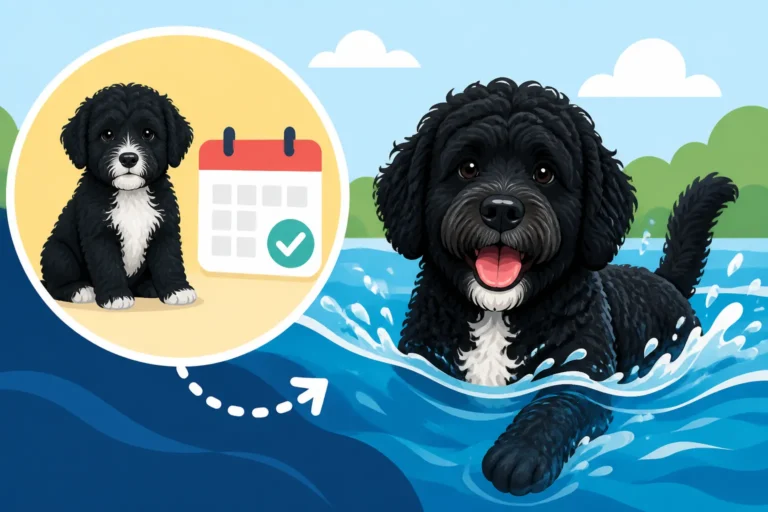
Teaching a Portuguese Water Dog to Wait on the Bank
Anyone who has ever walked a Portuguese Water Dog near a body of water knows the struggle: that sudden, intense pull, the laser focus, the absolute conviction that the universe is telling them to get in that water right now. It’s not just a minor inconvenience; it can be downright dangerous if your strong, water-loving companion bolts into traffic or a treacherous current. This guide is all about helping you teach your spirited Portuguese Water Dog the critical "wait" command, specifically when they're staring longingly at their aquatic paradise.
The Irresistible Call of the Water for a Portuguese Water Dog
It's no secret that Portuguese Water Dogs were bred for a life at sea, working alongside fishermen on the boats off the coast of Portugal. Their entire being is engineered for the water, from their strong, athletic build to their webbed feet and water-resistant coat. So, when you're walking along a riverbank, a lake shore, or even just past a large puddle, it's not surprising that their ancient instincts kick in with full force.
Understanding Your PWD's Deep-Rooted Water Drive
You see that glint in your Portuguese Water Dog’s eye, that twitch of their powerful tail, the way their nose lifts to sniff the moist air – they're not just excited, they're responding to centuries of genetic programming. These dogs were literally their human companions' partners in the fishing industry, diving into the chilly Atlantic to retrieve broken nets, herd fish into traps, and even carry messages between boats. It was a serious job, and their eagerness for water was a vital part of their utility. Understanding this profound drive helps you approach their training with patience and empathy, rather than just frustration. It’s not disobedience for the sake of it; it's instinct. You can learn more about their history in How a Portuguese Water Dog Drove Fish Into a Net.
Imagine a scenario: you’re at the local dog park, and there’s a small stream winding through it. Most dogs might sniff at it, maybe take a quick drink, but your PWD sees it as a personal invitation to a full-on aquatic adventure. They’ll accelerate, muscles tensing, ready to leap in before you’ve even registered their intention. This isn't naughtiness; it's simply a dog doing what it was born to do, often with an enthusiasm that borders on single-minded obsession.
The Overwhelming Excitement of Impending Splashdown
For many Portuguese Water Dogs, the sight or sound of water triggers an intense rush of excitement. This isn't just a mild interest; it can be an all-consuming urge that overrides learned commands, especially if the "wait" command hasn't been thoroughly proofed in high-distraction environments. Think about how a child reacts to an ice cream truck – pure, unadulterated joy that can make them momentarily forget everything else. Your PWD feels that same level of exhilaration, but for water.
This high level of arousal can make training challenging, as their brain is flooded with dopamine, making it hard to focus on your cues. You might see them quiver, whine softly, or even start to bark in anticipation. Their body language is clear: "Let me go! Let me go!" It’s in these moments that your calm, consistent leadership and rock-solid "wait" command become absolutely indispensable tools. Without them, you're essentially at the mercy of their aquatic desires, which isn't safe for anyone.
Building the "Wait" Command on Solid Ground
Before you even think about taking your Portuguese Water Dog to the edge of a lake and expecting them to stay put, you absolutely must build a strong foundation for the "wait" command in less distracting environments. Think of it like teaching a child to read before asking them to write a novel. The fundamentals are crucial.
Mastering "Wait" in Low-Distraction Environments
Start simple, in your home or a quiet backyard. Use high-value treats or a favorite toy to motivate your PWD. Hold the treat or toy, give the "wait" command, and take a single step back. If your dog stays, immediately return, praise them, and reward them. If they move, no fuss, just reset and try again. The key here is to keep it short, successful, and always positive. Gradually increase the distance you move away and the duration they need to "wait."
Once they've got it down in a quiet setting, slowly introduce mild distractions. Perhaps someone walks by in the background, or a different toy rolls across the floor. You're building their ability to resist temptation and maintain focus on your command, even when other appealing things are happening. Many online training programs, like those offered by BAXTER & Bella, offer structured modules for teaching foundational commands like "wait" that can be incredibly helpful for guided, step-by-step progress. They break down the process into manageable chunks, which is perfect for a dog as clever and sometimes stubborn as a PWD.
Introducing Leash Control Near Water
When your PWD has a solid "wait" on dry land, it's time to introduce a leash, even in those low-distraction environments. A sturdy, comfortable leash is your best friend when you’re teaching a PWD self-control, especially around water. Consider using a longer training lead, perhaps a 15- or 20-foot leash you can easily find on Amazon, which gives them a bit more freedom to test boundaries while still keeping them safely tethered. This allows you to practice "wait" with more distance between you, or even when you momentarily drop the leash as a simulation for off-leash work, knowing you can quickly regain control.
Walk your dog on leash near a calm, accessible water source – maybe a kiddie pool in your yard or a very shallow, still pond. The goal here isn't to let them swim, but to practice walking past the water, stopping at the edge, and using the "wait" command. The leash is your safety net. If they break the "wait" command, a firm but gentle leash correction, immediately followed by resetting and repeating the command, helps them understand the boundary. The moment they comply, even for a second, reward them enthusiastically. This teaches them that listening to "wait" near water brings good things, rather than just being a frustrating barrier. Remember, consistency is paramount here; every time you practice, you're reinforcing the behavior you want to see.
Integrating "Wait" with Water: The Gradual Approach
This is where the real challenge (and reward!) comes in. You've built the foundation, now you need to translate that solid "wait" to the very place your Portuguese Water Dog most desires to be. It's about careful exposure and setting your dog up for success every step of the way.
Starting with a Calm Water Source
Begin with the least distracting water source you can find. A small, shallow stream, a kiddie pool, or even a large bucket of water can be your training ground. The less temptation there is for a full-on dive, the better. Walk your PWD on a leash toward the water, giving the "wait" command a good distance away, before they even get to the edge. Practice stopping, waiting for a few seconds, then rewarding. Slowly, painstakingly, work your way closer to the water's edge.
The moment you see their body language shift – the ears perk, the nose twitches, the low whine starts – that's your cue to reinforce the "wait" command. Hold them firmly, say "wait," and praise them for any hesitation they show. If they stand still for even two seconds looking at the water without pulling, that's a huge victory. Reward that. Over time, you can gradually increase the proximity and the duration of the "wait" directly at the water's edge. This slow exposure helps them build self-control in the face of their deepest desires. Think about bringing a favorite floating toy, but keep it tucked away. The anticipation of the reward, rather than the immediate gratification, is what you're training for.
Escalating Distractions and Temptations
Once your Portuguese Water Dog is reliably waiting at the edge of a calm water source, it's time to dial up the distractions. This is crucial for proofing the command in real-world scenarios. Here's how you might progress:
- Moving Water: Introduce them to a gently flowing stream or the edge of a small pond with ripples. The movement can be a huge lure.
- Other Dogs: This is often the hardest one. Practice at a time when there are other dogs swimming or playing in the water nearby, but keep a safe distance initially. Your PWD will want to join the fun!
- Throwing Toys (Without Release): Have a favorite water toy in your hand. Approach the water, give the "wait" command, and even pretend to throw the toy. The anticipation will be enormous. Only release them with a clear "okay" or "go swim!" command.
- Different Locations: Practice at various beaches, lakes, and even different parts of the same body of water. Each new environment presents a fresh challenge.
The goal is for your PWD to understand that "wait" means "do not enter the water until I give the explicit release command," no matter what exciting things are happening around them. This level of control is what allows you to eventually trust them near unfenced water. For more on safety, consider reading Whether a Portuguese Water Dog Recalls Out of Water.
Tackling Common Challenges and Maintaining Control
Even with the best intentions and consistent training, there will be moments when your Portuguese Water Dog tests your patience and the strength of their "wait" command. It's completely normal for a breed with such a powerful drive.
The "Bolt for the Water" Syndrome
Ah, the infamous bolt! You've said "wait," but in their minds, they've heard "wait… then go!" and they've decided the "go" part happened five seconds too early. If your Portuguese Water Dog makes a break for the water, it’s critical how you respond. Firstly, do not chase them while yelling their name. This can turn it into a fun game for them or cause them to associate their name with being in trouble. Instead, a swift, firm (but not harsh) correction on the leash (if they're wearing one) is necessary. If they are off-leash, this is a moment to re-evaluate your training and go back to a long line or a leash in all situations around water.
The consequence for bolting should be an immediate removal from the tempting situation. This might mean turning around and walking away from the water for a few minutes, or even ending the water-related outing entirely for that day. They need to understand that bolting equals losing the privilege of being near the water. Conversely, when they do wait, even for a split second, that's your cue for massive praise and a high-value reward. This clear distinction between desired and undesired behavior is key. It takes relentless consistency to change this deeply ingrained behavior.
Maintaining Consistency Across Locations
One of the biggest hurdles is getting your Portuguese Water Dog to generalize the "wait" command, meaning they understand it applies everywhere, not just at your local pond. You might have a perfectly behaved PWD at the familiar lake, but then you visit a new beach, and suddenly, they've "forgotten" everything. This is because dogs don't automatically transfer learned behaviors from one context to another as easily as humans do.
You need to actively train in a variety of locations. Start with new, calm water sources, and slowly introduce more stimulating ones. Always begin with a leash and high-value rewards in each new spot.
| Water Environment | Initial Challenge | Training Strategy |
|---|---|---|
| Backyard Kiddie Pool | Novelty and shallow depth are still exciting | Treat high-value, short waits, constant praise for even momentary pauses |
| Calm Lake Shore | Vastness of water, potential for other dogs/swimmers | Use a long line, practice "wait" far from water first, slowly approach with rewards |
| Gently Flowing Stream | Moving water adds temptation and sensory input | Focus on stopping before the stream, reinforcing "wait" with steady leash pressure |
| Busy Beach/River | High distractions: people, other dogs, waves, boats | Start at off-peak hours, use highest value rewards, employ a secure harness and leash |
Remember, every new location is like starting a mini-training session from scratch, but with the benefit of the foundation you’ve already built. It's about patience and repetition.
When a Portuguese Water Dog Just Won't Listen
Sometimes, despite your best efforts, a Portuguese Water Dog might continue to struggle with self-control around water. This isn't a reflection of your failure, but rather an indication that you might need a different approach or some external help. Their intelligence and independent nature, which you can read more about in Training a Portuguese Water Dog That Was Bred to Think for Itself, mean they often need specific strategies.
If you're at your wit's end, don't hesitate to consult with a professional dog trainer who has experience with working breeds or specific PWD challenges. They can offer fresh perspectives, identify subtle cues you might be missing, and provide hands-on guidance. Sometimes, just having an experienced eye observe your interactions can make all the difference. They might introduce specific tools, like a particular type of harness or a clicker, that can help bridge the communication gap. Ultimately, the goal is a safe, happy, and well-behaved Portuguese Water Dog who respects boundaries, especially around the water they love so much.
Disclaimer
This article is for general informational purposes only and does not constitute professional advice. Laws, prices and regulations vary by location and change over time. Consult a qualified professional for guidance on your specific situation.