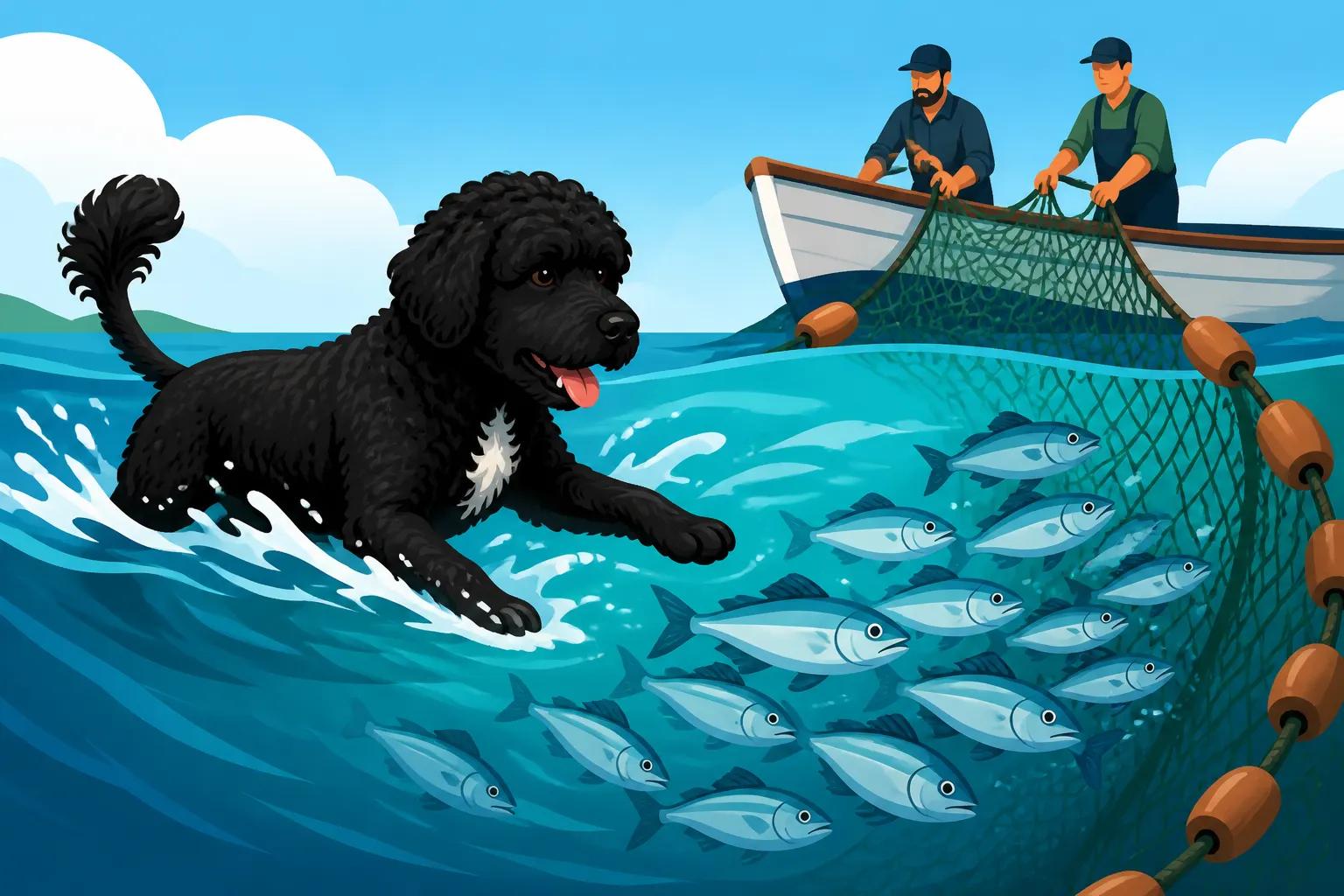
How a Portuguese Water Dog Drove Fish Into a Net
For those of us who share our lives with a Portuguese Water Dog, it’s easy to see their deep connection to water and their tireless enthusiasm for play. But sometimes, it's hard to truly grasp the profound history behind these traits – especially their ingenious role in traditional fishing. This guide dives deep into a specific, fascinating aspect of their heritage: how these intelligent canines were not just retrievers, but active participants in driving fish into nets, a skill that showcases their remarkable partnership with humans and their unique breed characteristics.
The Historical Role of the Portuguese Water Dog on Fishing Boats
Before the advent of modern fishing technology, the livelihood of fishermen along the rugged coasts of Portugal relied heavily on skill, endurance, and often, the help of a four-legged crewmate. The Portuguese Water Dog wasn't just a mascot; they were an indispensable part of the fishing fleet, performing a myriad of tasks that directly contributed to the success of the day's catch. Understanding this foundational role is key to appreciating their instincts today.
More Than Just a Retriever: The Versatile Canine Crewmate
When we think of dogs working with fishermen, our minds often jump to retrieving lost gear or fetching lines. And while Portuguese Water Dogs certainly excelled at these tasks, their job descriptions were far more extensive and nuanced. They were companions, guardians of the boat, and active helpers in the actual fishing process. Their incredible intelligence and eagerness to please meant they could be trained for complex duties that went far beyond simple fetch. It truly highlights that A Portuguese Water Dog Was Bred to Work a Boat, Not a Yard, emphasizing their active participation rather than just passive presence.
These dogs were true partners, adapting to the ever-changing conditions of the sea. Their keen observational skills allowed them to anticipate their owner's needs, often acting before a command was even given. Imagine a bustling fishing boat, lines flying, nets being hauled—a Portuguese Water Dog was right there in the thick of it, a seamless extension of the human crew. This historical context underscores why these dogs thrive when given a "job" or purpose, even if today that job is retrieving a ball from the local lake or excelling in a dog sport.
The Ancient Fishing Techniques of the Algarve
To understand how a Portuguese Water Dog drove fish into a net, we need to picture the fishing methods prevalent along the Iberian coast centuries ago. Fishermen used smaller boats, often working closer to shore or in coves, employing large, sweeping nets that required strategic deployment and retrieval. It wasn't about massive trawlers dragging the ocean floor, but about more intimate, labor-intensive techniques that benefited immensely from an extra, highly capable set of paws (and a powerful swimmer).
These traditional methods often involved encircling schools of fish with long nets. The challenge wasn't just deploying the net, but ensuring the fish remained within the netted area and were actively guided into the trap. This is where the Portuguese Water Dog's unique abilities came into play. The fishermen understood animal behavior and recognized that a dog, with its inherent predatory instincts and swimming prowess, could be trained to manipulate the fish's natural schooling and escape responses to their advantage. It was a sophisticated system of teamwork between man and dog, refined over generations.
The Mechanics of "Driving Fish" with a Portuguese Water Dog
The concept of a dog "driving" fish might seem a little fantastical at first glance. We often associate herding with sheep or cattle on land, but applying that same principle to a vast, open body of water requires a very special set of skills and instincts. The Portuguese Water Dog possessed these in spades, making them exceptionally effective.
Active Herding and Creating Disturbance
Imagine a school of fish, perhaps sardines or mackerel, visible near the surface or known to be in a certain area. The fishermen would deploy their net, forming a wide arc. The Portuguese Water Dog's job was then to actively swim into the open end of that arc, or along the edges, creating a disturbance that would push the fish deeper into the net's confines. This wasn't a gentle nudge; it was a deliberate, energetic effort.
The dog would swim powerfully, often diving and resurfacing, churning the water with their strong webbed feet. This rapid, erratic movement would mimic a predator, instinctually making the fish attempt to flee in the opposite direction – which, in this scenario, meant directly into the waiting net. Their incredible stamina meant they could keep this up for extended periods, making several passes if necessary to ensure the school was concentrated and moved effectively. This sophisticated "herding" demonstrated their high intelligence and their deep understanding of the fishing operation, truly illustrating How a Portuguese Water Dog Worked a Net.
The Role of Sound and Movement
Beyond just the physical act of swimming, the Portuguese Water Dog utilized a combination of sound and movement to maximize their effectiveness. Their distinctive barks, sometimes sharp and piercing, other times deeper and more insistent, would echo across the water. This sound, combined with their splashing and quick directional changes, created a sensory barrage for the fish.
Fish, much like other prey animals, are highly sensitive to sudden movements and loud noises. A dog barking and splashing directly behind a school would create a sense of urgency and panic, urging them forward and away from the perceived threat. It was a perfectly executed strategy, a testament to the dog's innate abilities and the fisherman's astute training. You can almost picture them, dark coats shimmering, weaving through the water, their tails acting as rudders, driving the catch. This is a far cry from a dog merely waiting on the boat; this was active, strategic participation.
Communication Between Dog and Fisherman
Such a complex task wasn't performed in silence or without direction. The bond between a Portuguese Water Dog and its fisherman was incredibly strong, built on trust, observation, and a unique system of communication. Fishermen would use specific hand signals, whistles, and verbal commands to guide their dogs, directing them precisely where to go, when to increase their activity, and when to hold back.
The dogs, in turn, were remarkably attuned to their human partners. They could read body language and vocal tones, understanding subtle cues that dictated their actions. This level of communication allowed for precise execution of the fish-driving maneuvers, making the process efficient and successful. It’s a powerful reminder of how intelligent and trainable these dogs are, and how that historical partnership translates into their eagerness to learn and work with us today, whether it's for complex agility courses or simple retrieving games. For new owners, this historical context can shed light on why training programs, like those offered by BAXTER & Bella, emphasize building a strong communication foundation.
Why This Unique Skill Was So Crucial
In the cutthroat world of historical fishing, every advantage counted. The ability of Portuguese Water Dogs to actively drive fish into nets wasn't just a quirky trick; it was a critical factor in the economic survival of many fishing communities and a testament to the breed's functional design.
Maximizing the Catch in a Challenging Environment
Think about the effort involved in traditional net fishing: laying out the nets, waiting, and then hauling them in. If a significant portion of the fish escaped before the net could be fully closed, it meant wasted time, wasted energy, and a reduced income for the fishermen. The Portuguese Water Dog minimized this waste by ensuring the fish were effectively trapped. They increased the yield, making the arduous work of fishing more profitable and sustainable.
In an era before advanced sonar or motorized boats to herd fish, having a highly agile, motivated swimmer capable of directing fish schools was an invaluable asset. It allowed fishermen to operate more efficiently, often targeting specific schools and making the most of limited resources and unpredictable weather conditions. This direct contribution to the bottom line made the Portuguese Water Dog not just a pet, but a vital piece of the economic puzzle for these coastal communities.
The Physical Attributes That Made Them Ideal
The Portuguese Water Dog's very anatomy is a blueprint for its historical work. Their dense, single coat, whether curly or wavy, is highly water-resistant and provides insulation, allowing them to remain in cold ocean waters for extended periods without succumbing to hypothermia. This is especially important for a dog engaged in active swimming and herding. How Long a Portuguese Water Dog Can Stay in Cold Water is a direct reflection of this protective coat.
Their powerful, well-muscled bodies are built for endurance and agility in the water. Perhaps most notably, their distinctive webbed feet are perfectly designed for propulsion and maneuverability, giving them an unmatched advantage as aquatic herders. How Much a Portuguese Water Dog's Webbing Adds to Its Speed is a key factor in their ability to quickly move and redirect fish. Couple this with their strong, rudder-like tail, which allowed for precise changes in direction, and you have a dog perfectly engineered for the task of driving fish. Their physical traits weren't accidental; they were honed by centuries of working alongside fishermen, making them perfectly adapted for their unique role.
Legacy and Modern-Day Echoes of the Past
While the specific job of driving fish into nets is largely a thing of the past, the legacy of this incredible work lives on in every Portuguese Water Dog today. Their inherent traits, love for water, and intelligence are direct reminders of their ancestors' crucial role.
The Decline of the Working Role
The era of the Portuguese Water Dog actively driving fish into nets began to wane with the modernization of the fishing industry. Larger boats, more sophisticated netting techniques, and eventually, powered engines capable of pursuing and encircling fish far more efficiently than a dog, rendered their traditional role less necessary. The shift from small, coastal fishing vessels to larger commercial operations meant there was simply less need for a canine crewmate to perform these specific tasks.
This decline led to a near-extinction of the breed by the early 20th century, a sobering reminder of how closely their fate was tied to their utility. Thankfully, dedicated enthusiasts recognized the breed's unique qualities and worked tirelessly to preserve them, ensuring that the legacy of these magnificent working dogs would not be lost entirely.
Preserving the Instinct in Modern Portuguese Water Dogs
Even today, a Portuguese Water Dog’s instincts scream "working dog." Their boundless energy, their need for mental stimulation, and their undeniable draw to water are all echoes of their past. While they might not be herding sardines into a net anymore, these instincts find expression in other ways. Many Portuguese Water Dogs excel in modern dog sports, particularly water-based activities like dock diving or competitive obedience involving retrieving from water.
These activities don't just provide exercise; they tap into the very core of what a Portuguese Water Dog was bred to do. Owners often find immense satisfaction in watching their dogs perform tasks that, though adapted for sport, are deeply rooted in their ancestral job descriptions. It's a way to honor their heritage and keep those incredible instincts alive. You can see this natural inclination in How Naturally a Portuguese Water Dog Swims.
Connecting with Their Heritage Through Training
For those of us fortunate enough to own a Portuguese Water Dog, understanding their history provides a rich context for their behavior and needs. It helps explain their intelligence, their desire to please (and sometimes to offer their own solutions!), and their profound connection to water. Incorporating water work into their lives, even if it's just regular swimming at a local lake or beach, can be incredibly fulfilling for them.
Consider enrolling your dog in water work classes or exploring sports like Dock Diving and Water Trials With a Portuguese Water Dog. These activities mimic the problem-solving and physical demands of their ancestors' work, providing an outlet for their natural abilities. Even simple games of retrieve with floating toys can activate those deep-seated instincts. Products found on platforms like Amazon can help, from durable floating toys to life jackets designed for active swimming dogs. Teaching a Portuguese Water Dog Puppy to Enter Water early and positively can set them up for a lifetime of enjoying their natural element, strengthening the bond with you and connecting them to their remarkable heritage. Remember, a fulfilled Portuguese Water Dog is a happy Portuguese Water Dog, and tapping into their history is a wonderful way to ensure their well-being.
| Historical Role | Modern Equivalent | Benefits for the Dog |
|---|---|---|
| Driving fish into nets | Water retrieving, dock diving, water trials | Mental stimulation, physical exercise, instinct fulfillment |
| Retrieving lost gear | Fetch games, scent work, obedience trials | Builds bond, problem-solving, reinforces training |
| Guarding the boat/catch | Alert barking (channeled), boundary training | Sense of purpose, feeling secure in their "pack" |
| Companion to fishermen | Family pet, therapy dog | Strong human-canine bond, affection, companionship |
Disclaimer
This article is for general informational purposes only and does not constitute professional advice. Laws, prices and regulations vary by location and change over time. Consult a qualified professional for guidance on your specific situation.