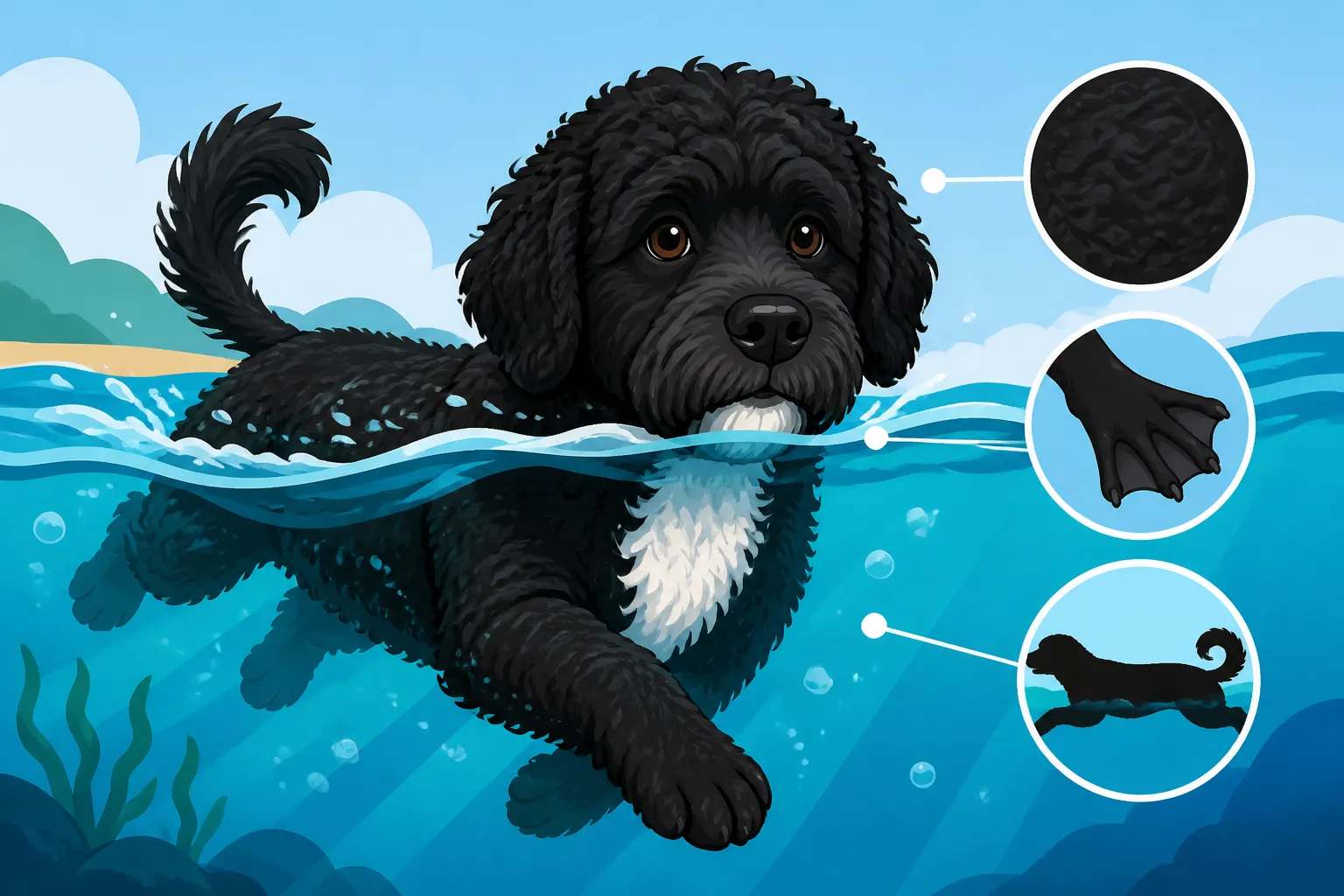
Why a Portuguese Water Dog Is Built to Swim
A Portuguese Water Dog may launch into a lake with the confidence of a dog born for it, but swimming ability is more than enthusiasm. Webbed feet, a powerful body, and a tail that helps with balance all contribute. This guide explains how those traits work, what the breed was developed to do in water, and how to keep swimming safe and enjoyable.
The Portuguese Water Dog’s body is built for swimming
Webbed feet help the dog move through water
Portuguese Water Dogs have webbing between their toes. It gives the paws more surface area as they push against water, much like a small paddle. That helps explain why a dog with this build can move efficiently through a swim instead of relying only on quick, frantic strokes.
The webbing is useful on land, too. It can help the dog move across soft or uneven ground, including muddy banks and slippery shorelines. It is not a guarantee of perfect traction, though. Wet rocks, boat ramps, and algae-covered steps can still be slick, so keep an eye on footing when your dog climbs out.
You can see how this physical feature fits into the breed’s broader design in Why a Portuguese Water Dog Has Webbed Feet. Still, webbing does not make a dog a natural expert at every kind of water. A young dog, an inexperienced swimmer, or one who is frightened may need time and patient encouragement before it feels comfortable.
A strong body supports repeated strokes
A Portuguese Water Dog has a muscular, athletic frame suited to sustained movement. Its chest and shoulders help power the front strokes, while its hindquarters contribute to forward drive. The result is a dog built for purposeful activity, not just a quick splash at the edge.
That strength can make swimming look effortless. It can also tempt owners to assume their dog can go farther or stay in the water longer than is sensible. Swimming is exercise, and cold, current, waves, fatigue, or an overexcited dog can change the situation quickly. Start with short, easy outings and let your dog rest before it is tired.
Swimming can be a useful activity for many dogs, but it should not be treated as a substitute for watching your individual dog’s condition. A puppy, a senior, or a dog returning to exercise after an injury may need a different plan from a fit adult. If your dog has a health concern, ask your veterinarian what type and amount of activity is appropriate.
The tail helps with balance and direction
The Portuguese Water Dog’s tail is more than a distinctive feature. In the water, it can help the dog balance and adjust its direction, especially while turning. Think of it as one part of a coordinated swimming movement: the limbs propel the body, while the tail contributes to control.
This does not mean the tail acts like a boat’s rudder in exactly the same way. It is better understood as a flexible aid that helps the dog steer and stabilize itself. The tail’s role is easier to appreciate when a dog changes direction, reaches for a floating toy, or turns back toward shore. Why a Portuguese Water Dog's Tail Works as a Rudder explores that function in more detail.
| Physical feature | How it can help in water | What it does not guarantee |
|---|---|---|
| Webbed feet | Adds surface area for pushing against water | Comfort or skill in every swimming situation |
| Muscular body | Supports purposeful strokes and active movement | Unlimited stamina |
| Tail | Helps with balance and directional adjustments | Safe navigation through waves or current |
| Water-associated coat | Offers some protection while the dog works in water | A waterproof coat or immunity to cold |
Why the breed developed its swimming abilities
A working dog shaped by Portugal’s fishing coast
Portuguese Water Dogs were developed as working dogs associated with Portugal’s fishing communities. Their tasks included helping fishermen around boats and in the water, where a capable, responsive dog could be useful. Swimming was not simply a recreational pastime; it was part of the work the breed was expected to do.
That history helps make sense of the dog’s athletic build and readiness for activity. It also explains why some Portuguese Water Dogs seem particularly alert around water: their heritage includes work that involved moving between shore, boat, and sea. For more on that background, see The Portuguese Water Dog Worked the Algarve Fishing Fleet.
A modern household does not need to recreate a fishing crew’s routine. Your dog may be perfectly content with supervised swims, retrieving games, walks, training, or other activities. The important connection is that this is an energetic working breed, and it tends to do best when its physical and mental needs are taken seriously.
Strong instincts are not the same as swimming lessons
Breed history can make a Portuguese Water Dog more likely to approach water, but it does not teach a puppy how to enter a pool safely, climb out at a beach, or respond to a recall while excited. Those are learned skills. Individual dogs also vary: one may charge into a shallow pond, while another hangs back and watches.
Avoid pushing a reluctant dog into water or assuming that a first enthusiastic splash means your dog is ready for a long swim. A better introduction is calm and gradual: let the dog explore the shoreline, reward relaxed behavior, and offer an easy way to leave. A confident adult dog can still benefit from practicing the same basics in a new place.
The breed’s reputation can set owners up for disappointment if they expect every dog to love swimming immediately. If your dog prefers to paddle at the edge or skip the water altogether, that does not make it a poor example of the breed. Whether Every Portuguese Water Dog Likes Water addresses that important difference between breed tendencies and individual temperament.
Coat, stamina, and swimming safety
A water-ready coat still needs care afterward
The Portuguese Water Dog’s coat is associated with its working heritage, but it should not be thought of as completely waterproof. A wet coat can hold water close to the body and may take time to dry, especially if it is long, dense, or tangled. After swimming, rinse away salt, chlorine, sand, or debris when needed, then dry your dog thoroughly.
Pay special attention to areas that can stay damp or collect tangles, such as behind the ears, under a harness, in the armpits, and between the toes. A wet coat that is left tangled can become uncomfortable and harder to brush out later. Regular coat maintenance is part of owning a swimming dog, not an optional extra for show dogs.
A towel kept near the door or in the car makes the after-swim routine easier. Chewy can be one place owners look for basic supplies such as towels, grooming tools, or dog-safe coat-care products; choose items that suit your dog’s coat and follow product directions. For a fuller routine, see Drying a Portuguese Water Dog After Every Swim.
Build stamina gradually and keep the water session positive
A dog can look powerful in the water and still become tired. Begin with brief swims in calm, shallow water where your dog can touch bottom or exit easily. Keep early sessions relaxed and end while your dog is still enjoying the activity. Gradually build duration only when your dog remains comfortable and responsive.
Watch for signs that the swim is becoming too much: slowing down, repeated attempts to reach shore, unusual panting, difficulty keeping the head comfortably above water, or not responding as usual. Do not wait until your dog is exhausted to call it in. Take breaks on land, offer fresh drinking water, and avoid encouraging repeated long retrieves simply because your dog keeps bringing the toy back.
A life jacket can add support in unfamiliar water, around boats, or where there is current, but it does not replace supervision. It should fit securely without restricting movement, and your dog should get used to wearing it on land before swimming in it. If you are deciding whether one is appropriate, When a Portuguese Water Dog Needs a Life Jacket offers a useful next step. Chewy may carry dog flotation gear, but fit, comfort, and suitability matter more than the retailer.
Match precautions to the water you are using
A fenced pool, a quiet lake, a river, and an ocean beach present very different risks. In a pool, teach your dog where the steps or ramp are and practice exiting from different points. Never assume the dog will find the way out on its own, especially if it is excited or the pool has a steep edge.
At a lake, check for hazards such as sharp debris, sudden drop-offs, strong currents, and poor water quality. Keep your dog close enough to guide back to shore, and do not allow it to drink large amounts of lake water. Conditions can change even when the surface initially looks calm. How a Portuguese Water Dog Can Swim in a Lake covers the setting-specific considerations.
At the ocean, waves, tides, and currents can quickly make a casual swim more demanding. Choose a sheltered area, stay near your dog, and end the session if conditions become rough. After swimming in salt water, rinse the coat and paws, and check for sand or irritation. Chewy is another possible source for practical after-swim items such as rinse-friendly grooming supplies, but a simple fresh-water rinse and careful drying remain the key habits.
Helping your Portuguese Water Dog become a confident swimmer
Introduce water in small, low-pressure steps
For a puppy or a dog new to swimming, start somewhere quiet and shallow. Let the dog approach at its own pace, sniff the water, and step in if it chooses. You can reward curiosity with calm praise or a favorite toy, but avoid luring the dog farther than it is ready to go.
Once your dog is comfortable standing in shallow water, encourage a few steps beside you rather than sending it swimming out to retrieve something. Keep the first sessions short. If the dog backs away, trembles, scrambles, or tries to climb onto you, give it space and return to an easier stage another day.
Make sure the entry and exit are both easy. A gentle bank, beach with a gradual slope, or pool ramp can make a new experience much less intimidating. Teaching a Portuguese Water Dog Puppy to Enter Water offers a step-by-step approach for building confidence without forcing the issue.
Teach safety cues before adding distance
A reliable recall is especially important around water. Practice the cue first on land, then near the water’s edge, and only later in a controlled swimming setting. Reward your dog generously for turning away from the water and coming back, even when a toy or another dog is nearby.
Teach a clear waiting cue at the bank or pool edge as well. This helps prevent a dog from launching into water before you have checked the conditions or secured its life jacket. If you take your dog on a boat, practice calm behavior aboard while docked before introducing movement, noise, or open water.
Swimming can be a joyful outlet for a Portuguese Water Dog, but it should remain an activity you manage together. The breed’s body and history give it useful advantages, not immunity from fatigue, fear, or water hazards. Start gently, respect your dog’s signals, and make every swim easy to end. For more about the breed’s swimming ability and how it varies between dogs, see How Naturally a Portuguese Water Dog Swims.
Disclaimer
This article is for general informational purposes only and does not constitute professional advice. Laws, prices and regulations vary by location and change over time. Consult a qualified professional for guidance on your specific situation.