Whether the Portuguese Water Dog Shares Ancestors With the Poodle
It's a question that often pops up in conversations among dog lovers, particularly those fascinated by the unique qualities of water-loving breeds: do Portuguese Water Dogs and Poodles share ancestors? Given their similar curly coats and undeniable affinity for the water, it’s a natural assumption, a puzzle many prospective owners try to solve. This guide will delve deep into the historical lineages of both breeds, dissecting their origins, evolutions, and the fascinating truth about their relationship, or lack thereof, to clear up this common misconception.
The Historical Tapestry of Water Dogs
Before we zero in on the Portuguese Water Dog and the Poodle, it’s helpful to understand the broader category of "water dogs." Across history, many different types of dogs were developed in various parts of the world to assist humans with tasks involving water. These weren't necessarily distinct breeds as we know them today, but rather functional types, often named for their primary role or the region they inhabited. They were bred for specific jobs, leading to convergent evolution where similar traits (like a water-resistant coat or strong swimming ability) appeared independently in different lines.
Ancient Water Dogs and Their Migrations
The story of water dogs stretches back centuries, with some theories suggesting their origins lie in ancient Asia, moving westward with various nomadic tribes and traders. These early canine companions were invaluable, helping with herding, hunting, and, crucially, retrieving from water. As people migrated and settled in new regions, they selectively bred dogs best suited to their local environments and needs. For coastal communities, a dog that could jump into icy waters, retrieve fishing gear, or even herd fish into nets was a prized asset. This often meant a dog with a dense, non-shedding, water-repellent coat and webbed feet – traits that are highly visible in modern water breeds. It's less about a single "ancestor" and more about the recurring need for a specific skill set leading to similar physical adaptations over time.
The Role of Seafaring and Trade
The spread of these early water-dog types was heavily influenced by seafaring and trade routes. Boats traveled extensively, carrying not just goods and people, but also working animals. A dog proven useful on a fishing vessel in one port might be taken to another, where its traits would be further developed or crossbred with local working dogs. This historical movement created a rich, intricate web of canine lineages, making it incredibly difficult to trace a single, direct common ancestor for all "water dog" breeds. The dogs that became the foundation for the Portuguese Water Dog, for instance, were likely brought to the Iberian Peninsula by various maritime travelers, adapting to the specific demands of the Portuguese fishing industry over many generations.
Distinct Paths: Portuguese Water Dog Origins
The Portuguese Water Dog, or Cão de Água Português, has a storied past deeply intertwined with the fishing communities along Portugal's coast. Their development was driven purely by utility, by the daily grind of life at sea. These dogs weren't pets; they were essential crew members.
The Iberian Connection
The earliest ancestors of the Portuguese Water Dog are believed to have arrived on the Iberian Peninsula thousands of years ago, possibly with the Visigoths or other seafaring groups from North Africa. Over centuries, these dogs were refined by Portuguese fishermen who valued specific abilities: retrieving lost tackle, driving fish into nets, and carrying messages between boats. Where the Portuguese Water Dog Comes From is a tale of rugged utility and adaptability to the challenging coastal environment. They developed their distinctive curly or wavy coats, not as a fashion statement, but as insulation against the cold Atlantic waters. The unique pattern of their work, often involving prolonged periods in the sea, shaped their very essence. The breed's history truly is a testament to its working heritage.
Function Over Form: The Working Dog Ethos
For the Portuguese Water Dog, every physical trait, every behavioral tendency, was honed for its job. Their robust, muscular bodies, powerful swimming abilities, and intelligent, independent minds made them indispensable. Fishermen didn't care about breed purity in the modern sense; they cared about effectiveness. They bred the dogs that performed best, passing on traits that were crucial for survival and success on the fishing boats. This explains why the breed maintained such strong working drives and physical characteristics perfectly suited for water retrieval. What a Portuguese Water Dog Was Bred to Do on a Boat illustrates just how vital these dogs were to the livelihood of their human companions. It's a testament to their unwavering loyalty and boundless energy in their historical role.
The Poodle's Independent Lineage
Now, let's turn our attention to the Poodle, a breed often associated with elegance and show rings, but one with equally robust working-dog roots, albeit from a different part of Europe.
From German Water Dog to French Aristocrat
Despite its strong association with France, the Poodle's origins are widely traced back to Germany, where it was known as the "Pudel" or "Pudelin," derived from the Old German word "Puddeln," meaning "to splash in the water." Like the Portuguese Water Dog, the Poodle was originally a water retriever, specifically bred to fetch waterfowl for hunters. Its distinctive haircut, the "lion clip," which many people find purely aesthetic today, actually served a practical purpose. Hunters would shave parts of the dog to reduce drag in the water while leaving hair on joints and vital organs to protect them from the cold. How a Portuguese Water Dog Differs From a Standard Poodle often touches on these divergent origins despite apparent similarities.
Early Poodle Types and Diversification
The Poodle lineage evolved primarily in Germany before gaining popularity in France, where it was further refined and eventually became a favorite of the aristocracy. This is where the breed began to diversify into the various sizes we see today – Standard, Miniature, and Toy – primarily driven by companion and performance needs rather than purely working ones. While the larger Standards maintained their retrieving prowess, the smaller varieties became fashionable companions. This divergence in purpose led to a somewhat different evolutionary path than the Portuguese Water Dog, which remained predominantly a working breed tied to fishing fleets for centuries. You can see this difference in some of their innate drives. Even today, many Poodle owners find excellent supplies and nutritional advice for their active dogs, from puppy to senior, through online retailers like Chewy.
Unpacking the "Shared Ancestry" Question
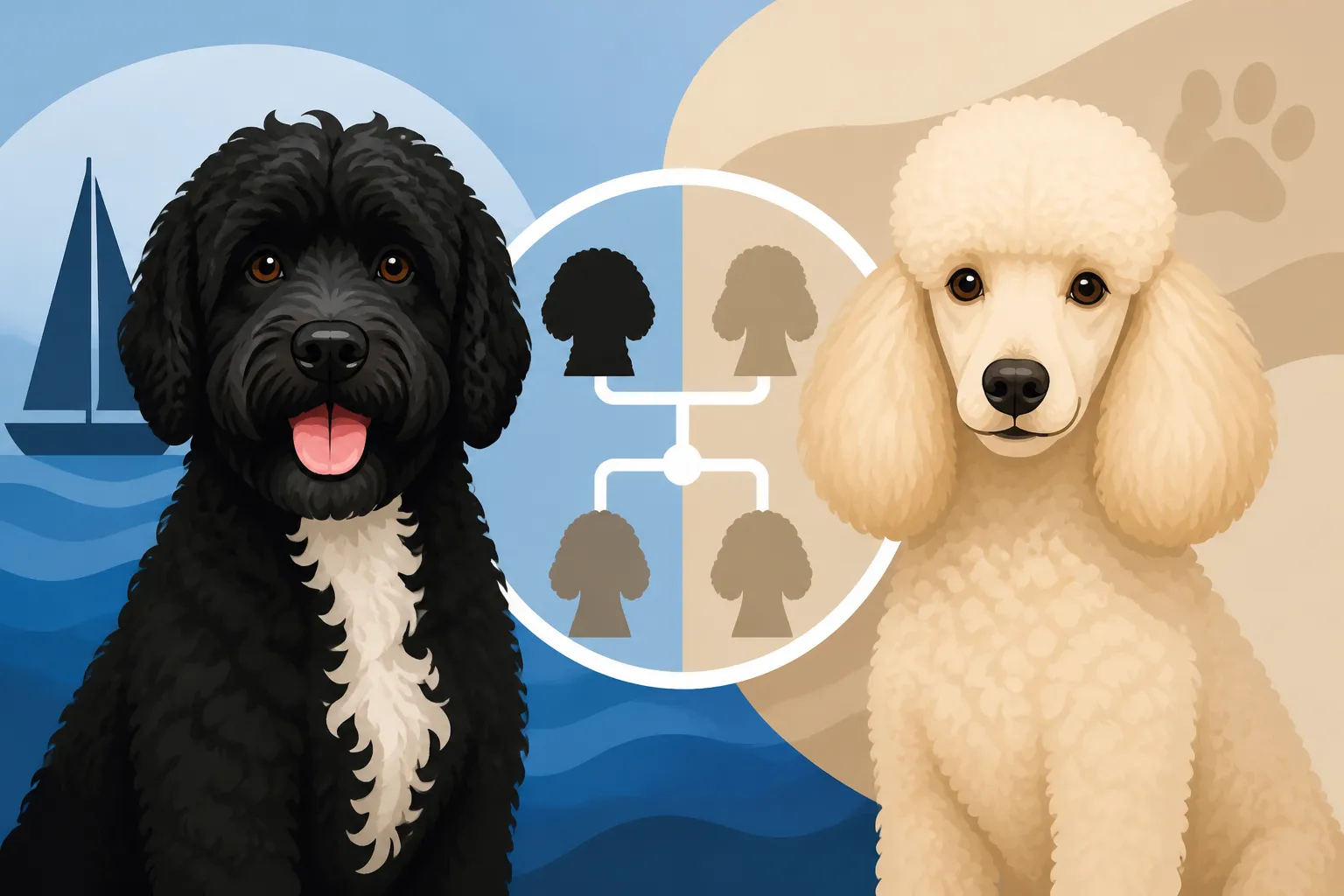
So, do these two magnificent water dogs share ancestors? The answer is nuanced, but in the sense of a direct, recent common ancestor, probably not. Their shared traits are more a product of similar job requirements and environments.
Convergent Evolution vs. Direct Kinship
The striking resemblances between Portuguese Water Dogs and Poodles are a classic example of convergent evolution. This is where different species or breeds, independently evolving in similar environments or facing similar selective pressures, develop similar traits. Both breeds were designed to work in water, leading to the selection for characteristics like dense, single coats that minimize shedding (a trait found in Why a Portuguese Water Dog Has a Single Coat), powerful swimming bodies, and webbed feet. They both possess high intelligence and a keen desire to retrieve.
Think of it like this: two different inventors, tasked with building a machine to fly, might independently come up with wings, even if their other components are vastly different. The "wings" (water-friendly coats, webbed feet) are the optimal solution for the problem (working in water), regardless of where or when the "invention" (breed development) took place. While there might be a very distant, ancient "proto-water dog" ancestor that contributed to many water-loving breeds across Europe, there's no strong genetic or historical evidence of a direct, recent shared lineage between the specific Portuguese Water Dog and Poodle lines that emerged. They developed in different geographical regions with different cultural influences and for slightly different (though related) working purposes.
Common Traits, Separate Journeys
While they don't share a direct common ancestor, their shared functional needs have led to some fascinating parallels. Both breeds are known for their high energy and intelligence, making them both highly trainable and capable of complex tasks. Both excel in dog sports that involve water, such as dock diving and water trials. Their distinctive coats – whether the tight curls of a Poodle or the curly or wavy coats of a Portuguese Water Dog Curly or Wavy: the Two Portuguese Water Dog Coats – are both adaptations for water work, requiring regular grooming to prevent matting. For diligent owners, finding the right grooming tools and products is crucial, and resources like Chewy offer a wide selection tailored to these specific coat types.
Here's a quick comparison of their typical origins:
| Feature | Portuguese Water Dog | Poodle |
|---|---|---|
| Origin Region | Iberian Peninsula (Portugal) | Germany (then popularized in France) |
| Primary Role | Fishermen's helper: retrieving, herding fish, carrying messages | Waterfowl retriever for hunters |
| Ancestry | Believed to derive from ancient Asian/North African water dogs brought by traders and Visigoths | Believed to derive from German water dogs, possibly Asian herding dogs |
| Coat Type | Curly or Wavy, single coat | Curly, single coat |
| Earliest Known Role | Assisting fishing fleets | Retrieving game from water |
The Portuguese Water Dog's history is steeped in the practical needs of the ocean, often working long hours on the boats as depicted in stories of How Many Portuguese Water Dogs a Boat Carried. The breed faced near extinction when fishing methods modernized, and Why Fishermen Stopped Needing the Portuguese Water Dog is a stark reminder of how breeds can fade when their primary purpose vanishes. Thankfully, dedicated individuals stepped in, and Who Saved the Portuguese Water Dog is a story of passion and preservation. Similarly, the Poodle's journey, from German duck hunter to French companion, also highlights how human needs and cultural preferences shape a breed's destiny.
In essence, while you might find a PWD and a Poodle enthusiastically splashing in the same lake, their family trees, though both rooted in "water dog" functionality, branch off in different directions much further back than many assume. They are magnificent, intelligent, and water-loving breeds, each with a rich, unique history that deserves to be celebrated on its own terms. Whether you're considering adding one to your family, you'll find everything from food to toys available from trusted sources like Chewy, ensuring your water dog, regardless of its specific lineage, thrives.
Disclaimer
This article is for general informational purposes only and does not constitute professional advice. Laws, prices and regulations vary by location and change over time. Consult a qualified professional for guidance on your specific situation.