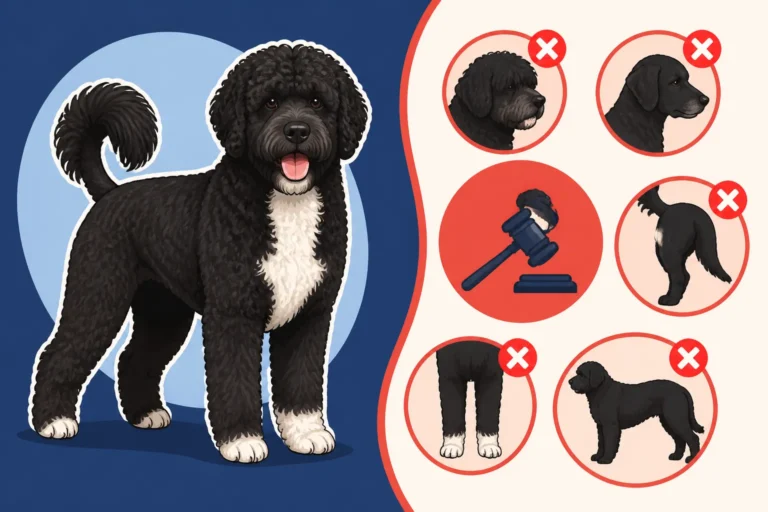
How a Portuguese Water Dog Should Move
A Portuguese Water Dog should move with a free, balanced, energetic stride—not a stiff, choppy one or a showy, exaggerated one. But it can be hard to judge what is normal when a shaggy coat hides the legs and a lively dog bounces around at home. This guide explains what to look for at a walk and trot, and when a change in movement deserves attention.
What correct Portuguese Water Dog movement looks like
The overall picture is balanced and purposeful
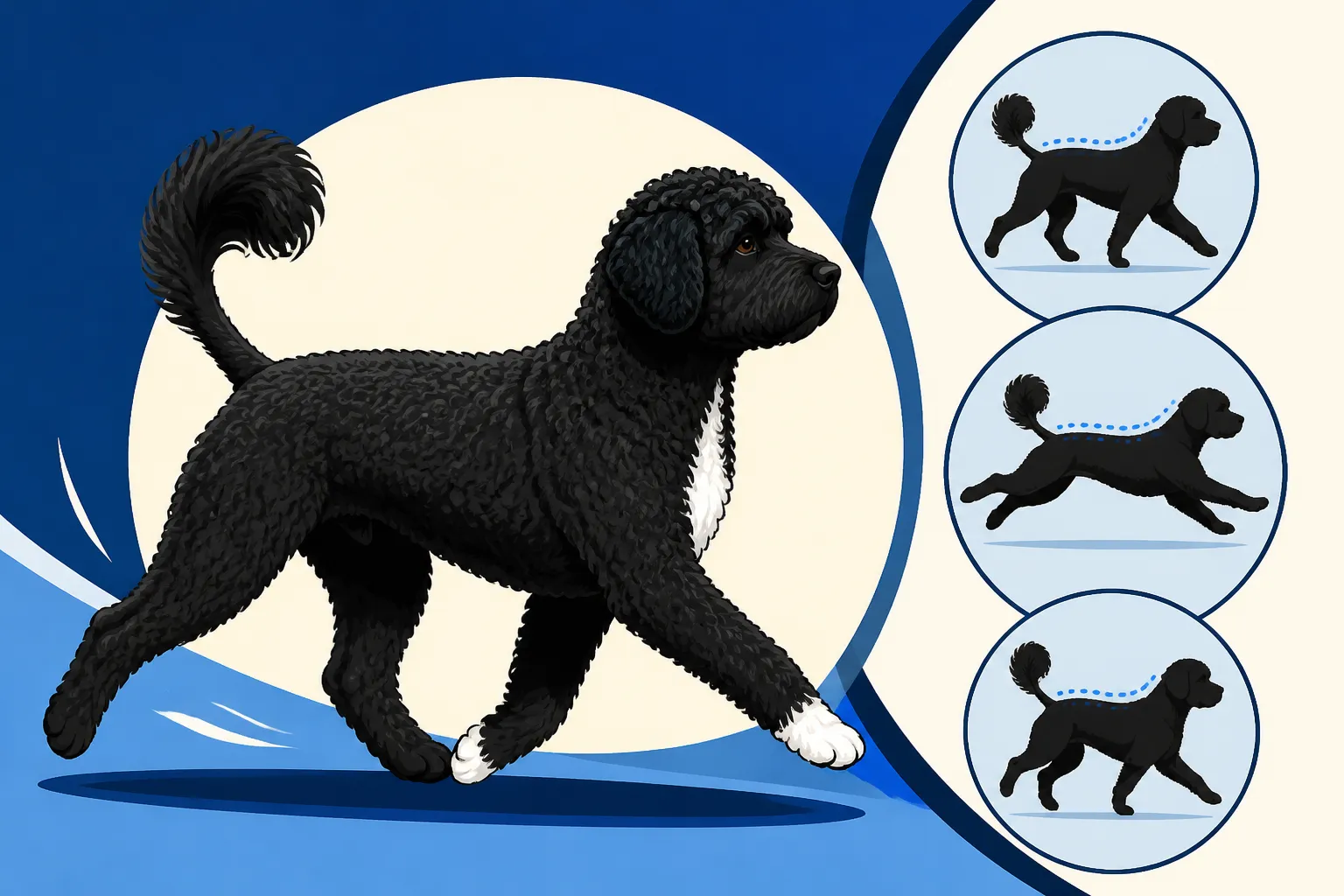
The Portuguese Water Dog was developed as a working dog, so its movement should look useful: coordinated, steady and capable of covering ground without apparent effort. Breed-standard language describes movement as free, balanced and vigorous, with reach in front and drive from behind. In everyday terms, the dog should look as though its front and rear legs are working together, rather than one end pulling while the other struggles to keep up.
A dog with a good stride does not need to move dramatically. The ideal is not an unusually high-stepping front leg, a huge rear kick or a rolling body. Instead, watch for an easy rhythm: the front legs reach forward, the rear legs push the body along, and the back remains reasonably steady. The dog should look comfortable at its chosen pace.
This is easier to see when the dog is moving in a straight line on level, secure ground. A Portuguese Water Dog racing toward a favorite person may bound, weave or throw in a playful hop. That can be perfectly ordinary excitement, but it is not the best way to assess its regular gait. Give the dog a chance to settle into a walk or trot before drawing conclusions.
For a broader picture of how movement relates to the dog’s shape, see What a Correct Portuguese Water Dog's Outline Looks Like. Proportions, muscle, coat and posture all affect what you see, but the dog should still appear coordinated and comfortable in motion.
Watch the walk and trot separately
At a walk, each step is deliberate, and you have time to notice whether the dog places its feet evenly. Look for a consistent rhythm, without repeated stumbling, toe dragging or obvious hesitation. A relaxed dog may carry its head naturally and look around; it does not have to hold a rigid show pose while walking.
A trot is often more revealing because it shows the dog’s rhythm and coordination at a faster pace. The stride should remain smooth, with the front and rear working in balance. As the dog moves faster, its legs may track closer to the center line of its body. That natural convergence can be easier to see from the front or behind, but it should not look like the dog is crossing its legs, tripping or struggling to stay upright.
A useful comparison is a dog walking down a quiet sidewalk versus one trying to keep up on a crowded path. The first may move in a loose, regular rhythm. The second may shorten its stride, turn its head repeatedly or pull against the leash. Those distractions can make normal movement look awkward, so choose a calm stretch of ground when you can.
| What to observe | A reassuring pattern | A reason to look more closely |
|---|---|---|
| Rhythm | Steps look regular and coordinated | Repeated limping, stumbling or uneven steps |
| Stride | Front reach and rear push appear balanced | One leg takes noticeably shorter steps |
| Back and body | The body stays controlled as the dog moves | Repeated dipping, twisting or excessive rocking |
| Feet | The dog places its paws confidently | Persistent toe dragging, scuffing or knuckling |
| Willingness | The dog moves comfortably at its usual pace | Reluctance to walk, jump or rise |
These are observations, not a diagnosis. A dog can move awkwardly because of excitement, slippery flooring, fatigue or an unfamiliar surface. What matters is whether the unusual pattern persists, returns regularly or comes with discomfort.
How to assess a Portuguese Water Dog’s gait at home
Choose a safe, useful setting
You do not need a show ring to notice how your dog moves. Start on a flat, familiar surface with enough room for a straight walk. A quiet paved path, a level driveway or a dry patch of short grass can work. Avoid slick floors, steep slopes and loose gravel when you are trying to judge gait; each can change how a dog places its feet.
Have someone walk the dog at a comfortable pace while you watch from the side, then from the front and back. If you are alone, a short video can help. Keep the leash loose enough for natural movement, but maintain control and do not encourage sprinting. Repeating the same short walk on another day can help you distinguish a consistent pattern from a one-off stumble.
A shaggy coat can make the legs hard to see. If you are unsure whether the dog’s feet are tracking evenly, look when the coat is clean and dry, or ask a groomer or veterinarian to help you assess what you are seeing. A trim should never be treated as a way to correct a movement problem. The coat can obscure the gait, but it does not explain persistent limping or reluctance to move.
If you are preparing for activity rather than simply observing, keep the equipment comfortable and properly fitted. A harness that rubs or restricts shoulder movement can change a dog’s stride, especially during a walk. Chewy can be one place owners browse for walking gear, but fit matters more than the label: check that straps do not press into the armpits or limit the legs. For a dog that swims, remove gear that is not designed for water use and supervise closely.
Compare your dog with its own normal
There is no single pace or stride that every Portuguese Water Dog will show. Age, fitness, body condition, excitement, surface and the length of the dog’s coat all affect what movement looks like. A young dog may be exuberant and uncoordinated during play, while an older dog may warm up more slowly. Those differences are worth noting, but they do not automatically indicate a problem.
Your dog’s usual movement is often the most useful reference point. Does it normally rise easily after resting? Does it take the stairs willingly? Does it trot beside you without lagging or repeatedly changing its stride? If you see a change, jot down when it started, which leg seems affected, whether it improves after rest, and whether it follows a particular activity.
Short videos can be particularly helpful. Film the dog walking toward you, away from you and across the frame, ideally on the same level surface each time. Avoid forcing a dog to repeat a movement that seems painful. A clip recorded during an ordinary walk may give your veterinarian a useful starting point, but it cannot replace an examination.
For more on joint health, read Hips and Joints in a Portuguese Water Dog and Hip Dysplasia in a Portuguese Water Dog. They can help explain why a dog’s movement may change, but gait alone cannot confirm a particular condition.
Puppy movement, exercise and normal variation
Puppies are still learning how to coordinate
A Portuguese Water Dog puppy can look a little clumsy as it grows. Young dogs are learning how to control longer legs, turn quickly and judge uneven ground. A brief stumble during play, followed by normal movement, is different from repeated limping, persistent weakness or a puppy that avoids putting weight on a leg.
Keep exercise appropriate for the puppy’s age and development. Encourage relaxed play, short walks and chances to explore safely rather than pushing for long, repetitive runs or high-impact jumping. A puppy that is tired may become less coordinated, so end an activity when it starts lagging or losing interest. For background on growth and activity, see When a Portuguese Water Dog's Growth Plates Close.
It can be tempting to compare a puppy’s gait with an adult dog’s, but that comparison is rarely helpful. Puppies have different proportions and movement habits as they grow. Instead, look for comfort, willingness to move and a general ability to use all four legs. If a puppy’s gait seems consistently uneven, bring it up with the breeder and veterinarian rather than waiting for the dog to “grow out of it.”
Activity should build fitness without hiding discomfort
Portuguese Water Dogs are energetic, athletic dogs, but enthusiasm is not proof that every movement is comfortable. Some dogs keep chasing a toy even when they are tired or sore. After exercise, notice whether your dog cools down normally and gets up the next day as usual. A persistent limp, stiffness that does not settle or new reluctance to play deserves attention.
Swimming can be a useful low-impact activity for many dogs, but it is not a substitute for watching how the dog moves on land. A dog may appear eager in the water and still be sore when walking afterward. Keep swimming supervised, use safe entry and exit points, and let the dog rest. If you are adding a new sport such as agility, increase the demands gradually and ask your veterinarian whether the activity suits your dog’s age and health.
When planning exercise, comfort and recovery matter more than hitting a mileage target. Chewy may offer toys and basic walking accessories that help make everyday activity more engaging, but no toy or piece of gear can establish whether a dog is fit for a demanding routine. If your dog’s movement changes after a new activity, pause the strenuous work and ask a veterinarian what to do next.
When a change in movement needs attention
Look for patterns rather than one awkward step
One slip on wet pavement is not the same as a limp that keeps returning. Pay attention to repeated signs: shortening one stride, holding a paw up, shifting weight, taking longer to rise, avoiding stairs or stopping during a walk. You may also notice that the dog is less interested in play or takes longer to settle after activity.
A change may be subtle in a Portuguese Water Dog. The coat can hide the legs, and a cheerful dog may continue greeting people or carrying toys while moving less comfortably than usual. Some dogs also adjust their gait to avoid putting weight on a sore area, so the visible limp may not point clearly to the source. That is why a pattern of behavior can be as useful as one quick look at the dog’s feet.
If you are concerned, note the timing and circumstances and contact your veterinarian for advice. Seek prompt veterinary care for severe pain, sudden inability to bear weight, an obvious injury or rapidly worsening movement. Do not give human pain medication unless a veterinarian specifically directs you to; some common medications can be dangerous for dogs.
A veterinarian can investigate what you cannot see
A veterinarian may watch the dog walk and trot, examine its limbs and joints, and ask about the onset of the change, activity level and medical history. Depending on what the examination suggests, further assessment may be recommended. An owner’s notes and video can help describe what happens at home, especially if the dog’s gait looks different in a clinic.
Do not assume that a particular gait automatically means hip dysplasia, a cruciate injury or another named condition. Several issues can produce similar signs, and some changes are temporary. For related reading, see Cruciate Tears in a Portuguese Water Dog, Signs a Portuguese Water Dog's Hips Hurt and When a Portuguese Water Dog Should Be X Rayed. These topics provide background, while an individual dog’s diagnosis and care plan belong with a veterinary professional.
A calm, regular stride is what you want to see: balanced effort, comfortable steps and a dog willing to move. If your Portuguese Water Dog’s usual pattern changes, especially if the change repeats or comes with reluctance or pain, take it seriously and arrange veterinary guidance rather than trying to correct the movement yourself.
Disclaimer
This article is for general informational purposes only and does not constitute professional advice. Laws, prices and regulations vary by location and change over time. Consult a qualified professional for guidance on your specific situation.