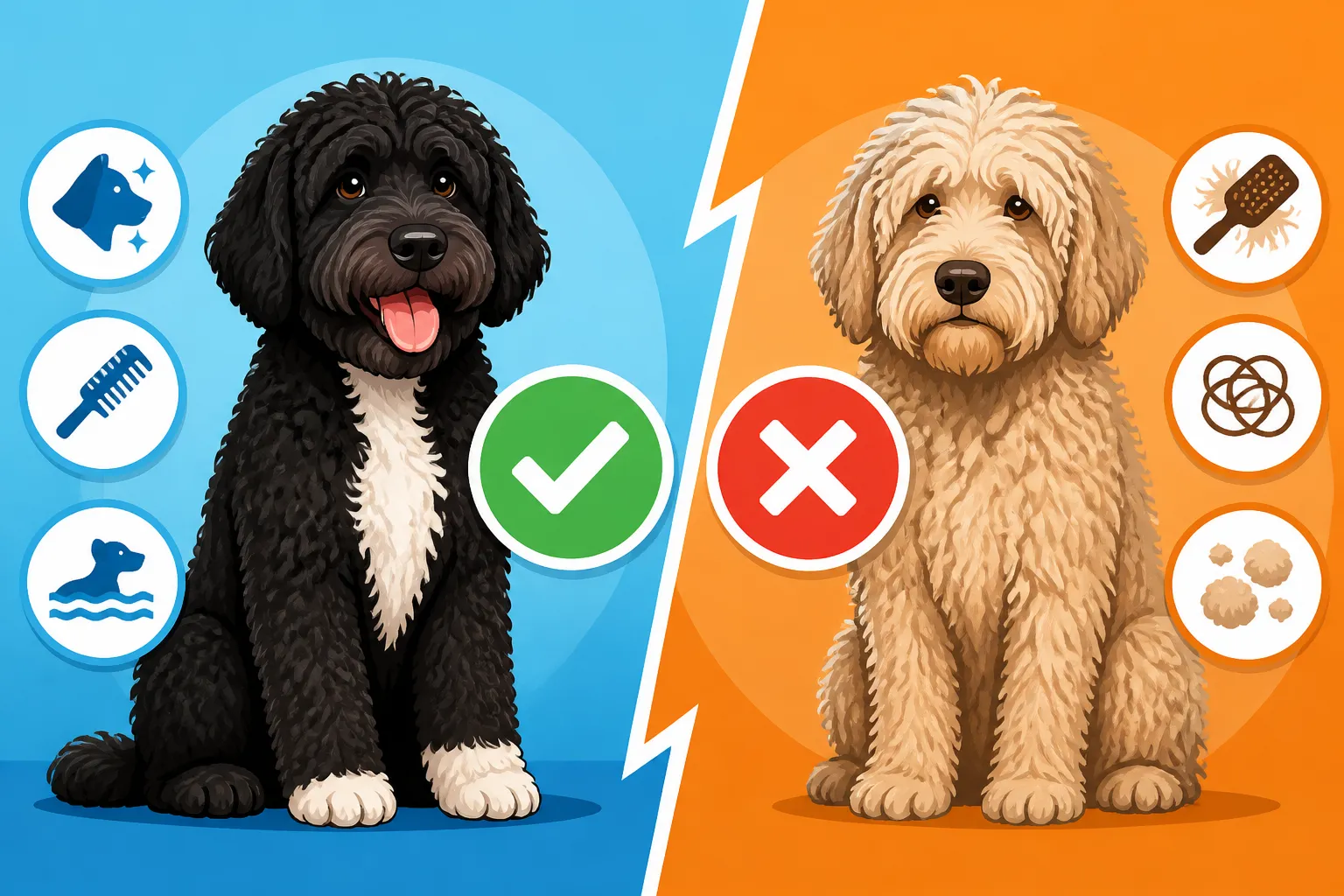
How Portuguese Water Dog Is Easier Than a Labradoodle
Choosing between a Portuguese Water Dog and a Labradoodle can feel surprisingly difficult: both may be curly-coated, clever, energetic companions, and neither comes with a low-maintenance guarantee. The useful difference is predictability. A Portuguese Water Dog is a recognized breed with a more consistent outline of size, coat, and temperament, while Labradoodles can vary widely. This guide explains where that consistency helps—and where it does not.
What “easier” means with these two dogs
A Portuguese Water Dog is more predictable, not automatically easier
A Portuguese Water Dog comes from an established breed with a written standard and a relatively consistent range of physical traits. You can generally make a more informed guess about its adult size, coat type, and working-dog tendencies by researching the breed and meeting its parents. Those traits still vary from dog to dog, but they are not quite the same guessing game as buying a cross whose parents may have very different characteristics.
A Labradoodle is a cross between a Labrador Retriever and a Poodle, but that label alone does not tell you exactly what the individual dog will be like. Labradoodles can vary in size, coat texture, shedding, energy, and inherited traits. Even puppies in the same litter may grow into noticeably different-looking adults. A careful breeder can explain a puppy’s parents and family history, but no label guarantees a particular coat or temperament.
That difference can make planning feel easier with a Portuguese Water Dog. You have a clearer breed profile to investigate before bringing one home. But predictability does not mean simplicity: a Portuguese Water Dog is an athletic, people-oriented working dog that needs grooming, training, activity, and company. For a broader look at its temperament and everyday fit, see What People Get Wrong About the Portuguese Water Dog.
Both can be active, intelligent, and demanding
Neither dog should be chosen on the assumption that a curly coat means a relaxed house pet. Portuguese Water Dogs were developed to work alongside fishing crews, and many still enjoy having something to do. They can be quick learners, but they may also improvise when a task is boring or a boundary is unclear. Labradoodles can inherit energy and enthusiasm from either parent breed, too, so their needs depend on the individual dog and its background.
In practical terms, “easy” often means the dog fits your actual week. If you have time for training, walks, play, grooming, and companionship, either dog may fit. If you are hoping for a dog that can entertain itself all day and needs little coat care, neither is a reliable bet. A Portuguese Water Dog’s working heritage is worth understanding before you commit; The Household a Portuguese Water Dog Was Built For explores what that background can mean at home.
It also helps to compare adult dogs rather than puppy photos. A tiny, fluffy puppy does not reveal how much exercise, training, or grooming the grown dog will require. Ask breeders or rescue organizations about the specific dog’s behavior, coat, and daily needs, and be honest about your own routine.
Coat care and allergy expectations
A recognized coat type still needs regular maintenance
Portuguese Water Dogs have either a curly or wavy coat, and both need ongoing care. Their coat can mat close to the skin, particularly behind the ears, under a collar or harness, and in areas that rub together. Brushing only the visible outer layer can leave tangles underneath, so a thorough routine matters more than a quick pass over the back.
Many owners keep the coat clipped to make home maintenance more manageable. That does not make grooming optional; it shifts the work. You still need to brush between appointments, check for mats, and keep the coat clean and dry after swimming or bathing. The amount of effort depends on coat length, texture, lifestyle, and how comfortable the dog is with handling. How a Curly Coat Differs From a Wavy Coat and Which Clip Suits a Pet Portuguese Water Dog can help you think through those choices.
Labradoodle coat care can be less predictable. Some have coats that are more Poodle-like, while others inherit a different texture or more shedding from their Labrador side. A dog with a coat that seems easy as a puppy may need a different routine as it matures. Before choosing one, ask to see the adult coats of close relatives if possible, and ask the breeder how they maintain them.
| Consideration | Portuguese Water Dog | Labradoodle |
|---|---|---|
| Coat expectation | Curly or wavy breed coat, though texture and care needs vary | Coat texture and shedding can vary depending on inherited traits |
| Grooming demands | Regular brushing and clipping are part of ownership | Regular brushing and professional grooming may also be needed |
| Predictability | More consistent breed profile, but individual coats differ | Coat outcomes can be harder to predict |
| Allergy expectations | No dog can be guaranteed allergy-safe | No dog can be guaranteed allergy-safe |
| Main planning question | Can you keep up with brushing, drying, and clipping? | Are you prepared for the coat your individual dog actually develops? |
Neither dog is a guaranteed hypoallergenic choice
People often look for a low-shedding dog because someone in the household has allergies. It is understandable to hope that a particular coat will solve the problem, but “hypoallergenic” does not mean allergy-proof. Reactions can be affected by an individual person, an individual dog, and the proteins found in skin flakes and saliva, not just the amount of loose hair around the house.
If allergies are a real concern, spend time around the specific dog or similar adult dogs before making a decision. A short visit may not predict how someone will react after living with a dog, but it is more informative than relying on a breed label. Discuss the situation with a healthcare professional, especially if symptoms are significant, and avoid treating a breeder’s assurance as a medical guarantee. Portuguese Water Dog or Labradoodle for Allergies offers a focused comparison of the question.
A household can also reduce some day-to-day mess with regular cleaning, washable bedding, and a consistent grooming routine, though those steps cannot promise that symptoms will disappear. If you are organizing supplies for brushing and cleanup, Chewy may be one place to compare grooming tools and washable bedding; check that any brush suits the dog’s coat and that the dog is comfortable with it.
Training, exercise, and life at home
Portuguese Water Dogs often need both movement and a job
A Portuguese Water Dog may be physically capable of a lively walk, swim, or game of fetch, but exercise is only part of the picture. Many also benefit from short training sessions, scent games, retrieving practice, or other activities that ask them to think. Without enough engagement, a dog may invent its own entertainment—such as carrying off household objects, barking for attention, or turning a quiet afternoon into a negotiation.
That does not mean every Portuguese Water Dog needs competitive sport or a waterfront home. It does mean owners should have a plan for regular activity and interaction. A walk combined with a few minutes of training or a search game may be more satisfying than simply letting the dog run around a yard. Learn more about the breed’s work-driven tendencies in A Portuguese Water Dog Was Bred to Work a Boat, Not a Yard.
Labradoodles can also be energetic, social, and bright. A Labrador-influenced dog may enjoy retrieving and active play, while Poodle traits can bring quick learning and a need for mental challenges. But crossbreeding does not guarantee a balanced blend or a calmer companion. Ask about the puppy’s parents and observed behavior, then prepare to adjust your exercise plan as the dog grows. Both dogs need training that is consistent and kind, especially around greetings, recall, settling, and being left alone.
Training ease depends on the individual dog and the household
A smart dog is not always an easy dog to train. Intelligence can mean fast learning, but it can also mean the dog notices when a rule changes or finds a more rewarding option. Portuguese Water Dogs often respond well to engaging, reward-based training, but repetition without purpose may lose their interest. Keep sessions clear, short enough to stay productive, and rewarding for the behavior you want.
Labradoodles also vary. Some may be eager to work with people; others may be more distractible, independent, or excitable. Early socialization and predictable routines help either dog learn how to behave around visitors, other dogs, children, and everyday household activity. A puppy class or qualified trainer can be especially useful if you are new to raising a high-energy dog.
Think about your own habits, too. If everyone in the home uses different cues or allows different rules, both dogs may become confused. A simple shared plan—such as one cue for recall, a consistent greeting routine, and a designated place to settle—can make day-to-day life easier. For a closer look at the breed’s independent streak, see Training a Portuguese Water Dog That Was Bred to Think for Itself.
Choosing responsibly and deciding which fits you
Compare the individual dog, not just the breed name
When speaking with a Portuguese Water Dog breeder, ask about health testing, the parents’ temperaments, grooming needs, and how the puppies are raised. Request documentation rather than relying on a general statement that the parents are healthy. A breeder should be willing to explain what tests were done and what the results mean. What a Portuguese Water Dog Club's Health Program Covers is a useful topic to explore as you learn what responsible breed health practices involve.
For a Labradoodle, ask equally specific questions about both parent dogs, their health history, and the characteristics the breeder is trying to produce. Ask how the breeder evaluates coat type and shedding, while remembering that those predictions are not guarantees. A seller who promises a certain adult size, coat, or allergy outcome without explaining the uncertainty deserves careful scrutiny.
If you are considering adoption, ask the rescue or shelter what is known about the dog’s behavior, medical background, and grooming tolerance. An adult dog may offer a clearer view of its size and coat than a puppy, although its history may be incomplete. Take time to meet the dog more than once if possible and discuss how it behaves when excited, alone, or around people and other animals.
Use your routine as the final test
A Portuguese Water Dog may be the more straightforward choice if you want a recognized breed with a more predictable physical profile and are ready for an athletic, involved companion. A Labradoodle may suit you if you are open to more variation between individuals and can assess the particular dog rather than choosing based on the crossbreed label alone. Neither is automatically easier in every home.
Before deciding, picture an ordinary weekday, not just the fun parts. Who will exercise the dog when the weather is unpleasant? How will you manage brushing when you are tired? Can the dog be alone for the stretches your schedule requires, and what training or care arrangements will support it? If swimming is part of your plan for a Portuguese Water Dog, remember that water activities bring extra drying and ear-care routines as well as fun. Drying a Portuguese Water Dog After Every Swim and Why a Portuguese Water Dog's Ears Need Checking Every Week cover two details new owners sometimes underestimate.
Make a realistic checklist:
- Grooming: Are you prepared for regular brushing and professional or home clipping?
- Activity: Can you provide daily movement and mental engagement?
- Training: Will everyone in the household follow the same basic rules?
- Time alone: Do you have a plan for companionship and gradual alone-time practice?
- Allergies: Has the household spent time with the specific dog, and have health concerns been discussed with a professional?
- Individual fit: Have you met the dog or its parents and asked detailed questions about temperament and health?
Chewy can be useful for comparing practical items such as combs, grooming supplies, and washable dog bedding, but buying equipment is only one small part of the commitment. Choose tools that suit the dog you bring home, and ask a groomer or veterinarian if you are unsure what is appropriate. A Portuguese Water Dog may be more predictable than a Labradoodle in some respects, but the best match is the individual dog whose care needs fit your household.
Disclaimer
This article is for general informational purposes only and does not constitute professional advice. Laws, prices and regulations vary by location and change over time. Consult a qualified professional for guidance on your specific situation.