How a Portuguese Water Dog Can Do Obedience Trials
Bringing home a Portuguese Water Dog is an absolute joy, but sometimes the sheer intelligence and independent nature of this incredible breed can make structured training feel like you're trying to outwit a furry, four-legged chess master. If you've ever dreamt of stepping into the obedience ring with your PWD, but worry about their tendency to "improvise" or lose interest, then this guide is for you. We're going to dive deep into how to channel that brilliant mind and boundless energy into a shining star of the obedience arena.
The Unique Challenge of Training a Portuguese Water Dog for Obedience
Portuguese Water Dogs are an exceptional breed, known for their sharp minds, boundless energy, and a distinctive independent streak that harks back to their working heritage on fishing boats. This isn't a breed bred to mindlessly obey; they were partners, problem-solvers, and collaborators with their human counterparts. This history makes them incredibly intelligent and capable, but it also means that traditional, rote obedience training methods might not always click, or worse, they might quickly lead to boredom and a lack of engagement. Understanding this inherent drive and how it influences their learning style is the first, crucial step toward success in obedience trials.
Understanding Their Independent Spirit and Drive
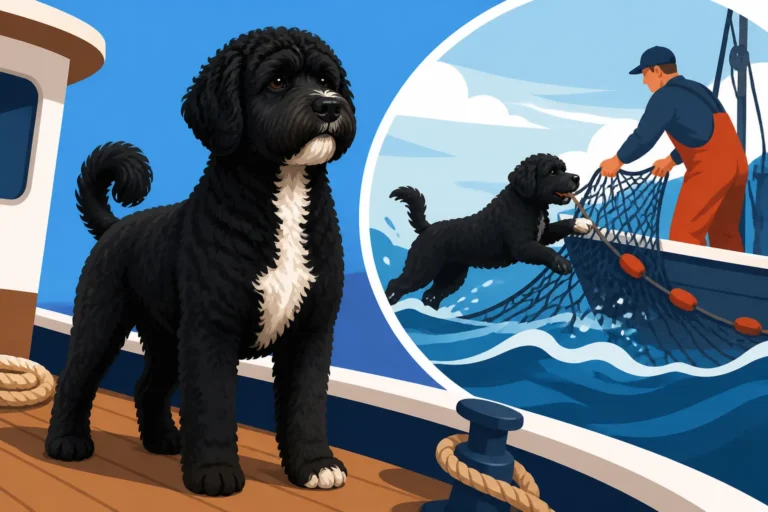
Imagine a Portuguese Water Dog on a fishing boat off the coast of Portugal, tasked with retrieving lost gear or driving fish into nets. They weren't waiting for a whistle for every move; they were making split-second decisions based on the ever-changing conditions of the sea. This explains why your PWD often seems to "think for themselves" or why they might offer a "better" solution to a command than the one you intended. Their intelligence isn't just about learning quickly; it's about active problem-solving. This means that while they can learn commands rapidly, maintaining their focus and precision in a repetitive trial setting requires more than just drilling. They crave mental stimulation, variety, and to feel like they are contributing to a task, not just performing a trick. It's a wonderful trait in many ways, but it certainly keeps you on your toes in a training class! Many owners find that understanding Training a Portuguese Water Dog That Was Bred to Think for Itself is key to unlocking their potential.
This independent spirit can manifest as a PWD that’s easily distracted in a busy trial environment, or one that decides to put its own spin on a stay command, perhaps by wiggling or offering a paw. It’s not defiance, but rather their brain working overtime, constantly assessing and re-evaluating the situation. They're also deeply bonded to their people, but that bond doesn't automatically translate to unquestioning obedience, especially if they perceive the task as redundant or uninteresting. This breed needs to feel like they are working with you, not just for you. When you hit a wall, it’s often about finding a new way to present the challenge, rather than repeating the same approach more forcefully.
The Importance of High-Value Motivation
Given their intelligent and independent nature, motivating a Portuguese Water Dog for obedience trials is paramount. They’re not usually dogs that will work just for the sake of it, or simply to please you if the task isn't stimulating enough. They need a reason to engage, and that reason typically involves something incredibly high-value to them. For many PWDs, this means food – not just any food, but truly irresistible treats like boiled chicken, cheese, or high-quality commercial soft treats. The smellier and softer, the better! Think of it as their paycheck for a job well done. You want them to feel like every correct response is a huge win. We explore this further in What Motivates a Portuguese Water Dog.
Beyond food, many Portuguese Water Dogs are deeply motivated by play, especially with toys. Their retrieving drive, honed by generations of working on boats, means a favorite squeaky ball or a sturdy tug toy can be an incredibly powerful reward. Integrating short bursts of play into training sessions, especially after a particularly challenging exercise, can reset their focus and keep their enthusiasm high. The trick is to use play as a reward, not just a distraction. So, a quick game of tug immediately after a perfect heel, then back to work, can be far more effective than just continuous treats. You might be surprised to see Which Toy a Portuguese Water Dog Will Work Hardest For if you experiment a bit.
The context and environment also play a huge role in their motivation. A PWD might perform perfectly in your quiet backyard but suddenly "forget" everything at a bustling dog club. This is where gradually increasing distractions and varying your training locations come in. Start small, add one new element at a time, and always keep your rewards high. Don't underestimate the power of praise and enthusiastic verbal cues either, but these usually work best in conjunction with tangible rewards, especially in the early stages or with difficult concepts. For training at home, tools like a hands-free treat pouch found on Amazon can make delivering rewards seamless and efficient.
Building the Core Skills for Obedience Success
Before you even think about stepping into an obedience trial ring, your Portuguese Water Dog needs a rock-solid foundation of basic commands and impeccable manners. This isn't just about memorizing "sit" or "stay" but building a deep understanding and reliable response even amidst distractions. Think of these foundational skills as the individual pieces of a complex puzzle that will eventually form the beautiful picture of a well-trained obedience dog.
From Puppyhood: Laying the Groundwork
The journey to obedience trials truly begins the moment you bring your Portuguese Water Dog puppy home. Early socialization is critical for PWDs, helping them become confident and resilient in new environments – crucial for the often-bustling atmosphere of trial grounds. Expose them positively to new sights, sounds, people, and other dogs, always ensuring these experiences are good ones. Puppy classes are an excellent way to start, not just for the commands taught, but for the controlled socialization and introduction to working in a group setting. For those seeking comprehensive guidance from the start, programs like BAXTER & Bella offer online resources that walk you through every step of puppy training, which can be invaluable. We have a dedicated article on The First Year With a Portuguese Water Dog Puppy which delves into all the aspects of their early development.
Beyond socialization, focus on positive reinforcement from day one. PWDs are sensitive dogs, and harsh corrections can easily shut them down, making them reluctant to offer behaviors or even affecting their willingness to work with you. Keep training sessions short, fun, and frequent, ending on a high note before your puppy gets bored or frustrated. Introduce a marker word like "yes!" or a clicker to precisely mark the exact moment they perform a desired action, followed immediately by a reward. This clarity helps them understand exactly what they're being rewarded for. Teach them to love learning, because that enthusiasm will carry them through more advanced training.
Mastering the Basics: Sit, Stay, Down, and Come
These are the building blocks of all obedience work, and for a Portuguese Water Dog, reliability is key. "Sit" and "Down" should be instant, fluid responses. Start in a quiet environment, lure the behavior with a treat, mark, and reward. Gradually add duration and distance to your "Stay" commands, always returning to your dog to reward them before releasing them. Don't rush this process; a solid stay needs to be bulletproof. Remember, PWDs have a clever way of finding loopholes or improvising, so practice these commands in various settings, indoors and out, with increasing levels of distraction. Your goal is for your PWD to perform these commands reliably even when there's an interesting smell or another dog nearby.
The "Come" or recall command is arguably the most important skill for any dog, especially an energetic breed like the PWD. Their independent nature and strong prey drive mean a reliable recall could literally save their life. Make coming to you the most rewarding thing ever. Start with short distances, lots of praise, and amazing treats. Never use "come" in anger or as a way to end fun; always associate it with positive experiences. Practice in a long line in a safe, open area, gradually letting out more line. You'll find that for this breed, keeping it positive and fun is the only way to ensure they come bounding back to you, eager for their reward. This responsiveness ties into How Trainable a Portuguese Water Dog Is and what makes them tick.
The Art of Heeling: Walking as One
Heeling, where your dog walks precisely beside you on a loose leash, is fundamental to obedience trials. For a Portuguese Water Dog, whose natural inclination might be to pull or explore, teaching a precise heel requires patience and consistent positive reinforcement. Start by teaching them to focus on you. Use a target stick or a high-value treat to keep their nose by your left knee. Mark and reward every step they take in the correct position. Break it down into tiny pieces: a step, a reward; two steps, a reward; turns, pauses, and changes of pace.
The challenge with PWDs in heeling is often maintaining their sustained attention. They'll give you bursts of brilliance, then their mind might wander. Keep sessions short and engaging. Incorporate fun games into your heeling practice to make it less monotonous. For example, suddenly speeding up or slowing down, or changing direction, can keep them on their toes and prevent them from zoning out. Using a comfortable, well-fitting flat collar or a front-clip harness can help manage their enthusiasm during practice walks before they truly understand the concept of heeling. Remember that How a Portuguese Water Dog Responds to Correction can vary, so gentle, consistent guidance is always better than harsh jerks.
Journeying Through Obedience Trial Levels
Once your Portuguese Water Dog has mastered the foundational skills, you might be ready to explore the exciting world of obedience trials. These events offer a fantastic way to bond with your PWD, challenge their intelligence, and showcase their capabilities. It’s a progression, with each level building upon the previous one, demanding increasing precision, control, and willingness to work off-leash amidst distractions.
Novice Class: Your First Steps into the Ring
The Novice class, often called Companion Dog (CD), is where most teams begin their obedience trial journey. It’s designed to test basic obedience skills performed on-leash and off-leash in a standardized setting. For your PWD, this means demonstrating reliable responses to commands like Heel (on and off-leash), Stand for Examination (where a judge will touch them), Recall (off-leash), and a group Sit-Stay and Down-Stay. The group stays are particularly challenging as your PWD will be alongside other dogs for several minutes, requiring serious focus and self-control.
The key to success in Novice with a PWD lies in consistent practice, proofing behaviors in diverse environments, and keeping them motivated. Remember, their intelligence sometimes leads them to "offer their own solutions" or improvise, so precision training is vital. Don't be discouraged if your first few trials are a learning experience; the atmosphere, the unfamiliar ring, and the judge can all be new distractions. Focus on making it a positive experience for your dog, with lots of encouragement and high-value rewards, even if they make a mistake. Building confidence in the ring is just as important as perfecting the commands. If you're wondering how they stack up, you might find insight in Where the Portuguese Water Dog Ranks for Obedience Intelligence.
Open and Utility Classes: Taking on Advanced Challenges
Once you've achieved your Companion Dog title, the Open class (Companion Dog Excellent, CDX) and then the Utility class (Utility Dog, UD) await, each presenting increasingly complex and challenging exercises. In Open, your PWD will perform off-leash heeling with changes of pace and direction, retrieve a dumbbell over a high jump and flat jump, do a drop on recall, and perform long, unassisted Sit-Stays and Down-Stays out of sight of the handler. This truly tests their reliability and your bond. The demands are much higher, as How Long a Portuguese Water Dog Will Work in a Session becomes a critical factor.
The Utility class is the pinnacle of obedience, requiring advanced skills, attention, and a deep understanding between dog and handler. Exercises include signal exercises (commands given only by hand signals), scent discrimination (finding your scent on a specific article among several others), directed retrieve, moving stand and exam, and directed jumping. These exercises demand incredible focus, precision, and problem-solving from your PWD, tapping into their natural intelligence in a very structured way. For example, the scent discrimination exercise really plays into their strong sense of smell and their natural drive to "find" things. Successfully navigating these levels means you've built an incredible partnership and refined your training methods to truly click with your PWD's unique mind.
Maximizing Your PWD's Potential in Obedience
Training a Portuguese Water Dog for obedience trials is a journey, not a destination. It requires dedication, but above all, a deep understanding of your dog's individual personality and learning style. With their intelligence and desire to work, PWDs can truly shine in the obedience ring, but it takes a thoughtful approach to keep them engaged and performing at their best.
Keeping Training Engaging and Fun
The biggest mistake you can make with a Portuguese Water Dog in obedience training is allowing it to become boring or repetitive. Because they are so smart, they pick up commands quickly, but then they can lose interest just as fast if there's no novelty. Vary your training routines, introduce new distractions gradually, and don't be afraid to teach fun tricks or engage in other dog sports like How a Portuguese Water Dog Can Do Agility to keep their minds sharp and bodies active. A PWD that is only doing repetitive obedience drills might soon become a PWD that "forgets" how to do a perfect heel.
Think like your PWD. What would make this exercise exciting for them today? Could you practice in a new location? Use a different, even higher-value treat? Or maybe finish a perfect recall with a lively game of tug? Keeping the energy positive and the atmosphere light is crucial. Avoid drilling the same exercise for too long; it's better to do several short, enthusiastic sessions than one long, tedious one. Always end on a successful note, even if it means simplifying the exercise slightly to ensure your dog finishes feeling good about their work. This is vital because What a Harsh Word Does to a Portuguese Water Dog's Water Work is true for all training—it can really set them back.
Overcoming Hurdles and Staying Persistent
You will encounter hurdles when training a Portuguese Water Dog for obedience trials. There will be days when your dog seems to have forgotten everything, or when they decide to investigate a blade of grass instead of heeling. This is normal! It's at these moments that your patience and persistence truly matter. Instead of getting frustrated, take a step back and analyze: Is my dog tired? Bored? Overstimulated? Under-exercised? Sometimes, the answer is as simple as a potty break or a good run before a training session, as How Much Exercise a Portuguese Water Dog Needs is always relevant.
If you hit a wall, break the exercise down into smaller components, go back to basics, or even take a short break from that particular skill. Seek guidance from experienced obedience trainers who understand intelligent, independent breeds. Sometimes a fresh perspective or a different technique is all it takes to click. Remember that PWDs thrive on having a "job," and obedience trials can provide that mental and physical outlet, but it needs to be framed in a way that respects their intelligence and their desire for collaboration. Keep learning, keep experimenting, and most importantly, keep nurturing that incredible bond you share. This long-term commitment is also why Why a Portuguese Water Dog Needs a Job is so important throughout their lives.
Here's a quick overview of the obedience trial classes:
| Class Name | Title Acronym | Key Requirements & Skills | Off-Leash Work | Focus for PWDs |
|---|---|---|---|---|
| Novice | CD | Heel (on/off-leash), Stand for Exam, Recall, Group Sit-Stay (1 min), Group Down-Stay (3 min) | Partial | Focus in new environments, sustained attention for stays, reliable recall. |
| Open | CDX | Off-leash Heeling, Drop on Recall, Retrieve Over High Jump, Retrieve Over Flat Jump, Broad Jump, Long Sit-Stay (3 min, out of sight), Long Down-Stay (5 min, out of sight) | Mostly | Precision heeling, confident retrieving over jumps, extended focus out of sight. |
| Utility | UD | Signal Exercises, Scent Discrimination (find handler's article), Directed Retrieve, Moving Stand and Exam, Directed Jumping | Full | Advanced mental work, subtle communication, independent problem-solving. |
Disclaimer
This article is for general informational purposes only and does not constitute professional advice. Laws, prices and regulations vary by location and change over time. Consult a qualified professional for guidance on your specific situation.