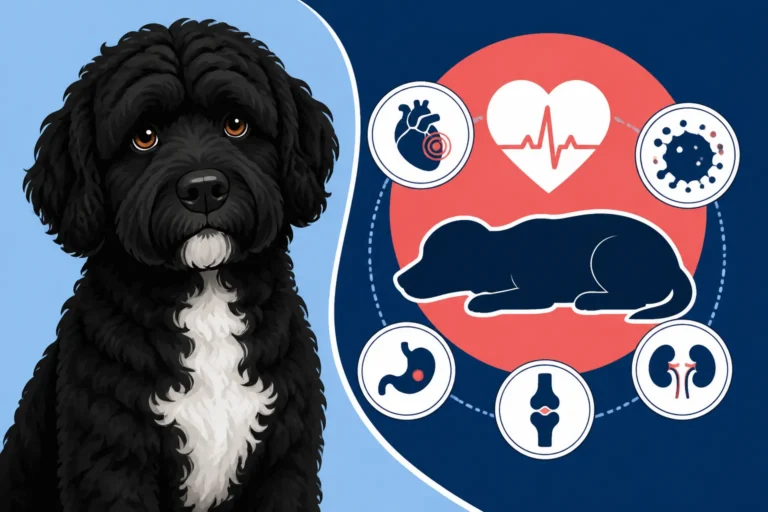
What Juvenile Dilated Cardiomyopathy Does to a Portuguese Water Dog
It's absolutely heartbreaking to think about a vibrant, playful Portuguese Water Dog puppy suddenly succumbing to a devastating illness. One of the most cruel diseases that can strike these beautiful dogs is Juvenile Dilated Cardiomyopathy (JDCM), a condition that often gives no warning and progresses with terrifying speed. This guide is here to help you understand exactly what JDCM does to a Portuguese Water Dog, how it manifests, and why awareness and responsible breeding are so incredibly vital.
Understanding Juvenile Dilated Cardiomyopathy (JDCM) in Portuguese Water Dogs
When you bring home a Portuguese Water Dog puppy, you envision years of happy, active companionship. The last thing on your mind is a sudden, fatal heart condition. Yet, for some unfortunate puppies, Juvenile Dilated Cardiomyopathy (JDCM) becomes a tragic reality. This inherited disease specifically targets the heart muscle, turning a healthy, robust heart into a weak, inefficient pump in a matter of weeks or months. It’s a truly insidious condition because it often lurks silently until it’s too late.
What is JDCM and How Does it Affect the Heart?
At its core, JDCM is a severe form of dilated cardiomyopathy that manifests in very young dogs. Unlike adult-onset dilated cardiomyopathy, which usually affects larger breeds later in life, JDCM is unique to Portuguese Water Dogs and strikes during their puppyhood. What happens is that the heart muscle, particularly the left ventricle, becomes stretched and thin. Think of a balloon that's been overinflated multiple times – it loses its elasticity and can no longer contract effectively. This weakened muscle struggles to pump blood throughout the body, meaning vital organs don't receive the oxygen and nutrients they desperately need.
The heart literally dilates, or enlarges, trying to compensate for its inability to push blood out with sufficient force. This compensatory mechanism is ultimately futile and leads to a vicious cycle of further weakening and enlargement. The valves inside the heart can also become leaky because the heart chambers are so stretched, allowing blood to flow backward, further reducing efficiency. It’s a catastrophic failure of the cardiovascular system that a puppy's small body simply cannot overcome.
The Devastating Rapid Progression of JDCM
One of the most terrifying aspects of JDCM is its incredibly rapid and often silent progression. Many owners report that their puppy seemed perfectly normal, full of energy and mischief, just days or even hours before symptoms became severe. There's no long, drawn-out illness with noticeable decline; it's an abrupt and brutal onslaught. A puppy might be playing exuberantly one moment and then suddenly collapse or show severe distress. This sudden onset is what makes JDCM so heartbreaking and difficult to anticipate.
The disease quickly progresses to congestive heart failure. This means fluid starts to back up, typically in the lungs, leading to breathing difficulties. The puppy's body is effectively drowning from the inside out due to its failing heart. This rapid deterioration leaves little to no time for intervention, and often, by the time a puppy exhibits overt signs, the damage is irreversible and extensive. It's not a gradual decline; it's more like a sudden, unexpected cliff edge that these innocent pups fall right over.
Recognizing the Subtle, Yet Cruel, Signs of JDCM in Puppies
The challenge with JDCM, and why it's so heartbreaking for owners, is that the initial signs are often incredibly subtle or easily mistaken for normal puppy behavior. A puppy might appear a little less energetic than usual, but who hasn't seen a puppy crash after a vigorous play session? This insidious nature means that by the time you're truly concerned, the disease has often reached an advanced stage.
Why Early Symptoms are So Often Missed
Imagine a Portuguese Water Dog puppy, full of zest, exploring the world with boundless energy. If this puppy has JDCM, those early, critical signs can be incredibly easy to overlook. A slight decrease in playfulness might be attributed to a growth spurt or just being a bit tired. A puppy might sleep a little more, but puppies sleep a lot anyway! They are masters at appearing fine, especially when they are so young and their natural instinct is to be active and curious. This makes it agonizing for owners who feel guilty for not noticing sooner, but the reality is that the disease masks itself well in its initial stages.
The non-specific nature of these early symptoms is precisely what makes JDCM so dangerous. Things like a slightly reduced appetite could be a picky phase, or even mild stomach upset. A little coughing might be mistaken for gulping water too fast. Without a heightened awareness of JDCM, these subtle clues can easily slip by, as they don't immediately scream "life-threatening heart disease." Owners might wait a day or two to see if the puppy "snaps out of it," losing precious time when the disease is already doing catastrophic damage. This stealthy progression is why many families only realize something is terribly wrong when their beloved pup is in acute distress. For more details on this, you might find Whether a JDCM Puppy Looks Normal Beforehand particularly insightful.
The Critical Signs to Watch For
While early signs are subtle, as the disease progresses, more critical and alarming symptoms will emerge. Unfortunately, these often signal that the heart is severely compromised. Look out for persistent lethargy or an unwillingness to play that goes beyond normal puppy tiredness. A healthy PWD puppy is typically a dynamo, so a noticeable and consistent drop in energy is a red flag. Difficulty breathing, often characterized by rapid, shallow breaths, or an increased effort to breathe (you might see their belly muscles working hard) is a serious concern. They might also develop a cough, particularly if fluid is accumulating in their lungs.
Other worrying signs include a reduced appetite or a complete refusal to eat, which leads to poor growth compared to their littermates. Their gums might appear pale or bluish, indicating a lack of oxygen in their blood. Some puppies might even collapse or faint, especially after exertion. While these signs can be indicative of many different health issues, in a Portuguese Water Dog puppy, they should immediately raise concerns about JDCM. If you observe any of these, contact your veterinarian immediately. Time is absolutely of the essence. It’s a tragic race against the clock. For a comprehensive list of what to watch for, check out Signs a Portuguese Water Dog Puppy Has JDCM.
Here's a quick comparison of normal puppy behavior versus potential JDCM symptoms:
| Behavior/Symptom | Normal Puppy Behavior | Potential JDCM Symptom |
|---|---|---|
| Energy Level | Bursts of intense play, followed by deep naps. | Persistent low energy, unwillingness to play, overall lethargy. |
| Appetite | Enthusiastic eating, occasional pickiness. | Consistently poor appetite, significant weight loss or failure to thrive. |
| Breathing | Quiet, relaxed breathing at rest; panting after play. | Rapid, labored breathing (dyspnea), noticeable effort, open-mouthed breathing at rest. |
| Coughing | Rare, might happen if they swallow too fast. | Frequent, persistent cough, especially after exertion. |
| Gum Color | Healthy pink. | Pale, whitish, or bluish gums (cyanosis). |
| Activity during play | Chasing, wrestling, running, retrieving. | Stops frequently, easily winded, avoids strenuous play, collapses. |
The Genetic Basis and Inheritance of JDCM
The crucial aspect of JDCM that allows us to fight against it is its genetic nature. This isn't a random illness; it's passed down through specific genes within the Portuguese Water Dog population. Understanding this inheritance pattern is paramount for responsible breeding and, ultimately, for eradicating the disease from the breed.
Autosomal Recessive Inheritance: A Crucial Understanding
JDCM is inherited in an autosomal recessive pattern. This means that for a puppy to develop JDCM, it must inherit two copies of the defective gene – one from its mother and one from its father. If a dog inherits only one copy of the gene, it is considered a "carrier" but will not show any symptoms of the disease itself. Carriers are perfectly healthy dogs, which is why the disease can persist unknowingly in breeding lines without proper testing. Imagine a scenario where two healthy-looking Portuguese Water Dogs, both carriers of the JDCM gene, are bred together. Each puppy in that litter has a 25% chance of inheriting two copies of the gene and thus being affected by JDCM, a 50% chance of being a carrier like its parents, and a 25% chance of being completely clear of the gene. This statistical reality is why diligent genetic screening is non-negotiable for ethical breeders. This inheritance pattern is a key piece of information for breeders when considering How JDCM Is Inherited in Portuguese Water Dogs.
The heartbreaking part is that carrier parents are completely unaware they hold the potential for this devastating disease unless they are tested. They are often robust, healthy dogs, active in sports, and wonderful companions, showing no outward signs of the genetic time bomb they carry. This is precisely why relying solely on a dog's health appearance isn't enough in breeding. It truly highlights the 'hidden' danger of recessive genes that only manifest when the right (or rather, wrong) combination occurs.
The Role of DNA Testing in Preventing JDCM
Fortunately, thanks to dedicated research and the efforts of organizations like the Orthopedic Foundation for Animals (OFA) and the American Kennel Club (AKC) Canine Health Foundation, a highly accurate DNA test is available for JDCM. This test allows breeders to determine if a dog is "Clear" (meaning it doesn't carry the gene), a "Carrier" (carries one copy but is not affected), or "Affected" (carries two copies and will develop the disease). The availability of this test has been a game-changer for the Portuguese Water Dog breed. You can learn more about where these tests are performed by looking into Where the Portuguese Water Dog JDCM Test Is Run.
Responsible breeders meticulously test all their breeding stock before any mating takes place. The golden rule is to never breed two carriers together. By breeding a "Clear" dog to another "Clear" dog, all puppies will be clear of the JDCM gene. If a breeder chooses to use a "Carrier" in their breeding program (perhaps because the dog possesses other exceptional qualities important to the breed standard, like temperament or structure), they must only breed that carrier to a "Clear" dog. In such a pairing, statistically, half the puppies will be carriers, but none will be affected by JDCM. The puppies identified as carriers can then be used in future breeding programs, again, only ever paired with a "Clear" partner. This strategy gradually reduces the frequency of the gene in the breed without losing valuable genetic diversity from the carriers. The genetic test has truly revolutionized the approach to JDCM, giving breeders the power to prevent this tragedy.
The Heartbreaking Reality: Prognosis and Treatment for JDCM
If JDCM is diagnosed in a Portuguese Water Dog puppy, the reality is incredibly grim. This is not a condition where optimistic outcomes are common, and preparing for the worst is unfortunately the most realistic approach for families facing this diagnosis.
Why Treatment is So Challenging
The brutal truth about JDCM is that there is no effective treatment or cure. Once the disease takes hold and the heart muscle begins its rapid deterioration, medical interventions are largely unsuccessful in altering the course of the disease. Veterinarians can attempt to manage the symptoms of congestive heart failure, using medications such as diuretics to reduce fluid buildup in the lungs or drugs to help the heart beat more effectively. However, these are palliative measures, designed to provide comfort rather than to reverse the underlying pathology. They might offer a brief reprieve, but they do not stop the relentless progression of the heart failure. You might wonder Whether Any Treatment Helps a Portuguese Water Dog With JDCM, and sadly, the answer is often disappointing.
The speed at which the disease progresses in puppies means that by the time a diagnosis is made, the heart is already extensively damaged. Unlike some other forms of heart disease that can be managed for years, JDCM's aggressive nature leaves little room for sustained medical intervention. The puppy's small body, combined with the severity of the heart muscle weakening, means that even advanced veterinary care often cannot stem the tide. It's a devastating diagnosis that leaves both owners and veterinary professionals feeling helpless.
The Short Lifespan of an Affected Puppy
The prognosis for a Portuguese Water Dog puppy diagnosed with JDCM is, without exaggeration, devastating. The vast majority of affected puppies will not live past six months of age, and many succumb much earlier, often between 4 and 16 weeks. This incredibly short lifespan adds to the immense grief and shock for families. One day, you have a seemingly healthy, energetic puppy, and the next, you are facing the unimaginable loss of a young life. This tragic reality underscores just The Age JDCM Kills a Portuguese Water Dog.
The rapid death is often due to acute heart failure, arrhythmia (irregular heartbeats), or sudden collapse. There is generally no opportunity for long-term care; the disease simply doesn't allow it. For an owner, this means navigating an intense period of bonding with a puppy only to have that joy abruptly shattered. It's a stark reminder of the fragile nature of life and the immense responsibility breeders carry to prevent such tragedies. Knowing How Quickly a Portuguese Water Dog Puppy Dies of JDCM highlights the urgent need for genetic testing.
The Impact of JDCM on the Portuguese Water Dog Breed
While JDCM is a devastating individual tragedy, its existence has a broader impact on the entire Portuguese Water Dog breed. It serves as a powerful reminder of the importance of ethical practices and collective responsibility within the breeding community.
Breeding Practices and Ethical Responsibilities
The presence of JDCM in the Portuguese Water Dog breed places a significant ethical burden on breeders. The clear availability of a genetic test means there is no longer an excuse for unknowingly breeding affected puppies. Reputable, responsible breeders consider health testing, including for JDCM, to be a fundamental part of their breeding program. They understand that their responsibility extends beyond producing beautiful puppies; it includes ensuring the long-term health and well-being of the breed itself. This means openly sharing health test results, being transparent about their lines, and carefully planning matings to avoid producing affected puppies. You can often find breeders registered with clubs like the Portuguese Water Dog Club of America (PWDCA) who prioritize these health clearances. They are committed to reducing the incidence of genetic diseases like JDCM, Progressive Retinal Atrophy (PRA), and GM1 Gangliosidosis through careful selection and testing. It really emphasizes why you need to know What a Portuguese Water Dog Breeder Should Have Tested.
The ethical responsibility also extends to how breeders manage carrier dogs. While it's ideal to breed only "Clear" dogs, sometimes a "Carrier" possesses exceptional qualities that make them valuable to the gene pool. In such cases, the ethical breeder will only breed that carrier to a "Clear" dog, ensuring no affected puppies are produced and carefully tracking the carrier status of the offspring. This approach maintains genetic diversity while actively working to reduce the gene's presence in future generations. The long-term goal for the breed is to eliminate JDCM entirely, and this relies heavily on every breeder adhering to these strict ethical guidelines. This is how the breed is slowly working towards Whether JDCM Has Been Bred Out of Portuguese Water Dogs.
Supporting Research and Awareness
Beyond breeding practices, the fight against JDCM also relies on ongoing research and broad awareness within the Portuguese Water Dog community and among prospective owners. Organizations like the AKC Canine Health Foundation and breed-specific clubs often fund research into genetic diseases, and supporting these efforts is crucial. Every donation, every volunteer hour contributes to a deeper understanding of these conditions and the development of new tools or treatments, even if JDCM's prognosis remains poor.
For prospective Portuguese Water Dog owners, awareness is your best defense. Don't be afraid to ask breeders tough questions about health testing. Ask to see the DNA results for both parents for JDCM and other known conditions. A reputable breeder will be happy to provide this documentation and discuss their health screening protocols. Remember, a healthy puppy comes from parents who have been thoroughly screened. It’s also wise for owners to consider pet insurance, like plans from Healthy Paws, from the moment they bring a puppy home. While JDCM might be considered a pre-existing condition if signs emerge early, being prepared for other potential health challenges throughout your dog's life is always a smart move. Having a plan for the unexpected can alleviate significant financial stress during an already difficult time. By being informed, asking the right questions, and supporting responsible practices, we can all contribute to a healthier future for the Portuguese Water Dog.
Disclaimer
Please remember that the information provided in this article is intended for educational purposes only and should not be taken as veterinary advice. Always consult with a qualified veterinary professional for any health concerns or before making any decisions about your pet's care.