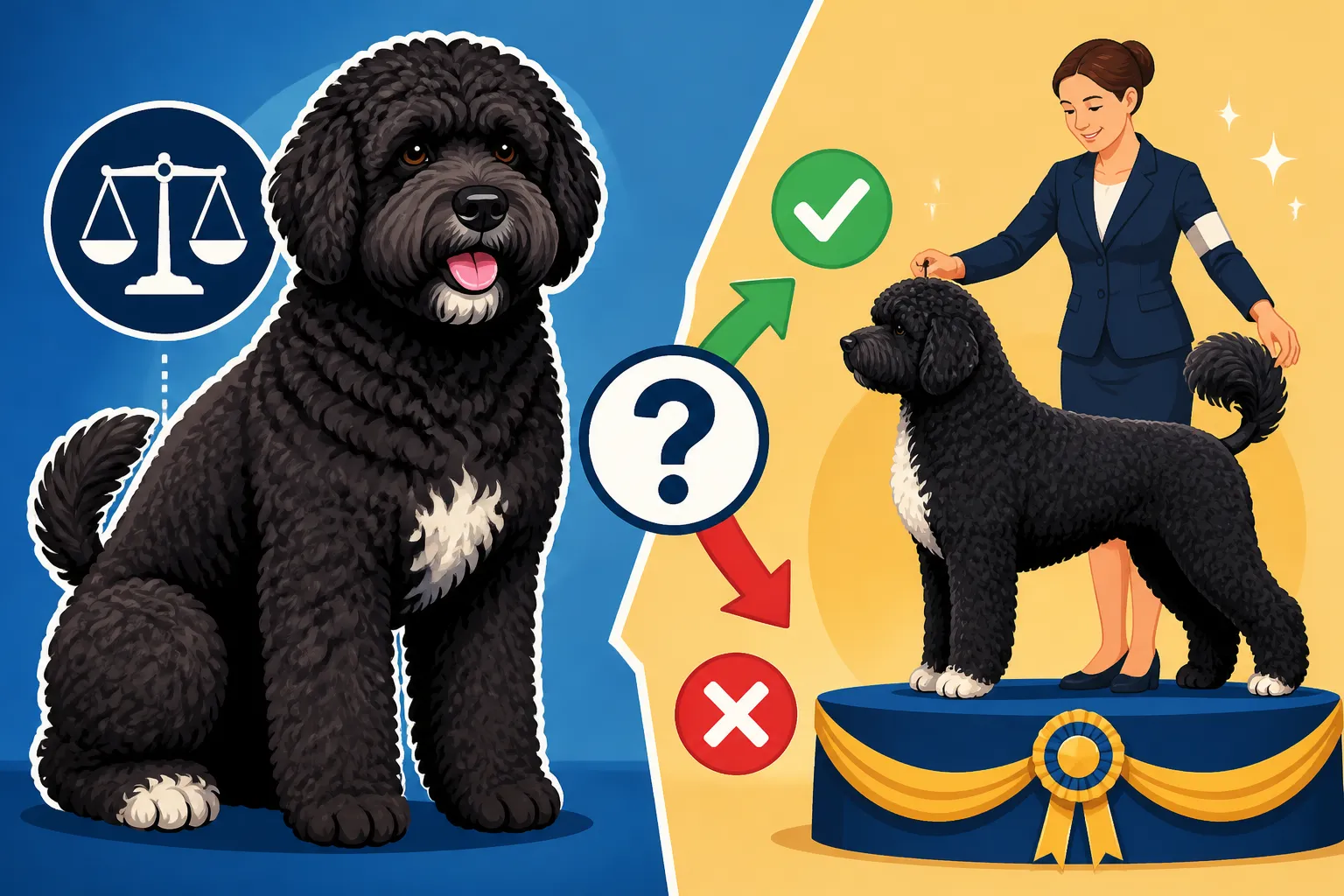
Whether an Oversized Portuguese Water Dog Can Be Shown
A Portuguese Water Dog can look oversized because of a long coat, a sturdy build, or simply being taller than the dogs you usually see. But appearance and show eligibility are not the same thing. This guide explains how conformation standards define height, when an oversized dog may be disqualified, and what other options are available if your dog falls outside the standard.
What oversized means in the show ring
For conformation shows, “oversized” usually refers to a dog whose measured height falls outside the limits in the breed standard—not a dog that merely looks big or weighs more than another Portuguese Water Dog. The applicable standard depends on the country and the organization holding the event, so check the rules for the specific show you have in mind.
In the American Kennel Club standard, the height limits differ by sex. A dog above the stated maximum is outside the standard’s permitted range. That matters because conformation judging is meant to assess how closely a dog matches the written description of its breed, not simply whether the dog is healthy, athletic, or appealing.
Height limits are different for males and females
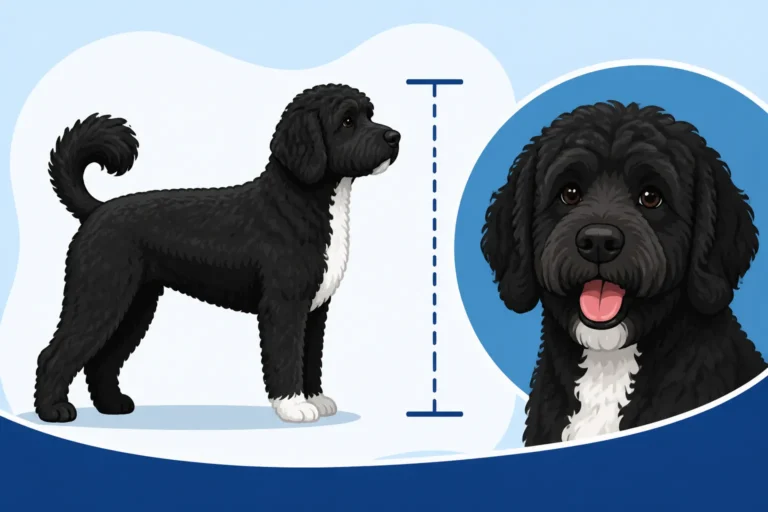
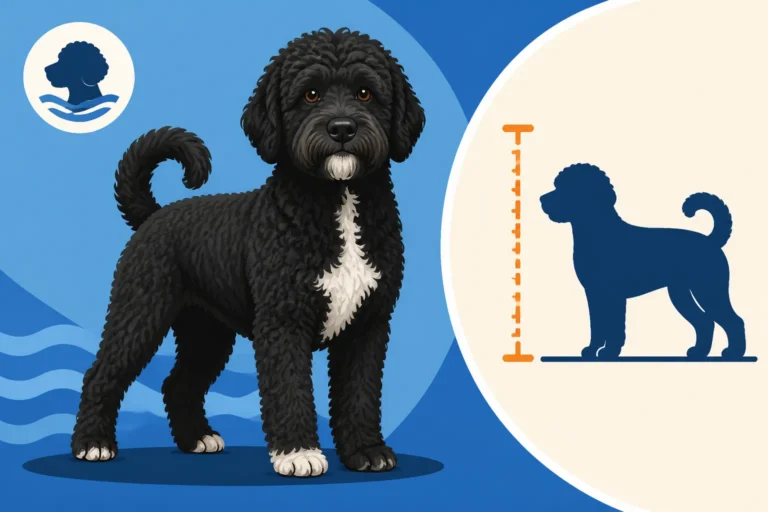
Under the AKC Portuguese Water Dog standard, males are expected to stand from 20 to 23 inches at the withers, while females are expected to stand from 17 to 21 inches. The withers are the highest point of the shoulders, where the neck meets the back. The standard identifies heights beyond those ranges as grounds for disqualification in AKC conformation.
That means an adult male measured above 23 inches or an adult female measured above 21 inches may not be eligible to compete in an AKC conformation class. It is the official measurement, not a breeder’s estimate or a casual measurement at home, that matters in the show setting.
If you are trying to judge your dog’s likely eligibility, start with What Height the Portuguese Water Dog Standard Asks For. It helps to keep the sex-specific limits in view rather than relying on a general impression such as “he’s a big one.” A dog can look tall beside a smaller housemate and still fall within the standard.
Weight alone does not automatically make a dog oversized
A heavy Portuguese Water Dog is not necessarily too tall for conformation. Weight and height are related, but the standard describes a dog that is well-proportioned and strong without being coarse or cumbersome. A dog might be heavier than the usual range for its sex and still measure within the height limits; another dog might be lean but stand above the maximum.
A thick coat can also make a dog appear larger than it is. A long topknot, full furnishings, or an untrimmed coat may change the outline you see in the living room, but the judge is evaluating the dog’s structure and measuring height where required. The coat cannot make a dog’s bones shorter or taller, though it can make visual estimates unreliable.
For a fuller explanation of body size and proportion, see What Weight a Portuguese Water Dog Should Fall In and What a Correct Portuguese Water Dog's Outline Looks Like. They’re useful context, but don’t treat a weight figure as a substitute for an actual height measurement or the rules of the show you want to enter.
Show rules can differ between countries and organizations
The AKC standard is relevant to AKC conformation shows in the United States. Other national kennel clubs and show organizations may use different wording, measurement systems, or procedures. A dog that falls outside one organization’s range may be treated differently elsewhere, so avoid assuming that a single answer applies to every show ring.
Before planning an entry, identify the registry and the specific event. Ask the show secretary, the relevant kennel club, or a knowledgeable Portuguese Water Dog breeder how that organization handles size. The comparison in How Portuguese Water Dog Standards Differ Between Countries can help explain why a dog’s eligibility may depend on where it is being shown.
| Question | Why it matters | What to check |
|---|---|---|
| Which organization is running the show? | Breed standards and procedures may vary | The event listing and registry rules |
| Is the dog fully grown? | A young dog’s final height may not be settled | Age, development, and advice from your veterinarian or breeder |
| What is the dog’s measured height? | Visual estimates can be misleading | Measurement at the withers using the show’s procedure |
| Is the concern height or weight? | Height limits are not the same as a weight guideline | The exact wording of the breed standard |
| Is the event conformation or performance? | Different event types judge different things | The event’s eligibility and class rules |
How a Portuguese Water Dog is measured
If you suspect your dog may be close to the upper limit, a careful measurement is more useful than guessing from photographs. A dog’s stance, a sloped floor, a lifted head, or a thick coat can affect an at-home reading. The official show process may also use equipment and procedures that are not identical to what you try in your kitchen.
Measure at the withers, not the top of the head
Height is measured from the ground to the withers, not to the top of the head, ears, or coat. The dog needs to stand naturally on a level surface, with its legs placed in a stable position. If the dog is hunched, stretched awkwardly, or shifting its weight, the result may not be dependable.
At home, you can get a rough idea by asking someone to help keep your dog standing square while you use a proper measuring tool. But treat that as a preliminary check, not an official determination. A small measuring error matters most when the dog is close to a limit, and it is easy to misread the shoulder point through a dense coat.
If the height estimate is near the maximum, ask an experienced breeder, handler, or club representative about the right way to get a more reliable measurement. A show official can explain how measurement is handled at that event. Don’t try to force your dog into a position that makes the reading look smaller; it will only add stress and won’t answer the eligibility question.
Consider age and growth before drawing a conclusion
A puppy or adolescent is not necessarily at its final height. Young dogs grow at different rates, and a rough measurement made during a growth spurt does not tell you precisely where the dog will finish. A veterinarian can discuss your dog’s growth and overall development, while a breeder may be able to explain the size patterns in the dog’s family.
If you have a puppy, it is sensible to focus on healthy development and enjoyable training rather than treating show eligibility as settled. A dog that is close to a height limit may need to mature before you can know whether the concern is real. Likewise, don’t restrict food or exercise in an attempt to alter a dog’s adult height; that risks harming the dog without providing a responsible way to change its genetic size.
A breeder’s estimate can be helpful background, but it is not a promise. Even puppies from the same litter can mature into dogs with different builds. For questions about responsible breeding and the traits breeders evaluate, What Portuguese Water Dog Owners Wish They Had Known offers broader context about the breed and the decisions that come with owning one.
A judge’s measurement is the one that affects entry
A measurement taken at home can help you decide whether to ask more questions, but it does not replace the show’s official process. If a judge or designated official measures a dog and finds it outside the applicable standard, the show’s rules determine what happens next. Don’t assume that a breeder’s measurement, a veterinarian’s chart, or a previous measurement at another event settles the issue for every competition.
If there is a disagreement or you are unsure how a result is handled, ask the event staff to explain the procedure and any available steps. Keep the conversation practical and respectful. A measurement is about applying the show rules; it is not a judgment of your dog’s value or the care you provide.
What happens if your dog is too tall for conformation
If an adult dog exceeds the maximum height in the applicable standard, that can mean the dog is disqualified from conformation competition under that organization’s rules. It does not mean the dog is unhealthy, badly bred, or less deserving of a full life. It means the dog does not meet one criterion used to assess breeding stock in that particular ring.
There usually is not a special oversized class
People sometimes hope there is a separate class where larger examples of the breed can compete. In ordinary conformation, the purpose is to compare dogs with the breed standard, so a class for dogs that exceed a disqualifying limit is not generally a workaround. Check the rules for the event rather than relying on hearsay, especially if you are entering a show organized outside the United States.
A dog can also be large without being over the height limit. Judges evaluate more than one feature, including structure, movement, balance, coat, and overall type. Size is one part of the standard, not a shortcut for judging the entire dog. Other structural or presentation issues may affect a dog’s evaluation too, as described in Which Faults Judges Penalize in a Portuguese Water Dog.
Being disqualified from conformation does not close every door
Conformation is only one kind of dog event. Depending on your dog’s temperament, training, health, and interests, you might explore obedience, rally, scent work, agility, or water-related activities. Those events test different skills and usually do not ask a dog to match the breed’s conformation standard in the same way.
Before entering any event, read its eligibility rules. A dog may need to be registered or listed with the relevant organization, and requirements can differ between activities. A local kennel club or Portuguese Water Dog club can point you toward beginner-friendly classes, while a qualified trainer can help you decide what is appropriate for your individual dog.
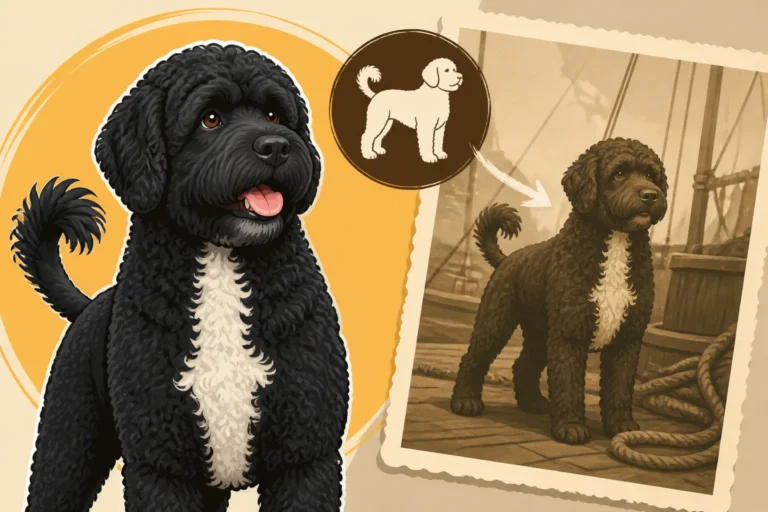
The breed’s working history makes activities involving cooperation and retrieving an appealing option for many dogs, but no sport is mandatory. Some Portuguese Water Dogs love water; others are more interested in toys, food puzzles, or training games on land. If performance events sound like a better fit than the show ring, What a Portuguese Water Dog Did for a Fishing Crew provides a useful look at the breed’s traditional working role.
Size is not a verdict on health or quality of life
A taller-than-standard dog can still be affectionate, capable, and healthy. A conformation disqualification is not a medical diagnosis. If you have concerns about your dog’s joints, weight, stamina, or growth, discuss those separately with your veterinarian. The dog’s day-to-day health should not be inferred from whether it qualifies for a class.
Likewise, don’t use a dog’s height by itself to make assumptions about exercise needs or feeding. A dog’s activity level, body condition, age, and health all matter. You should be able to feel the ribs without pressing hard, but your veterinarian can help assess whether your dog is at a healthy weight beneath the coat.
It’s also worth remembering that “oversized” is not the same as a distinct miniature or giant variety. Portuguese Water Dogs are not divided into official size varieties in the way some breeds are. For background on size labels and what they do—or do not—mean for the breed, see Whether a Miniature Portuguese Water Dog Exists.
Preparing for a show without putting your dog under pressure
If your dog is within the relevant height range and you want to explore conformation, preparation is about more than trimming the coat. You’ll need to understand the event’s rules, get your dog comfortable with handling, and decide whether the experience suits both of you. If your dog is outside the standard, you can still use much of that preparation to build useful skills for everyday life or other activities.
Ask the right questions before entering
Confirm the measurement limits, entry requirements, and measurement procedure with the organization holding the show. If your dog is close to the maximum, ask what happens if the official measurement falls outside the range. It is better to understand the rules before paying an entry fee or travelling than to arrive with an assumption that turns out to be wrong.
You can also ask a breeder or experienced handler to assess your dog’s overall structure and presentation. Their opinion may help you decide whether to pursue showing, but it does not override the official rules. A good mentor should be able to explain strengths and limitations without making you feel that one measurement defines your dog.
Keep a simple record of your dog’s age, measurements, and any questions you want to ask. If you are assembling show supplies, a grooming checklist can keep the basics organized; some owners browse stores such as Chewy for everyday brushes, combs, or coat-care items. Shopping for equipment, though, cannot make an out-of-standard height eligible, and the right tools depend on your dog’s coat and grooming needs.
Build comfort with handling and grooming
Conformation dogs are examined by a judge, so it helps to teach your dog that a brief physical examination can be calm and predictable. Practice gentle handling of the paws, ears, and body, rewarding relaxed behavior. Keep sessions short at first. If your dog pulls away or becomes worried, back up to an easier step rather than holding the dog still by force.
Coat preparation matters too. Portuguese Water Dogs have a coat that needs regular care, and mats can make grooming uncomfortable. Learn which clip is appropriate for the event and what the standard allows; Whether Both Portuguese Water Dog Clips Are Allowed in the Ring is a useful starting point. If you need a comb, brush, or other everyday grooming supplies, Chewy may be one place to compare options, but a groomer familiar with the breed can help you choose what suits your dog’s coat.
Don’t let show preparation become an all-or-nothing project. A clean, comfortable coat and a dog that can stand calmly are worthwhile goals even if you later decide not to compete. If the process is stressful for your dog, it is completely reasonable to choose a different activity.
Choose a route that fits the dog you have
It can be disappointing to learn that your dog may not qualify for conformation, especially if you have already pictured the two of you in the ring. Give yourself room to feel that disappointment without turning it into a judgment of your dog. A standard describes the ideal for a breed; it does not describe every quality that makes an individual dog a good companion.
If your dog enjoys training, try a beginner class and see what captures its attention. A tall dog might excel at scent work, rally, retrieving games, or simply learning polished everyday manners. Even a few minutes of focused practice can provide mental work and strengthen your communication with each other.
For practical shopping, you may find supplies for training and grooming through a local pet shop or Chewy, but the most important investment is choosing activities that are safe and enjoyable for your particular dog. Your dog’s height may affect conformation eligibility; it does not decide whether the two of you can have a rewarding life together.
Disclaimer
This article is for general informational purposes only and does not constitute professional advice. Laws, prices and regulations vary by location and change over time. Consult a qualified professional for guidance on your specific situation.