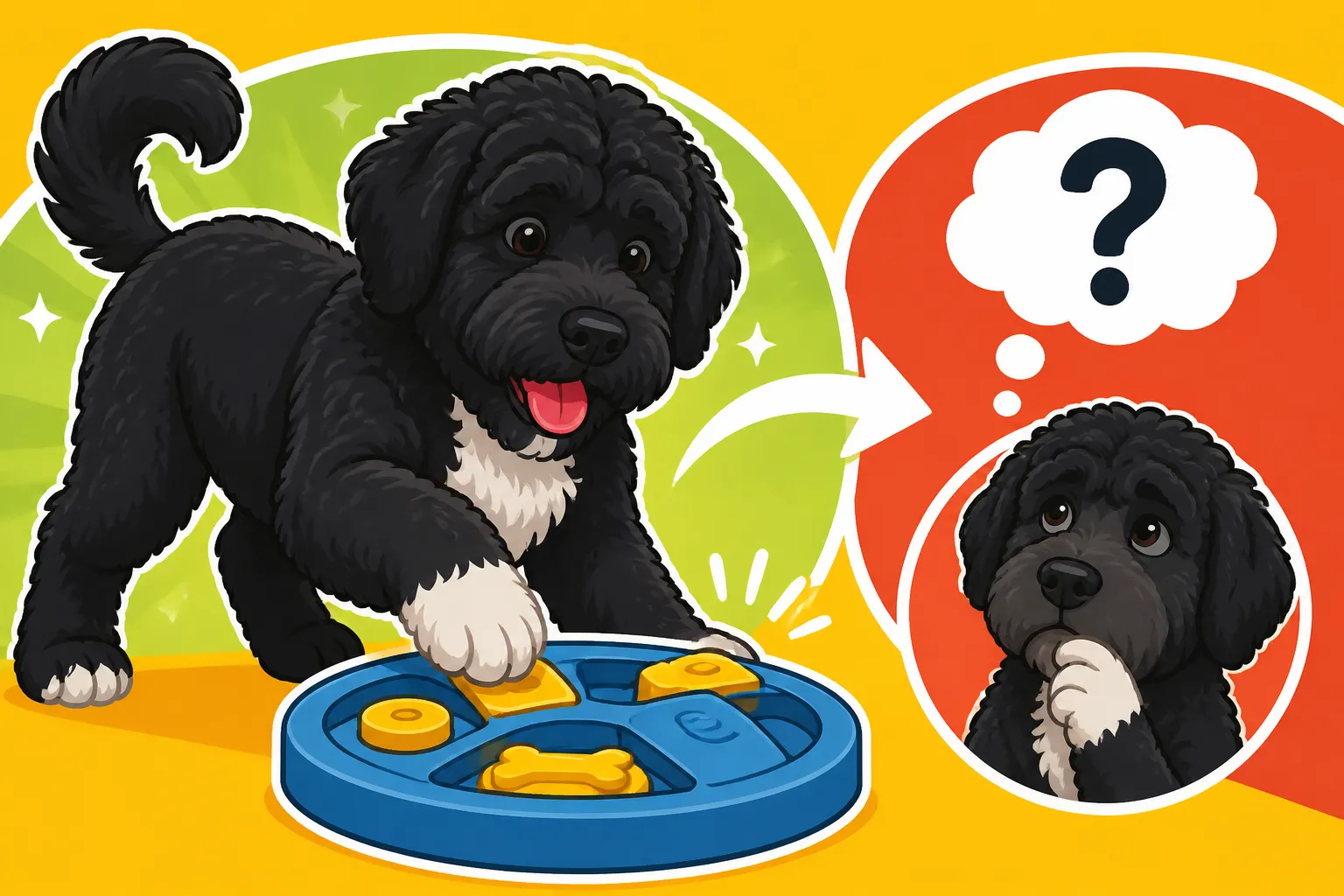
Whether a Portuguese Water Dog Solves a Puzzle Toy Too Fast
If you're a Portuguese Water Dog owner, you've probably faced the delightful but sometimes frustrating reality that your clever canine can often outsmart even the most complex puzzle toy in mere minutes. It’s a common experience, leaving many of us scratching our heads and wondering if we’ll ever find a toy that truly challenges their brilliant minds. This guide is here to validate that feeling, dive into why your PWD might be solving puzzle toys so quickly, and offer practical, real-world strategies to keep them engaged, entertained, and mentally stimulated for longer.
Understanding the Portuguese Water Dog's Intelligence and Drive
Let's be honest, your Portuguese Water Dog isn't just a pretty face with an amazing coat; they're a bona fide canine genius wrapped in a web-footed package. This breed was never meant to be a couch potato, and their intelligence is a huge part of their charm, as well as the root of many of our puzzle toy predicaments. Understanding their history and innate drives is key to appreciating why they approach these challenges with such zeal.
Bred for Problem-Solving, Not Just Obedience
Think back to their origins on the fishing boats off the coast of Portugal. These dogs weren't just fetching ropes; they were integral crew members, often working independently and making quick decisions. They'd herd fish into nets, retrieve lost tackle, and even carry messages between boats. This wasn't about blindly following commands; it was about assessing a situation, problem-solving on the fly, and using their intelligence to achieve a goal. This inherent trait, this drive to figure things out for themselves, is still deeply ingrained in today's Portuguese Water Dog. It’s why you’ll often find yourself in a playful battle of wits with your PWD, and why Training a Portuguese Water Dog That Was Bred to Think for Itself can be such a unique experience. They don't just want to be told what to do; they want to understand it and maybe even find a more efficient way.
When you present a puzzle toy, your PWD isn't just seeing a dispenser for treats. They're seeing a challenge, a problem to be solved. Their minds are wired to analyze mechanisms, anticipate outcomes, and experiment with different approaches. That's why a simple push-and-slide mechanism that might stump another breed for a while is often cracked by a PWD in a flash. They apply that ancestral problem-solving capacity to every new contraption you bring home.
The Drive to Work and Retrieve
Beyond just general intelligence, the Portuguese Water Dog possesses a strong, inherent working drive. They thrive when given a purpose, a "job" to do. This isn't just a cute saying; it's a fundamental aspect of their well-being. Whether it's retrieving, swimming, or, yes, solving a puzzle, they want to put their minds and bodies to use. This retrieval drive, honed over centuries of working alongside fishermen, means they are often highly motivated by a reward, especially if that reward is food or a favorite toy.
This powerful drive directly impacts how they interact with puzzle toys. They don't just passively bat at them; they engage with them with intensity and focus, eager to get to the prize. A puzzle toy, in their eyes, is a miniature "job" that promises a tasty paycheck. This inherent motivation means they're not easily deterred. If a solution isn't immediately obvious, they'll often keep trying different tactics until they succeed, which is why Why a Portuguese Water Dog Needs a Job is so crucial to their overall happiness and behavior. Their persistence can be truly astounding, and it's this persistence that often leads to rapid "toy completion."
High Energy and Mental Stimulation Needs
It's no secret that Portuguese Water Dogs are active dogs. They're bred for stamina and endurance, capable of spending hours in and around the water. This physical energy needs an outlet, but what many owners sometimes overlook is the equally intense need for mental stimulation. A tired body isn't enough; they need a tired brain too. A lack of mental engagement can lead to boredom, and a bored PWD is often a destructive or mischievous PWD.
Puzzle toys are fantastic tools for providing this mental workout. However, because their minds work so quickly, a toy that's genuinely challenging for most dogs might only offer a few minutes of brainpower for your PWD. If the puzzle is too easy, they'll solve it, get the treats, and then still have all that mental energy buzzing, looking for the next "problem" to tackle – which might be your couch cushions or the kitchen counter. This is why it feels like they solve puzzles "too fast"; they absorb the challenge so rapidly that the mental stimulation provided by many standard toys is simply insufficient for their considerable brainpower. You need to keep them thinking, always.
Why Puzzle Toys Are a Double-Edged Sword for PWDs
For many breeds, a good puzzle toy is a godsend, keeping them occupied and entertained for ages. For Portuguese Water Dogs, however, these ingenious contraptions can sometimes feel like a fleeting amusement, quickly conquered and then cast aside. This isn't a flaw in the toy, but rather a testament to the PWD's unique blend of intelligence and drive.
The Initial Excitement and Rapid Mastery
When you first introduce a new puzzle toy to your Portuguese Water Dog, the excitement is palpable. Their eyes light up, their tail wags with anticipation, and they approach it with an eager curiosity that's truly endearing. They sniff, paw, mouth, and nudge, quickly assessing the mechanics. It's often during this initial exploratory phase that their incredible problem-solving abilities become glaringly apparent. A simple slide, a lever to push, a compartment to flip – they pick up on the patterns with astonishing speed.
It’s not uncommon for a PWD to go from completely new to a toy to mastering its intricacies in a single session, sometimes in a matter of minutes. They're highly observant and quick to connect actions with consequences. "Ah, if I push this way, the treat comes out!" This rapid mastery is wonderful to witness, showing off their smarts, but it also means the "puzzle" aspect quickly diminishes. The challenge they crave is met and overcome almost instantly, leaving them ready for the next level before you've even had time to refill the first toy. This cycle of rapid mastery is why How Trainable a Portuguese Water Dog Is often means they pick up new tricks and tasks at a surprising rate, but it also applies to toys.
The "Too Easy" Phenomenon
The biggest frustration for PWD owners and the central theme of this article is the "too easy" phenomenon. You spend good money on a supposedly "advanced" puzzle toy, you set it up with high hopes, and within five minutes, your PWD has extracted every single morsel and is looking at you with an expression that clearly says, "Is that all you've got?" This isn't your dog being ungrateful; it's simply a reflection of their superior cognitive abilities.
The moment a puzzle toy becomes predictable, it loses its appeal. For a breed that thrives on mental engagement, a solved puzzle is no longer engaging. It's just a treat dispenser. This quick transition from "challenging game" to "boring chore" can be disheartening. You want to provide meaningful enrichment, but it feels like you're constantly fighting against their intellect. They don't just want the treat; they want the process of figuring out how to get it. When the process becomes routine, the motivation wanes.
Potential for Boredom and Destructive Behavior
What happens when a Portuguese Water Dog is bored? Well, if you've owned one for more than a few weeks, you likely know the answer: they invent their own puzzles. And often, these self-invented puzzles involve things you'd rather them not touch, like the leg of a chair, the remote control, or your favorite pair of shoes. Why a Portuguese Water Dog Puts Everything in Its Mouth is a habit that's exacerbated by boredom and a lack of appropriate mental outlets.
A PWD with unfulfilled mental energy will find ways to occupy themselves, and these ways aren't always conducive to a harmonious household. They might start counter-surfing more frequently, digging in the yard, barking excessively, or engaging in other attention-seeking behaviors. Puzzle toys are meant to prevent this, but if they're too easy, they don't do their job effectively. Instead of providing sustained mental exercise, they offer a brief distraction, after which the dog is still left with a surplus of mental energy, ripe for redirecting into less desirable activities. This highlights the critical importance of continuous, varied mental stimulation in their daily routine.
Strategies for Keeping Puzzle Toys Challenging
So, your PWD is a puzzle-solving prodigy. Great! Now what? The key isn't to give up on puzzle toys, but to get smarter about how you use them. It's about staying one step ahead of their brilliant minds and providing a continuous stream of novel challenges.
Layering Difficulty and Rotating Toys
One of the most effective ways to combat the "too easy" problem is to actively manage the difficulty and novelty of the toys. You can't just buy one advanced puzzle and expect it to last forever. Instead, think of it as a revolving library of challenges.
First, invest in a variety of puzzle toys at different difficulty levels. When introducing a new toy, start with the easiest configuration to build confidence, but quickly increase the complexity as your PWD masters it. Many modern puzzle toys, especially those you might find on Amazon, come with adjustable difficulty settings or multiple stages. Don't be afraid to experiment with these. If a toy has three steps, ensure your PWD masters step one before moving to step two, and then combine them.
Secondly, rotate your toys! Just like children get bored with the same old toys, so do dogs. Don't leave all your puzzles out all the time. Instead, have a selection of 3-5 puzzles that you rotate through every few days or even weekly. When a toy "reappears" after a break, it often feels fresh and new again, sparking that initial curiosity and engagement. This strategy keeps their minds guessing and prevents them from simply memorizing the solution to every single toy you own.
DIY and Advanced Puzzle Solutions
Sometimes, even the most expensive store-bought puzzle toys simply aren't enough for a truly brilliant Portuguese Water Dog. This is where your own creativity comes into play! Many PWD owners find themselves becoming amateur puzzle designers.
Think outside the box (literally!). You can combine elements from different toys or use household items to create more complex scenarios. For example:
- Box Mazes: Take several cardboard boxes, cut holes in them, and arrange them into a maze. Hide treats inside and under crumpled paper. Your PWD has to navigate and sniff out the rewards.
- Towel Rolls: Spread treats on a towel, roll it up tightly, and then tie knots in it. This makes a simple treat dispenser much harder to unravel.
- Muffin Tin Games: Place treats in the cups of a muffin tin, then cover each cup with a tennis ball or a sturdy toy. Your dog has to figure out how to remove the balls to get to the treats.
For truly advanced dogs, consider incorporating training commands into the puzzle-solving. Instead of just letting them figure it out, require them to "sit," "stay," or even perform a trick before they can access the next stage of the puzzle. This elevates the mental game significantly. If you’re looking for structured guidance, programs like BAXTER & Bella often emphasize integrating obedience and problem-solving, which is perfect for keeping a PWD’s sharp mind engaged. This transforms a simple treat delivery into a multi-faceted mental exercise, tapping into their incredible What Motivates a Portuguese Water Dog.
Integrating Puzzle Work with Training and Daily Life
Puzzle toys shouldn't just be standalone activities; they can be powerful tools integrated into your PWD's broader training and daily routine. This makes them more effective and ensures your dog is consistently challenged.
Consider using puzzle toys as part of their regular mealtime. Instead of simply putting their kibble in a bowl, divide it into a few different puzzle toys. This slows down their eating, provides mental enrichment, and turns a mundane activity into a brain game. This is especially good for puppies, teaching them to work for their food from an early age.
Another strategy is to use puzzles as a reward system or as a way to manage their energy during specific times. For example, if you know you need to focus on a task for an hour, provide a high-value, longer-lasting puzzle to keep your PWD occupied. You can also hide puzzle toys around the house, turning mealtime or snack time into a stimulating scavenger hunt. This taps into their natural scenting abilities and provides an even deeper level of engagement. Remember, What a Portuguese Water Dog Does All Day needs to involve a good balance of physical exercise and these types of mental challenges to prevent boredom.
Recommended Types of Puzzle Toys and Considerations
Given their intelligence and strength, not all puzzle toys are created equal for the Portuguese Water Dog. Choosing the right types of toys, with an eye towards both challenge and durability, is paramount.
Interactive Feeders and Snuffle Mats
For starters, or for those moments when you need a slightly less intense mental workout, interactive feeders and snuffle mats are excellent choices.
- Interactive Feeders: These range from simple wobble-toys that dispense kibble as your dog nudges them, to more complex designs with multiple compartments and levels. Brands like Kong offer various options, from classic stuffable toys (which can be frozen for an extended challenge) to more intricate models. For a PWD, look for those designed for "power chewers" if they're particularly mouthy, as Why a Portuguese Water Dog Puts Everything in Its Mouth can mean toys get destroyed quickly. You can find a vast selection of these on Amazon, often with reviews that can guide you toward durable options.
- Snuffle Mats: These fabric mats with numerous fleece strips are designed to hide kibble or small treats, encouraging your dog to sniff and forage. While not a "puzzle" in the mechanical sense, they provide excellent scent work and mental engagement, tapping into their natural instincts. They're great for slowing down fast eaters and providing a calming activity.
These types of toys are generally lower difficulty but can be made harder by using smaller treats or packing them more tightly. They're also great for those times when you want to give their brains a break from complex mechanics but still provide enriching activity.
Advanced and Multi-Step Puzzles
This is where you'll really start to challenge your Portuguese Water Dog. These are toys that require multiple actions, sequential steps, or a combination of pushing, pulling, lifting, and sliding.
- Sequential Puzzles: Look for toys that require your dog to complete one step before they can move on to the next, like lifting a peg to slide a cover, or rotating one section to reveal another. Brands that specialize in these kinds of multi-layered challenges are often a good bet.
- Combination Puzzles: The best advanced puzzles often combine different types of mechanisms. For example, your PWD might need to pull a string, then push a lever, and then flip open a lid. These demand more complex cognitive processing and can keep a PWD engaged for longer. When shopping, seek out puzzle toys specifically marketed for "expert" or "advanced" dogs, and be prepared to invest in them. They might seem pricey, but a toy that truly challenges your PWD is worth it.
Remember, even with these advanced toys, your PWD might still figure them out faster than you expect. The goal isn't to find a puzzle they never solve, but one that provides a substantial, satisfying mental workout each time they interact with it.
Durability and Safety Concerns
Portuguese Water Dogs are robust, strong dogs with powerful jaws and an enthusiastic approach to life. This means that toy durability and safety are not minor considerations. A flimsy plastic puzzle toy might quickly succumb to their eager teeth, becoming a choking hazard or simply rendering the toy useless.
When selecting puzzle toys:
- Material Matters: Opt for durable, food-grade plastics, hard rubber, or wood where appropriate. Avoid toys with small, easily detachable parts that could be swallowed.
- Construction Quality: Check for sturdy construction. Are the parts well-secured? Are there sharp edges once the toy is "solved" or chewed?
- Supervision: Always supervise your Portuguese Water Dog when they're using a new puzzle toy, especially until you understand how they interact with it. This allows you to intervene if they try to chew the toy rather than solve it, or if a piece breaks off.
- Size Appropriateness: Ensure the toy is appropriately sized for your PWD. Too small and it could be swallowed; too large and it might be unwieldy or impossible for them to manipulate effectively.
A table outlining different types of puzzles can help you choose:
| Puzzle Type | Difficulty for PWD | Engagement Level | Durability | Best Use Case |
|---|---|---|---|---|
| Kong Classic (stuffed) | Low to Medium | Moderate | High | Daily treat dispenser, crate time, calming |
| Snuffle Mat | Low | High (scent) | Medium | Mealtime, mental stimulation, calming |
| Wobble/Ball Dispenser | Low | Moderate | Medium to High | Quick treat, beginner puzzles |
| Slider Puzzles | Medium | High | Medium (plastic) | Intermediate challenge, learning mechanics |
| Flip/Lift Puzzles | Medium to High | High | Medium to High | Good for focus, sequential thinking |
| Multi-Step Combinations | High | Very High | Medium to High | Advanced problem-solving, sustained challenge |
| DIY Box/Towel Puzzles | Variable | High | Low (disposable) | Creative, varied, cost-effective, custom tasks |
Ultimately, finding the right balance of challenge, variety, and durability is an ongoing process for any Portuguese Water Dog owner. Their brilliant minds are a gift, and providing them with appropriate outlets for that intelligence is one of the most rewarding aspects of sharing your life with this incredible breed. Keep experimenting, keep observing, and you'll keep that clever canine happily engaged!
Disclaimer
This article is for general informational purposes only and does not constitute professional advice. Laws, prices and regulations vary by location and change over time. Consult a qualified professional for guidance on your specific situation.