Whether Coat Type Runs in Portuguese Water Dog Lines
A Portuguese Water Dog breeder may describe a litter as coming from curly-coated parents, yet the puppies’ coats can still develop differently. That can make it hard to predict the adult look from a pedigree or a young puppy’s curls. This guide explains how coat type is inherited, what family lines can tell you, and why grooming and age can complicate the picture.
How coat type is inherited in Portuguese Water Dogs
Coat type runs in families, but it is not a simple guarantee
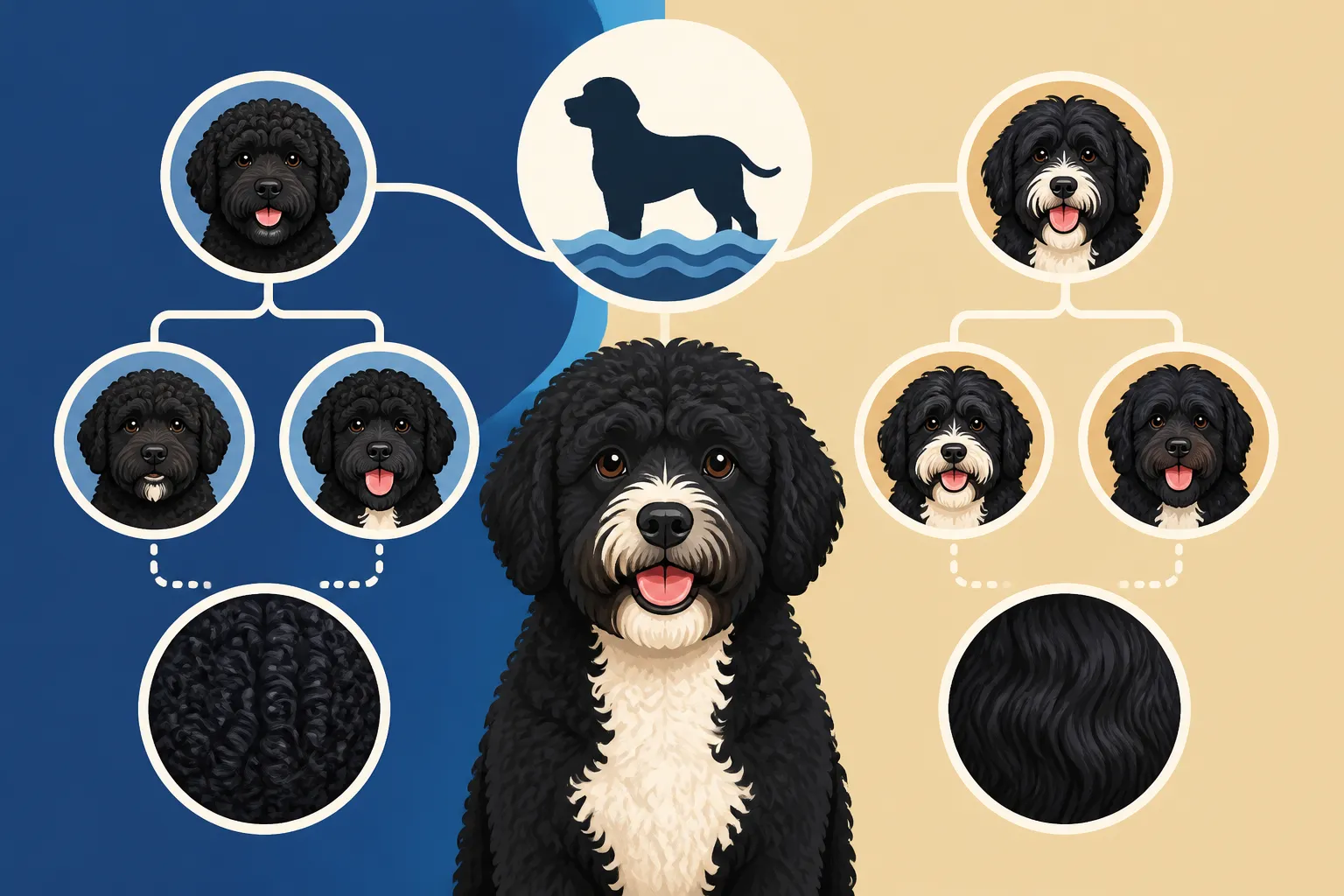
Portuguese Water Dogs have two recognised coat types: curly and wavy. Because coat traits are inherited, a dog’s ancestry can offer useful clues about the coat it may develop. If a line regularly produces curly coats, or often produces a softer wave, that pattern may be worth discussing with the breeder.
But a family pattern is not a promise about an individual puppy. A litter can include puppies whose coats look different from one another, even when they share the same parents. Coat inheritance involves traits passed down from both sides of the pedigree, and the visible result can vary. Knowing what the parents look like is helpful, but it does not settle the question by itself.
That distinction matters when choosing a puppy. Someone who has their heart set on a particular coat may assume that two curly-coated parents can only have curly-coated puppies, or that a wavy-coated parent determines the whole litter. Those assumptions can lead to disappointment. Ask about the coats produced by close relatives and previous litters, but treat those details as clues rather than guarantees. For a basic comparison of the two forms, see Which Coat Types a Portuguese Water Dog Comes In and How a Curly Coat Differs From a Wavy Coat.
What a pedigree can and cannot tell you
A pedigree can help you spot recurring patterns. A breeder who knows several generations of dogs in a line may be able to explain whether relatives tend to have tight curls, looser waves, or a range of textures. Previous litters can add useful context, particularly when the breeder can describe how puppies’ coats developed as they matured.
However, a pedigree is not a coat prediction chart. It records ancestry, not a guaranteed description of every puppy’s adult coat. A distant relative’s coat may be less informative than the coats of parents and close relatives, and even close family patterns do not remove variation. A responsible breeder should be comfortable explaining what they have observed without claiming that they can promise a precise adult texture.
It can also help to ask what the breeder means by “curly” or “wavy.” People may use those labels casually when puppies are still young, and a puppy’s soft, developing coat may not yet show the adult pattern clearly. Ask to see photographs of parents and mature relatives, and ask whether the examples were taken before or after grooming. The clip, coat length, lighting, and wetness can all change how a coat appears in a photograph.
Can curly and wavy puppies come from the same litter?
Yes. Curly and wavy puppies can occur in the same Portuguese Water Dog litter. Siblings inherit different combinations of traits from the same parents, so one puppy may develop a more obvious curl while another has a looser wave. This is one reason a breeder’s history of previous litters can be useful, while still not offering certainty about the next one.
The difference may be subtle when puppies are very young. A puppy photographed with a short coat may look smoother than it will later, while a longer, tousled coat can make another puppy seem curlier than it really is. The way a puppy’s coat sits after bathing and drying may also differ from its appearance when it has been sleeping, playing, or getting damp.
If coat type is important to you, talk about it before choosing a puppy and ask how the breeder evaluates coat as the litter grows. A thoughtful breeder can explain what they see and what remains uncertain. For more on sibling variation, read Whether Curly and Wavy Portuguese Water Dogs Share a Litter.
Why coat type may be hard to identify in a puppy
Puppy coats change as dogs mature
A puppy’s coat is not always a reliable preview of its adult texture. As the coat develops, its length, density, and feel can change. The timing and extent of that transition vary among individual dogs, so two puppies of the same age may look quite different.
Owners sometimes worry that a puppy’s coat has “turned into” a different type. In many cases, the apparent change is a mix of normal coat development and changing length. A soft puppy coat may seem fluffy or loosely curled; later, the adult coat can look more defined, heavier, or more wavy. That does not necessarily mean the dog’s inherited coat type changed. It may mean the coat has matured enough for its pattern to show more clearly.
Grooming can make this transition feel even more dramatic. A short trim removes length that helped show a wave or curl, and a bath followed by thorough drying can make the texture look different again. If you are trying to judge a puppy’s coat, look at it over time and ask the breeder or a groomer familiar with the breed to help interpret what you are seeing. You may also find When a Portuguese Water Dog's Puppy Coat Changes and Whether a Portuguese Water Dog's Coat Changes Texture With Age helpful.
Coat length and condition affect appearance
A coat can look more curly or more wavy depending on its length and condition. Longer hair may hang in waves, while a shorter clip can make curls seem tighter or less noticeable. Brushing and drying methods matter too: brushing a coat out can soften its visible pattern, while allowing it to dry in its natural shape may make the texture easier to see.
Mats and tangles can disguise the coat’s natural appearance. A section that has clumped together may look like a curl, but it is not a useful way to identify coat type. Likewise, a coat that has been brushed roughly or is dry and damaged may look frizzier than usual. If the coat suddenly changes in texture or condition, especially alongside skin irritation or hair loss, ask a veterinarian rather than assuming the change is just inherited texture.
A simple grooming routine helps you assess what is actually there. Work through the coat in sections, use a comb to check down to the skin, and keep notes or photographs from time to time if you are following a puppy’s development. You can find basic grooming tools through a local pet shop or retailers such as Chewy, but the technique and the dog’s comfort matter more than where the tools are bought.
What coat lines mean when choosing a puppy
Questions to ask a breeder
A useful conversation with a breeder goes beyond asking whether the parents are curly or wavy. Ask what coat types have appeared in the parents’ close relatives, whether previous litters have included both types, and how the breeder describes the puppies’ coats at their current age. These questions invite a practical answer instead of a guarantee that no one can honestly make.
You can also ask how the breeder distinguishes coat type from coat length, grooming style, and general coat condition. If they share photographs, ask whether the dogs are shown in their usual pet clip or a show-style trim, and whether the coats are wet, freshly dried, or brushed out. That context helps you compare like with like.
Be cautious if someone promises an exact adult coat based only on a puppy’s appearance or the parents’ coats. It is reasonable for a breeder to describe a likely pattern based on experience; it is less reasonable to present that estimate as certain. The same careful approach applies to other inherited characteristics and health questions. For a wider look at the breed’s coat, see What a Portuguese Water Dog's Coat Is Made Of.
Match coat expectations with grooming realities
Curly and wavy describe texture, not how much grooming a dog will need in your home. Both types need regular attention to prevent tangles and mats, and either can become difficult to manage if brushing is skipped. Coat length, the dog’s activities, and how often it swims may affect the routine as much as the broad coat label.
For example, a dog that swims often and wears a harness may need extra checks where the coat rubs or stays damp. A longer coat may need more time to work through, while a short clip can make day-to-day maintenance easier for some households. Neither type is automatically “low maintenance,” and a tidy-looking outer layer does not always mean the coat is clear down to the skin. See Which Portuguese Water Dog Coat Mats More and How Often a Portuguese Water Dog Needs Brushing for practical care considerations.
If you are building a grooming kit, start with tools you can use safely and consistently: an appropriate brush, a metal comb for checking the coat, and dog-formulated shampoo when a bath is needed. A pet retailer such as Chewy can be one place to compare basic options, but ask your breeder or groomer what suits your dog’s coat and skin. You do not need a complicated collection of products to care for a coat well.
A practical way to think about coat type
Use family history as evidence, not a promise
When a coat type appears repeatedly in a Portuguese Water Dog line, that history is meaningful. It can give you a reasonable expectation and help you ask better questions. But a line’s tendency does not guarantee that every puppy will have the same texture, and a puppy’s early coat may not reveal the full adult pattern.
A helpful way to assess the information is to separate what you know from what you are guessing. You may know the parents’ coat types and have photographs of mature relatives. You may also know what appeared in earlier litters. What you may not know with certainty is exactly how one puppy’s coat will look after it matures and is groomed in a particular style. Keeping those categories separate makes the decision less stressful.
If the coat is one of several preferences, consider the puppy’s temperament, health background, and fit with your household alongside appearance. If a specific texture is essential to you, tell the breeder early and ask for an honest discussion of uncertainty. A good match is more than a coat description, and a dog’s everyday needs will matter long after the puppy coat has changed.
Observe the coat without overinterpreting every change
As your dog grows, notice how the coat behaves when clean, dry, and reasonably well maintained. A few photographs taken under similar conditions can be more useful than comparing pictures taken at different lengths or after different grooming routines. If you are unsure whether you are seeing a normal development change or a problem with coat condition, ask a groomer familiar with Portuguese Water Dogs or your veterinarian.
For routine care, choose grooming products based on the dog’s needs rather than the label “curly” or “wavy” alone. Chewy and other pet retailers may carry brushes, combs, and dog shampoo, while a professional groomer can help you work out a manageable schedule. The best approach is the one your dog tolerates and you can maintain without letting tangles build up.
Finally, remember that coat type is only one part of a Portuguese Water Dog’s appearance. It can run in families and offer useful clues, but it does not define the dog’s health, personality, or suitability as a companion. A careful breeder can explain the patterns they have seen, and patient observation will tell you more as the puppy matures.
Disclaimer
This article is for general informational purposes only and does not constitute professional advice. Laws, prices and regulations vary by location and change over time. Consult a qualified professional for guidance on your specific situation.