Why Fishermen Stopped Needing the Portuguese Water Dog
It’s a romantic image, isn’t it? The steadfast Portuguese Water Dog, working tirelessly alongside its human companion on the rough seas, a true partner in the arduous life of a fisherman. But like many traditions, this deep bond, born of necessity and shared purpose, eventually faded. The reality is, the world changed, and the very tasks that once made these dogs indispensable became obsolete, leaving many to wonder why these incredible working dogs were no longer needed on the boats. This guide delves into the historical shifts that led to the decline of the Portuguese Water Dog's traditional role, exploring the mechanization, economic pressures, and societal changes that reshaped their destiny.
The Mechanization of Fishing Fleets: Trading Paws for Pistons
The early 20th century brought about a revolution in fishing, much like it did in many other industries. For centuries, fishing had been a labor-intensive endeavor, relying heavily on human and animal power. Dogs like the Portuguese Water Dog were integral to this system, acting as invaluable crew members. However, as technology advanced, particularly with the widespread adoption of internal combustion engines, the landscape of fishing changed dramatically, reducing the need for canine assistance.
The Advent of Engine Power
Before engines became common, fishermen relied on sails, oars, and sheer muscle to navigate and manage their boats. In this environment, a dog like the Portuguese Water Dog wasn't just a pet; it was a highly trained, specialized tool. They would dive for lost tackle, herd fish into nets, and even carry messages between boats. Their agility, strong swimming abilities, and intelligent problem-solving skills were perfectly suited to these tasks. Imagine a heavy net needing to be hauled in, or a precious piece of equipment sinking into the murky depths—these were situations where a skilled PWD truly shone.
But then, the engine arrived. With a motorized boat, fishermen could travel further, faster, and against stronger currents. The physical demands on the human crew changed, and the need for a dog to, say, pull a rope or act as a living tugboat diminished significantly. The boat itself now possessed the power to overcome the sea's resistance, rendering many of the PWD's traditional hauling and towing tasks redundant. It was a gradual shift, of course, but an undeniable one that eroded the very foundation of their working partnership. How Engines Ended the Portuguese Water Dog's Job is a story about efficiency replacing centuries of tradition.
Automation of Net Handling and Hauling
Beyond just propulsion, mechanization extended to the very process of fishing itself. Hauling in heavy nets, often laden with fish, was one of the most back-breaking jobs on a fishing vessel. This is where the Portuguese Water Dog’s strength and enthusiasm could be harnessed. They were known to help with the nets, using their strong bodies to assist in the arduous process. How a Portuguese Water Dog Worked a Net involved a remarkable understanding between dog and human, a dance of coordinated effort that maximized the catch.
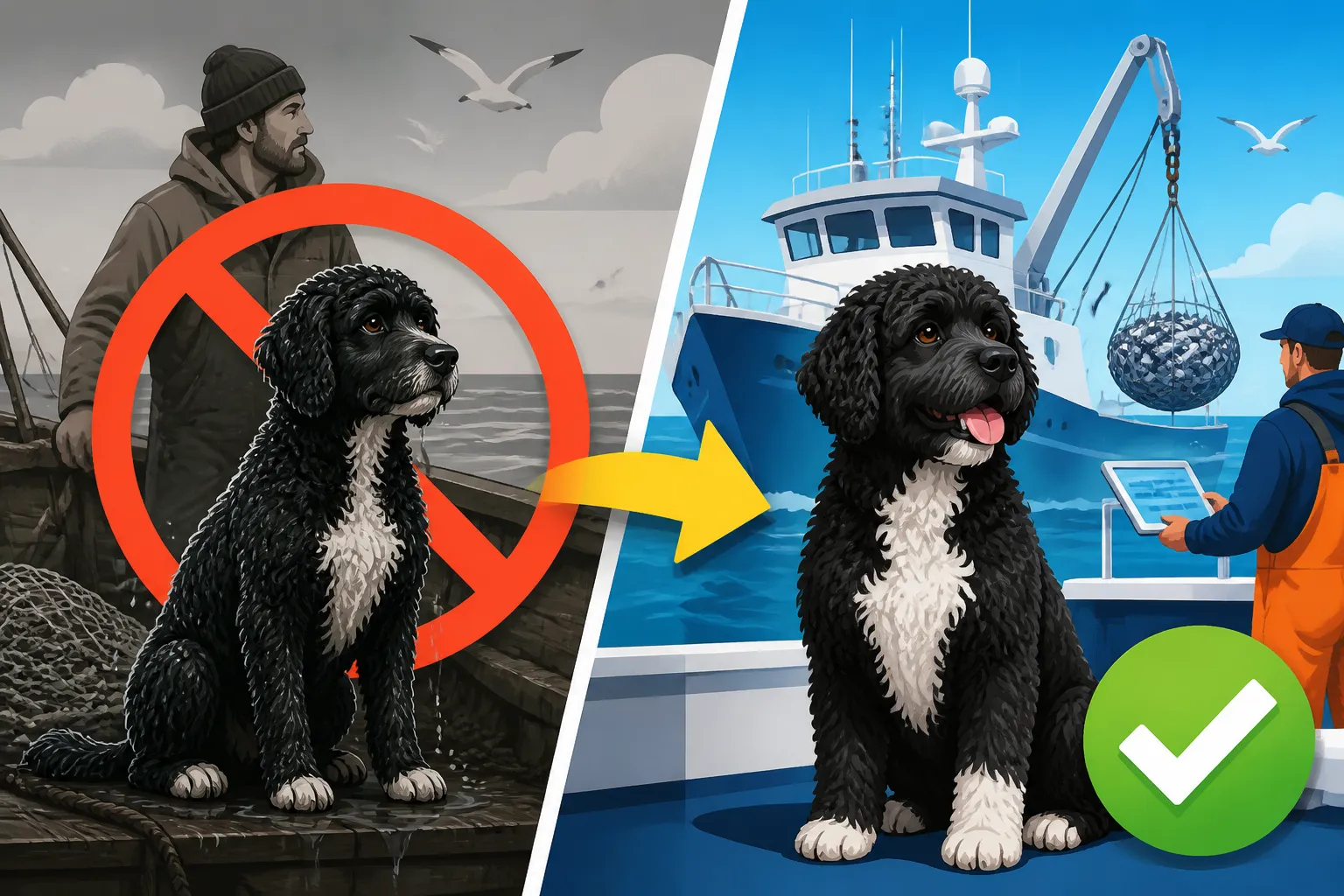
However, as fishing vessels grew larger and technology advanced, winches, hydraulic systems, and power blocks took over these tasks. These machines could pull in nets with far greater speed and less effort than any combination of human and dog could manage. A fisherman no longer needed a dog to retrieve a rope or help haul a struggling net; a button push or a lever pull did the job. This technological leap, while making fishing more efficient and less physically demanding for the human crew, effectively automated the PWD out of a significant portion of its job description.
The Decline of Traditional Fishing Methods
The rise of larger, more powerful vessels and sophisticated equipment also led to a decline in the traditional, smaller-scale fishing methods where the PWD truly thrived. These were often family-owned or small community boats, relying on local knowledge and generations of accumulated skill. The dogs were often a part of this heritage, passed down and trained in specific family traditions.
As industrial fishing expanded, these smaller operations struggled to compete. Trawlers and factory ships, designed for massive hauls and long voyages, had no practical need for a dog. Their operations were too vast, too standardized, and too focused on pure volume to incorporate a canine crew member. The nuances of a dog herding fish or retrieving a small item were irrelevant in an environment where miles of net were deployed and hauled by powerful machinery. This shift in the very nature of fishing—from a more artisanal craft to an industrial enterprise—left the Portuguese Water Dog's historical role with little room to exist.
Evolving Fishing Economies and the Human Workforce
Beyond just the machines themselves, the economic realities of the fishing industry also played a pivotal role in changing the Portuguese Water Dog’s place on board. The economics of operating a boat, paying a crew, and maximizing profit became increasingly tight, making every expense and every crew member's contribution subject to intense scrutiny.
Economic Pressure and Crew Sizes
Running a fishing boat, then as now, was an expensive undertaking. Fuel, supplies, repairs, and crew wages all added up. In the days when the PWD was a staple, the economics were different. Their "wage" was food and a place on the boat, a negligible cost compared to a human crew member, especially when their contributions were so vital. But as fishing became more competitive and margins thinner, every single component of the operation had to justify its existence in terms of pure output and cost-effectiveness.
Fishermen began to streamline their operations, often reducing human crew sizes as mechanization allowed fewer hands to do more work. In this environment, an animal, no matter how loyal or skilled, started to look like an unnecessary mouth to feed or an additional liability if it didn't directly contribute to the bottom line in a way that couldn't be replaced by a machine. The decision to keep a dog on board shifted from being an obvious choice to a luxury, one that many struggling fishing families simply couldn't afford when efficiency became paramount.
The Shift from Subsistence to Commercial Scale
Historically, many fishing operations were semi-subsistence or small-scale commercial, meaning they fished partly to feed their families and communities, and partly to sell their catch. These operations often fostered a deep connection to their tools and their animals. The Portuguese Water Dog was more than just a worker; it was often a companion, a guardian, and a part of the family unit that depended on the sea.
As the industry moved towards larger, purely commercial endeavors, the personal relationship between fisherman and dog diminished in a professional context. Big fishing companies, operating fleets of boats, viewed their operations purely through the lens of profit and loss. Dogs simply didn't fit into this new corporate structure. They weren't an asset that could be easily scaled or optimized across a large fleet. The intimate, traditional knowledge that a dog could provide in a specific local fishing ground was superseded by sonar, GPS, and vast tracking systems, making the PWD's unique skills less relevant to the new breed of industrial fisherman.
Increased Specialization of Labor
In the past, a fisherman and his dog were often generalists, tackling a wide range of tasks as needed. The dog might retrieve, herd, guard, and keep spirits up. The human might navigate, mend nets, catch fish, and maintain the boat. It was a fluid, multi-faceted approach to work.
Modern commercial fishing, however, has become highly specialized. Different crew members have specific roles, from net technicians to electronics operators to deckhands focused on processing the catch. There’s little room for an animal that performs a variety of unspecialized tasks that can now be done more efficiently by a machine or a specifically trained human. The Portuguese Water Dog's versatility, once its greatest asset, ironically became a disadvantage in an industry that increasingly valued narrow, optimized roles for maximum output. The dog couldn't operate the sonar, or repair a diesel engine, and those became the skills in demand.
The Changing Perception and Role of Dogs in Society
Beyond the practicalities of fishing, broader societal changes profoundly influenced the fate of working dogs. As societies industrialized and urbanized, the role of dogs began to shift dramatically from utilitarian workers to cherished companions.
From Working Partner to Family Member
For centuries, dogs held a clear, functional role in human society: hunting, herding, guarding, and, in the case of the Portuguese Water Dog, working on boats. Their value was primarily measured by their utility and contribution to human labor. However, as human labor became less reliant on animal power, and living standards improved in many parts of the world, the emotional bond with dogs began to take precedence.
Dogs increasingly moved from the barnyard or the boat deck into the home, becoming integral members of the family unit. This shift meant that qualities like temperament, trainability for obedience, and suitability as a household pet became more desirable than sheer working ability. While the PWD's intelligence and loyalty made them adaptable to this new role, the expectation of what a dog should be fundamentally changed. The fisherman who previously relied on his PWD to bring in the catch now looked for a dog to greet him at the door and play with his children. A Portuguese Water Dog Was Bred to Work a Boat, Not a Yard speaks volumes to this transition.
The Rise of Pet Ownership and Breed Standards
As the concept of a "pet" gained traction, so did the formalization of dog breeds. Breed clubs emerged, establishing standards for appearance, temperament, and health. The focus often shifted from a dog's practical working ability to its conformity to a written standard, its success in conformation shows, and its appeal as a companion.
The Portuguese Water Dog, while still retaining its inherent working drives, was increasingly judged by these new metrics. Breeders began to focus on preserving the breed's distinct characteristics—its unique coat, webbed feet, and lively intelligence—within the context of a family pet or show dog, rather than a robust, seafaring laborer. This isn't to say their working heritage was forgotten, but the primary driver for breeding and owning them began to evolve. Companies like Chewy responded to this growing pet market, offering a vast array of products from specialized dog food to toys and grooming supplies, catering to the needs of companion animals rather than working beasts of burden.
The Diminishing Need for Canine Laborers
Ultimately, the most straightforward reason for the Portuguese Water Dog's departure from the fishing fleets was simply that the demand for canine labor disappeared. Most of the tasks they performed could now be done more effectively, reliably, and cheaply by machines or humans in specialized roles. There was no longer a need for a dog to swim out to a lost net buoy, or to drive fish towards a waiting net, or to retrieve floating debris.
This decline in demand wasn't unique to the PWD; it affected many working breeds globally. Farm dogs, drovers, and other working animals also saw their roles diminish as agriculture and industry mechanized. It's a bittersweet truth: the very progress that made human lives easier also rendered many animal partnerships obsolete. The fishing communities, which had been the heartland of the PWD for centuries, found themselves in a new era where their trusted canine companions, while still beloved, no longer had a job to do.
The Portuguese Water Dog's Near Disappearance and Modern Revival
These shifts didn't just change the PWD's job; they threatened its very existence. With their working role gone, the breed's numbers plummeted, pushing them to the brink of extinction before dedicated enthusiasts stepped in.
The Breed on the Brink of Extinction
By the early 20th century, particularly in the 1930s, the future of the Portuguese Water Dog looked grim. As traditional fishing declined, so did the populations of these dogs. They were no longer being bred for their specific working traits, and their numbers dwindled dramatically. It wasn't a sudden collapse but a slow, heartbreaking fade as their purpose dissolved. The Portuguese Water Dog Was Almost Gone by the 1930s is a somber reminder of how quickly a once-thriving breed can disappear when its utility is lost.
Imagine a world where these incredible dogs, with their boundless energy and profound intelligence, were simply disappearing, one by one. There was no widespread interest in them as companion animals yet, and the cultural memory of their working prowess was fading. It was a perilous time for the breed, truly teetering on the edge of oblivion, a stark contrast to their current status as beloved family members.
Dedicated Efforts to Save the Breed
Fortunately, a few passionate individuals recognized the unique qualities of the Portuguese Water Dog and dedicated themselves to its preservation. Figures like Dr. Vasco Bensaude, a wealthy Portuguese shipping magnate, were instrumental in collecting the remaining dogs and establishing a breeding program focused on reviving and standardizing the breed. These individuals saw beyond the immediate utility and recognized the historical and genetic value of these dogs. Who Saved the Portuguese Water Dog is a testament to the power of committed individuals.
Their efforts involved careful documentation, selective breeding, and championing the breed's qualities, not just as working dogs, but as intelligent, robust, and engaging companions. Without this intervention, it's highly likely that the Portuguese Water Dog would be nothing more than a historical footnote today. Their vision allowed the breed to transition from its ancient working role to a new existence as a cherished modern breed.
New Purposes and Popularity for the PWD
Today, the Portuguese Water Dog enjoys a vibrant existence, having successfully transitioned from its original role on fishing boats to a variety of modern purposes. They are no longer driving fish into nets, but they excel in other areas, proving their incredible adaptability. Many PWDs are active in dog sports like agility, obedience, rally, and, perhaps most fittingly, dock diving and water trials. These activities allow them to exercise their natural athleticism, intelligence, and love for water in a structured, competitive, and enjoyable way. Dock Diving and Water Trials With a Portuguese Water Dog demonstrates how their innate abilities are still highly valued.
Beyond sports, PWDs make exceptional family companions. Their intelligence and eagerness to please, combined with their non-shedding, hypoallergenic coat, have made them popular choices for active families. They require significant exercise and mental stimulation, reflecting their working heritage, but they thrive when given a "job" to do, even if that job is simply being the best family dog they can be. Resources like Chewy offer everything an owner needs to keep an active PWD healthy and engaged, from high-quality food to interactive toys. This breed's journey from near extinction to widespread affection is a powerful example of resilience and adaptation, proving that even without a boat to work, a Portuguese Water Dog can still lead a full and purposeful life.
To illustrate the stark contrast in the PWD's historical and modern roles, consider the following:
| Aspect | Traditional Role (Pre-20th Century) | Modern Role (21st Century) |
|---|---|---|
| Primary Function | Working partner on fishing boats | Family companion, dog sport competitor, therapy dog |
| Key Skills Used | Fish herding, net retrieval, boat-to-boat communication, guarding, hauling | Obedience, agility, retrieving, swimming (for sport/fun), problem-solving, companionship |
| Living Environment | Primarily on fishing vessels, coastal villages | Family homes, often with access to water (lakes, pools) |
| Economic Value | Direct contributor to livelihood/catch | Emotional value, participation in pet industry (e.g., Chewy products) |
| Breeding Focus | Maximizing working ability, physical toughness | Conformation, temperament, genetic health for longevity as a pet |
| Training Emphasis | Practical fishing tasks, resilience | Socialization, basic obedience, advanced dog sports training |
This table highlights the profound shift in expectations and roles for these remarkable dogs. While the old ways are largely gone, the spirit of the working Portuguese Water Dog lives on in their intelligence, athleticism, and unwavering loyalty.
Disclaimer
This article is for general informational purposes only and does not constitute professional advice. Laws, prices and regulations vary by location and change over time. Consult a qualified professional for guidance on your specific situation.