How Portuguese Water Dog Is Related to the Irish Water Spaniel
Portuguese Water Dogs and Irish Water Spaniels share an unmistakable love of water, athletic builds, and curly coats, so it is easy to assume one breed came directly from the other. The history is less certain: they may share older water-dog ancestry, but there is no settled proof of a direct parent-and-descendant relationship. Here’s what the similarities, records, and differences can tell us.
What the two water-dog breeds have in common
Shared traits do not prove direct descent
The Portuguese Water Dog and Irish Water Spaniel were both developed as capable working dogs around water. Each is an energetic swimmer with a coat that can look curly, and both were valued for retrieving and responding to people working nearby. Those features make the breeds look related, but they are not a family tree by themselves. Similar jobs can favor similar abilities and body features in dogs that developed separately.
A dog that regularly swims, retrieves, and works around boats benefits from stamina, a confident nature, and a coat that offers some protection from the elements. These practical demands help explain why unrelated or distantly related breeds can resemble each other. A shared working role is a clue worth considering, but it cannot establish exactly which breed descended from which.
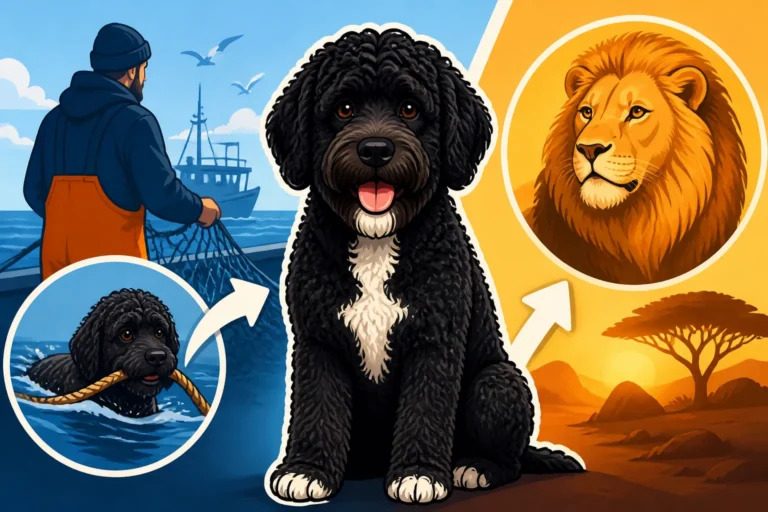
The Portuguese Water Dog’s history is closely associated with Portugal’s fishing coast and the work of fishing crews. The Irish Water Spaniel, meanwhile, developed in Ireland as a water-retrieving dog. Reading about What a Portuguese Water Dog Did for a Fishing Crew gives useful context for the Portuguese breed’s particular working identity, rather than treating all water dogs as interchangeable.
The history leaves room for shared ancestors
Dog breeds did not always develop with the neat records and closed registries familiar to modern breeders. For centuries, working dogs were often selected for their usefulness, and dogs could travel with people by land or sea. That makes it plausible that different European water-dog populations shared older ancestors or influenced one another at some point.
Plausible, however, is not the same as proven. Historical accounts of dog origins can be incomplete, and descriptions such as “water dog” were sometimes used broadly rather than as the name of one precisely defined modern breed. A resemblance between two dogs, or a possible route by which dogs could have travelled, does not demonstrate a documented cross.
That is why it helps to separate three ideas: the breeds look alike in some respects; they may have distant ancestry in common; and one modern breed directly descends from the other. The first is easy to observe, the second is possible, and the third is not established as a settled fact.
Water work shaped both breeds in different places
The Portuguese Water Dog is linked to fishing communities along Portugal’s coast. The breed’s traditional tasks included retrieving objects and working close to boats, where a responsive dog that could swim well was useful. Its history is part of a broader story about how coastal communities used dogs to support everyday work. Where the Portuguese Water Dog Comes From explores that regional background.
The Irish Water Spaniel’s history is rooted in Ireland, where it became known as a distinctive water-retrieving spaniel. Its signature appearance includes a tight, curly body coat and a long, smooth “rat tail,” a striking feature that sets it apart from the Portuguese Water Dog. It was shaped within its own working and breeding tradition, not simply as a variation of the Portuguese breed.
So the most grounded answer is that both are water-working breeds with some overlapping characteristics, and they may reflect older shared European dog ancestry. Their separate histories, though, make it misleading to describe either one confidently as the direct ancestor of the other.
What we know and what remains uncertain
The Portuguese Water Dog has its own documented breed story
The Portuguese Water Dog’s modern history includes a period when its traditional work declined and the breed became rare. In the twentieth century, Portuguese breeders and supporters worked to preserve and develop it. That conservation history is one reason the breed’s identity is strongly associated with Portugal, even though its distant ancestry is harder to reconstruct. How Close the Portuguese Water Dog Came to Extinction provides more background on that vulnerable chapter.
The breed’s association with fishing work does not mean every detail of its earliest origins is known. Historical accounts can describe how dogs were used without recording the precise ancestry of every dog involved. It is therefore possible to understand the Portuguese Water Dog’s cultural and working role while still acknowledging uncertainty about the older roots behind it.
The Irish Water Spaniel also developed as a distinct breed
The Irish Water Spaniel is recognized as a separate breed, with its own standard, appearance, and history. Its modern form is commonly associated with nineteenth-century Ireland and the influential work of breeders there. As with many breeds, accounts of its deeper ancestry include theories rather than a single universally documented lineage.
This matters because “water spaniel” and “water dog” can sound like labels for one broad family. They describe a type of work or historical category in some contexts, not necessarily a direct relationship between the modern breeds that carry those names. The Irish Water Spaniel’s title does not mean it is a spaniel version of the Portuguese Water Dog.
Likewise, the Portuguese Water Dog’s name points to its national and working associations, not a guaranteed explanation of its complete genetic history. The two breed histories can be compared, but one should not be used as proof of the other’s ancestry.
Claims about ancestry should be treated carefully
When you encounter a claim that the Portuguese Water Dog “came from” the Irish Water Spaniel, or that the Irish Water Spaniel was created from Portuguese dogs, look for the distinction between a documented record and a proposed theory. A reliable historical explanation should say what is known, explain what is inferred, and avoid presenting possibility as certainty.
Modern DNA testing can help study relationships among dog populations, but it does not automatically provide a simple, complete family tree for every breed. Results depend on the samples and questions being studied, and broad genetic similarity does not necessarily identify a specific historical ancestor. For a related example of how breed-history theories are discussed, see Whether the Portuguese Water Dog Shares Ancestors With the Poodle.
A useful rule is to be cautious with neat origin stories. Dog history is often messier than a single cross or one founding dog, especially when the breeds emerged from working populations over long periods.
How the breeds differ despite their similarities
Their coats and outlines are not the same
Both breeds may have curly coats, but the overall look differs. The Portuguese Water Dog can have a curly or wavy coat and is commonly seen in black, brown, or combinations that include white. The Irish Water Spaniel is especially recognizable for its liver-colored coat, topknot of longer curls, and smooth tail. These distinctive features make identification easier once you know what to look for.
Their coats also bring different grooming considerations. A dense, curly or wavy coat can tangle and mat if it is not maintained, especially after swimming. If you are caring for either breed, routine brushing and thorough drying are more useful than relying on appearance alone to judge how much work the coat needs. For a practical introduction to the Portuguese breed’s coat varieties, see Which Coat Types a Portuguese Water Dog Comes In.
Some owners comparing both breeds look for a suitable comb or coat-care supplies at retailers such as Chewy. The important thing is to choose tools that suit the individual dog’s coat and to introduce grooming gradually, rather than assuming that one brush or routine will work equally well for every curly-coated dog.
Their size and working style overlap, but are not identical
The two breeds are medium-to-large, athletic dogs, and their size ranges can overlap. The Irish Water Spaniel is generally a taller, rangier dog, while the Portuguese Water Dog has a sturdy, balanced build suited to its own working heritage. Individual dogs vary, so height alone is not a dependable way to decide which breed you are looking at.
Both breeds are intelligent and active, but that does not mean their temperaments or training needs are interchangeable. A dog’s behavior reflects its genetics, socialization, health, and daily life. A prospective owner should meet dogs from the breed they are considering and ask breeders or rescue organizations about the temperaments of the specific dogs, not rely only on a comparison based on water-loving reputations.
Their historical work also differed in context. The Portuguese Water Dog is particularly associated with fishing crews and life around boats. The Irish Water Spaniel is known as a water-retrieving spaniel. For a closer look at the Portuguese breed’s working history, How a Portuguese Water Dog Worked a Net offers a useful point of comparison.
| Feature | Portuguese Water Dog | Irish Water Spaniel |
|---|---|---|
| Historical association | Portuguese fishing communities and coastal work | Irish water retrieving |
| Coat appearance | Curly or wavy; several accepted colors | Liver-colored curls with a characteristic topknot |
| Distinctive feature | Strong, athletic build and a plumed tail | Long, smooth rat tail |
| Relationship status | Separate modern breed; older shared ancestry is possible | Separate modern breed; direct descent from the Portuguese Water Dog is unproven |
Shared love of water still calls for individual care
Neither breed should be assumed to be ready for every swimming situation simply because of its heritage. Dogs need gradual, positive introductions to water, close supervision, and a safe exit point. Open water can involve currents, cold, slippery banks, or boat traffic, while pools present their own hazards. A life jacket may be sensible for some dogs and settings, but it does not replace supervision.
If you are shopping for a properly fitted life jacket, retailers such as Chewy may offer options to compare. Check the fit on the dog, make sure movement is not restricted, and let the dog become comfortable wearing it on land before relying on it near water. This is particularly helpful when a dog is new to swimming or joining a family outing on a boat.
After a swim, rinse away salt, pool residue, or debris when needed, then dry the coat and check the ears and skin. Owners who keep grooming supplies or ear-care products at home—including items found through Chewy—should still follow veterinary guidance for a dog with irritation or recurring ear trouble. A breed’s water-loving history does not make it immune to discomfort or infection.
What to take away when comparing the breeds
Choose based on the dog, not an assumed family link
If you are deciding between a Portuguese Water Dog and an Irish Water Spaniel, ancestry is only one small part of the decision—and in this case, the direct relationship is uncertain. Consider the breed’s exercise needs, coat care, size, temperament, and whether its typical working style fits your daily routine. Talk with knowledgeable breeders or breed-specific rescue groups and spend time with adult dogs where possible.
Ask what health screening has been done and request documentation rather than relying on a broad statement that a breed is “healthy.” For Portuguese Water Dogs, What a Portuguese Water Dog Club Health Program Covers can help you understand the kinds of breed health information owners may encounter. For an overview of the breed’s wider history and identity, How Old the Portuguese Water Dog Breed Is is another useful read.
Keep the answer measured
The Portuguese Water Dog and Irish Water Spaniel clearly share a water-working character and some visible traits. It is reasonable to wonder whether older water-dog populations connected them, particularly given the long history of people and dogs travelling across Europe. But a direct line from one modern breed to the other is not established.
In everyday terms, think of them as distinct breeds with overlapping abilities and a possible distant historical connection—not as two versions of the same dog. Their similar coats and swimming skills make the comparison natural, while their separate histories and identifying features show why each deserves to be understood on its own.
Disclaimer
This article is for general informational purposes only and does not constitute professional advice. Laws, prices and regulations vary by location and change over time. Consult a qualified professional for guidance on your specific situation.