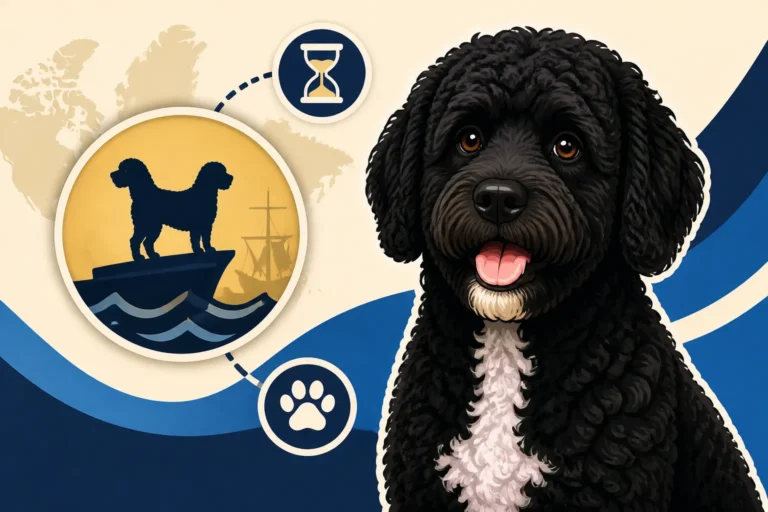
Whether Portuguese Water Dogs Still Work in Portugal
A Portuguese Water Dog on a fishing boat in the Algarve belongs to the breed’s history, but it is not a common sight in Portugal’s modern commercial fishing fleet. This guide explains what the dogs did, why that work faded, and what “working” means for Portuguese Water Dogs in Portugal today—from heritage demonstrations to water sports and life as active companions.
The Portuguese Water Dog’s original work in Portugal
A working partner for coastal fishing crews
The Portuguese Water Dog, known in Portuguese as the Cão de Água Português, developed along Portugal’s coast as a practical helper for fishermen. It was not simply a dog that enjoyed a swim. On a working boat, it could retrieve objects from the water, carry messages between boats and shore, and help with tasks around nets and equipment. Its strong swimming ability and willingness to work close to people made it useful in a setting where water was part of the everyday job.
The breed’s history is closely tied to fishing communities, including those along the Algarve and other stretches of the Portuguese coast. A dog working aboard a small fishing vessel needed to be responsive in a noisy, busy environment, steady around people and equipment, and comfortable getting into the water repeatedly. Those demands help explain why the breed is athletic, alert, and often keen to interact with its people. For more background, see What a Portuguese Water Dog Did for a Fishing Crew and How a Portuguese Water Dog Worked a Net.
These dogs were working animals, not decorative passengers. A crew needed a dog that could be useful while the boat was operating, rather than one that needed constant attention. In practical terms, a dog that could retrieve a dropped item or carry a message could contribute to the crew’s routine. The breed’s webbed feet and water-resistant coat supported the work, but the dog’s trainability and stamina mattered just as much.
Why the fishing role disappeared
The fishing work that shaped the breed did not remain a regular job as commercial practices changed. Boats, equipment, and communication methods evolved, reducing the need for a dog to carry out tasks that once made sense on a fishing vessel. As the everyday role diminished, Portuguese Water Dogs became less essential to the working fleet. Why Fishermen Stopped Needing the Portuguese Water Dog and How Engines Ended the Portuguese Water Dog's Job explore this transition.
This change was not a sudden decision that the breed could no longer work. It was a shift in what fishing crews needed. When a task can be done more reliably through modern equipment or a different routine, maintaining a dog for that task is no longer practical. The dogs’ abilities remained, but the job around them changed.
That distinction matters when people ask whether Portuguese Water Dogs still work in Portugal. The breed’s working heritage is real, but heritage does not mean that the original occupation continues at the same scale. A dog may still be capable of water work without being part of a commercial fishing crew. The difference is between a skill that survives in the breed and a job that remains common in the economy.
Do Portuguese Water Dogs still work in Portugal today?
Not usually as everyday fishing dogs
Portuguese Water Dogs are not commonly used as routine crew dogs on Portugal’s commercial fishing boats today. The old role is best understood as a historical occupation rather than a widespread modern one. A visitor walking along a working harbor should not expect to see the breed regularly retrieving fishing gear or carrying messages between vessels.
That does not mean no individual dog in Portugal ever helps around a boat or takes part in water-related work. Owners may involve their dogs in activities that draw on the breed’s abilities, and some may live near the coast or spend time around boats. But isolated examples are different from a standard, organized occupation across the fishing industry.
It is also helpful to separate “working dog” from “dog that works.” In breed discussions, “working” can describe historical purpose, formal competition, practical tasks, or simply regular training and activity. A Portuguese Water Dog that swims, retrieves, or participates in a trial is using skills associated with its heritage. That does not necessarily make it a commercial fishing dog.
Heritage, demonstrations, and water sports
In modern life, the breed’s connection to water is more likely to appear through training, recreation, demonstrations, and organized dog activities than through commercial fishing. A Portuguese Water Dog may practice retrieving objects, swimming to a handler, or completing structured water tasks. These activities can preserve elements of the breed’s history while giving the dog a safe, purposeful outlet.
The details vary by dog and owner. One family might take its dog swimming at an appropriate beach or lake; another might attend training sessions or explore water trials. Someone else may never take their dog into open water at all. Not every Portuguese Water Dog is automatically confident in every setting, and even a strong swimmer needs gradual, supervised introductions. The breed’s past is not a substitute for teaching an individual dog how to behave safely around water.
For readers curious about what these activities involve, What a Water Trial Asks a Portuguese Water Dog to Do explains the structured side of water work, while Whether Portuguese Water Dogs Still Work in Portugal is the broader question this guide addresses. The short answer is that the old fishing role is no longer a typical job, but water-related skills can still be practiced in modern settings.
| Meaning of “working” | What it can look like in Portugal today | How it relates to the breed’s history |
|---|---|---|
| Commercial fishing work | Not a common everyday role for the breed | Closely connected to the original occupation |
| Water training or trials | Structured tasks such as swimming and retrieving | Preserves selected working skills |
| Recreation with an owner | Supervised swimming, retrieving, or boating activities | Uses natural abilities without being a job |
| Active companion life | Training, exercise, and household activities | Gives the dog a purpose, though not a fishing role |
What the breed’s working heritage means for owners
The old job explains some modern behavior
A Portuguese Water Dog may be lively, curious, persistent, and inclined to carry objects around. Those traits can feel charming when the dog brings a toy to the sofa, but less charming when it takes a shoe, steals a dish towel, or invents its own game while its owner is on a call. These behaviors do not mean that every dog is a direct replica of a fishing dog. They do reflect a breed developed to stay engaged and work in partnership with people.
That is why a walk around the block may not satisfy every Portuguese Water Dog. Physical exercise helps, but so can short training sessions, retrieving games, scent activities, and predictable household tasks. The goal is not to recreate a fishing vessel in the living room. It is to give the dog suitable ways to use its energy and attention. Why a Portuguese Water Dog Needs a Job offers more ideas for building that kind of daily routine.
Owners outside Portugal can support active play with basic equipment and enrichment items. For example, a person looking for toys or routine dog supplies might compare options at Chewy or at local pet shops, while choosing items suited to the dog’s size and play style. Chewy is only one possible retailer; the useful point is to select safe, durable gear rather than assume a particular product will suit every dog. If a dog is a persistent chewer or tends to swallow objects, supervision and advice from a veterinarian are more important than the retailer.
Water instinct does not replace safety training
A breed’s history around water should never be treated as a guarantee that an individual dog can safely manage any water situation. Rivers, beaches, pools, and boat ramps create different risks. Currents, cold water, waves, slippery surfaces, and exhaustion can affect even a confident swimmer. A dog that rushes toward water also needs reliable recall and practice waiting at the bank or dock.
Start with calm, shallow conditions and let the dog approach at its own pace. Keep early sessions short, supervise closely, and use a well-fitted canine life jacket when conditions call for one, especially around boats or unfamiliar water. Avoid forcing a reluctant dog to swim. If you need guidance on introducing a puppy, see Teaching a Portuguese Water Dog Puppy to Enter Water. For owners gathering supplies, Chewy may be one place to compare general pet gear, but a life jacket should fit correctly and be appropriate for the dog and activity.
The breed’s traditional work also does not mean every dog will enjoy the same activities. Temperament, age, health, experience, and individual preference all matter. Some dogs are enthusiastic swimmers; others are more comfortable retrieving on land or learning scent work. A rewarding “job” should match the dog in front of you, not an idealized image of what the breed once did.
How to understand the Portuguese Water Dog’s place in Portugal
A living breed, not a living fishing custom
The Portuguese Water Dog remains connected to Portugal through its name, history, and identity, even though commercial fishing is no longer its typical occupation. The breed’s past is still worth understanding because it helps explain its physical design and many of its behavioral tendencies. But it is more accurate to say that the working tradition survives in the breed’s story and in selected activities than to suggest that Portuguese fishing crews still depend on these dogs as they once did.
This is a common source of confusion for prospective owners. Breed descriptions may call a dog a “working breed,” which can sound like a promise that it will naturally fit into a specific job. In reality, that label often points to historical purpose. The modern dog may need structured training and an owner who makes time for exercise and engagement, but it will not automatically know how to work safely around boats or perform a water task.
If you are considering the breed, think about your daily life rather than the romance of its history. Can you provide regular exercise, grooming, training, and company? Do you have a safe way to offer mental stimulation? You do not need to live beside the Algarve or own a boat to give a Portuguese Water Dog a satisfying life. A thoughtful mix of walks, play, training, and rest can suit many dogs better than occasional high-intensity water outings.
What to take away from the question
So, do Portuguese Water Dogs still work in Portugal? Generally, not in the traditional, routine role of assisting commercial fishing crews. The original work declined as fishing practices and equipment changed. Today, individual dogs may still take part in water activities, training, or demonstrations, and the breed’s working qualities remain important to its identity.
The clearest way to describe the situation is that the occupation faded, but the abilities and heritage did not. A Portuguese Water Dog can still enjoy retrieving, swimming, and learning tasks, but those activities are usually part of modern companionship or organized recreation—not a continuation of the old fishing job. For a broader look at the breed’s past, Where the Portuguese Water Dog Comes From and How a Portuguese Water Dog Drove Fish Toward a Net provide useful context.
For modern owners, the most practical lesson is to offer a safe, suitable outlet for the dog’s energy without assuming that every dog needs to swim or work on a boat. A water-loving dog may enjoy training and supervised swimming; another may prefer land-based games. If you are browsing for everyday enrichment supplies, Chewy can be one option among many, but choose activities around your dog’s comfort, health, and training—not simply its historical reputation.
Disclaimer
This article is for general informational purposes only and does not constitute professional advice. Laws, prices and regulations vary by location and change over time. Consult a qualified professional for guidance on your specific situation.