Why a Portuguese Water Dog’s Tail Works as a Rudder
It's quite amazing, isn't it? You watch a Portuguese Water Dog powering through the water, making sharp turns, or diving with incredible agility, and you might not immediately realize just how crucial every part of their body is to that performance. Many people think a dog's tail is mostly for balance on land or expressing emotion, but for a PWD, it's so much more. This guide is going to dive deep into exactly why the Portuguese Water Dog's tail acts like a sophisticated rudder, turning your beloved companion into a highly efficient aquatic athlete.
The Portuguese Water Dog's Tail: More Than Just Wags
When you look at a Portuguese Water Dog, their tail often stands out. It's usually thick at the base, tapering to a point, and covered in that characteristic curly or wavy coat. But its appearance is only part of the story; its design and function are deeply intertwined with the breed's historical purpose and their incredible swimming abilities. This isn't just a pretty appendage; it's a vital piece of their aquatic engineering.
A Natural Extension of Their Body
The tail of a Portuguese Water Dog isn't merely an external feature; it's a direct continuation of their spine, rich with powerful muscles and nerve endings that allow for an incredible range of motion and fine control. Think of it as a natural extension of their core, intimately connected to their overall body mechanics. These powerful muscles allow the tail to sweep from side to side with force and precision, providing propulsion and direction. On land, it helps them balance when running, jumping, or changing direction suddenly, much like a tightrope walker uses a pole. But in the water, where buoyancy and resistance completely change the dynamics, this musculature and skeletal structure take on an even more critical role. It allows them to use their tail not just for a gentle nudge in one direction, but for powerful, controlled steering. Their entire body is designed for water work, and the tail is a testament to this, perfectly adapted to complement their powerful swimming strokes and webbed feet. You can often see How a Portuguese Water Dog's Tail Should Be Carried even in their stance, reflecting its strength and importance.
Historical Context: Working the Fishing Boats
To truly understand the PWD's tail as a rudder, you have to look back at their origins. These dogs weren't bred as pampered companions; they were indispensable working partners on the fishing boats along Portugal's coast. Their job was incredibly demanding, requiring them to be agile, strong, and highly intelligent in often treacherous waters. They would retrieve lost tackle and broken nets, carry messages between boats, and even "herd" fish into nets. Imagine trying to maneuver in choppy seas to bring a floating net back to the boat, or diving for a dropped rope. These tasks required not just swimming ability, but precise navigation and the capacity to change direction quickly and efficiently without losing momentum. This is where the tail came into its own. It allowed them to perform intricate maneuvers, making tight turns around obstacles or adjusting their course to catch a rapidly moving fish. The fishermen relied on this unique capability, and over generations, the breed developed this powerful, responsive "rudder" as a key tool in their aquatic toolkit. Without it, their efficiency and effectiveness on the high seas would have been significantly compromised, which is why Why a Portuguese Water Dog's Tail Is Never Docked is so important to their breed standard.
How the Tail Functions as a Rudder in Water
When a Portuguese Water Dog enters the water, it's like watching a finely tuned submarine come to life. Their entire body, from their powerful hindquarters to their distinctive tail, works in concert to achieve unparalleled agility and speed. The tail's role, in particular, becomes incredibly obvious once you know what to look for. It's not just a passive appendage; it's an active, dynamic steering mechanism.
Steering and Balance in Dynamic Environments
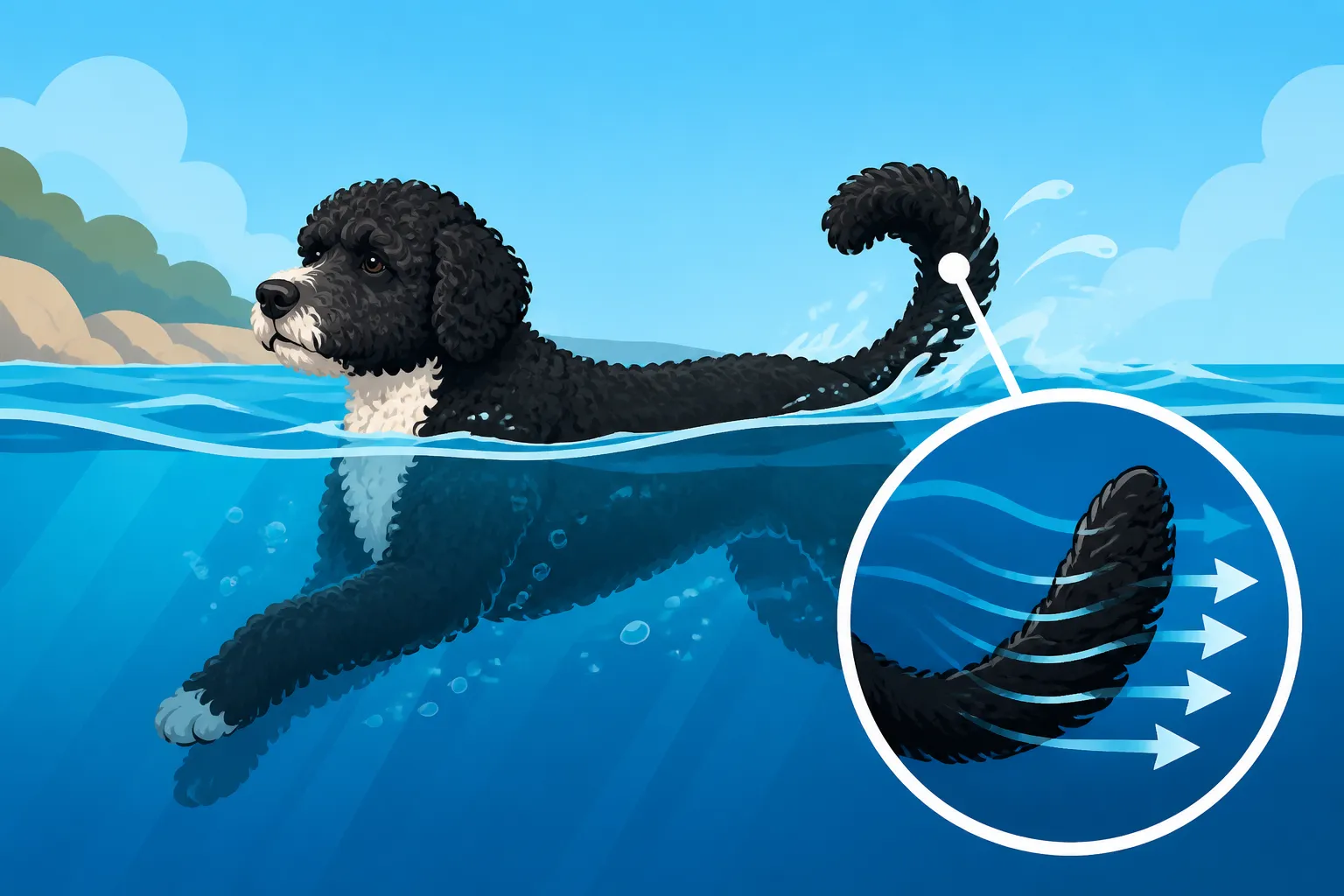
Picture a PWD swimming at full speed. Their powerful hind legs and webbed feet provide the primary propulsion, churning the water to drive them forward. But what happens when they need to make a sudden ninety-degree turn to chase a thrown bumper, or adjust their course to avoid a submerged log? This is where the tail, acting as a true rudder, comes into play. By sweeping their tail vigorously from side to side, they can generate lateral force, effectively pushing water in one direction to propel their body in the opposite direction. It’s exactly how a boat's rudder works: a small movement at the stern translates into a significant change in direction for the entire vessel.
Moreover, the tail provides vital balance. When a dog is swimming through waves or strong currents, stability is paramount. A sudden shift in water can easily throw them off course or even destabilize them. The PWD's strong, muscular tail can act as a counterbalance, making minute adjustments to keep their body aligned and maintain their desired trajectory. This allows them to conserve energy, as they don't have to constantly fight against disruptive forces with their larger limbs. It's this precise control that made them so invaluable to the fishermen, enabling them to retrieve heavy nets or dive efficiently, even in less-than-ideal conditions. Watching a PWD perform in a dock diving event or a water trial truly showcases this steering prowess. They hit the water, launch themselves after a toy, and then, mid-swim, with a flick of the tail, they can adjust their angle of attack to grab the toy perfectly. How a Portuguese Water Dog Swims in a Lake is a great demonstration of this agility.
Counterbalance and Stability
Beyond just directional steering, the tail provides critical counterbalance and stability. Imagine a dog trying to dive for an object underwater. To descend efficiently and maintain a specific depth or angle, they need more than just downward thrust. Their tail can be angled and swept to control their pitch and roll, ensuring they don't tumble head-over-heels or drift uncontrollably. It helps them maintain a streamlined position, reducing drag and making their movements more efficient.
This counterbalancing act is especially vital during rapid changes in speed or direction. If a PWD accelerates suddenly, the tail can be used to prevent their hindquarters from lagging, keeping their body in a more hydrodynamic line. Conversely, if they brake quickly, the tail can help stabilize their body against the sudden deceleration. This isn't unlike how a diver uses their arms and legs for fine adjustments in the water to maintain perfect form. The tail allows the Portuguese Water Dog to be incredibly nimble and stable, whether they are navigating tight spaces between boats, retrieving a far-flung item, or just enjoying a vigorous swim. This anatomical advantage, combined with their strong How Much a Portuguese Water Dog's Webbing Adds to Its Speed, truly makes them masters of the aquatic environment.
Here's a quick comparison of tail function:
| Function | On Land | In Water |
|---|---|---|
| Balance | Aids in running, jumping, tight turns | Critical for stability in currents/waves, diving |
| Steering | Minor role in sharp direction changes | Primary rudder for precise directional control |
| Propulsion | Minimal; primarily legs | Secondary propulsion; helps maintain momentum |
| Communication | Expresses emotion (excitement, fear) | Still expresses emotion; also active work tool |
| Counterbalance | Helps prevent falls or tumbles | Essential for dynamic movements, dives, turns |
Training and Conditioning for Optimal Tail Use
While the Portuguese Water Dog's tail is a marvel of natural engineering, its effective use, especially in complex water tasks, benefits immensely from proper training and conditioning. You wouldn't expect a human swimmer to perform at their peak without practice and physical fitness, and the same goes for our canine companions. Encouraging their natural instincts and ensuring their physical well-being are key to unlocking their full potential.
Encouraging Natural Water Instincts
The good news is that for most PWDs, the desire to be in the water is deeply ingrained. They were bred for it, after all! However, not every puppy is born a fearless swimmer, and even those with strong instincts benefit from positive, guided introductions. The goal is to build confidence and refine their natural abilities, allowing their tail-as-rudder mechanism to develop and be utilized instinctively. Start with shallow, calm water, making it a fun and positive experience. Never force them. Use encouraging words and high-value treats. Toys are often a great motivator. Many owners find floating retrieve toys from brands available on platforms like Amazon to be excellent for enticing their PWD into the water.
Begin by simply allowing them to wade, gradually increasing depth as they become more comfortable. Praise every brave step. Once they are confident wading, you can gently encourage them to swim short distances. This is where you'll start seeing that tail come alive, subtly (or not so subtly!) adjusting their course. Puppy classes, even those not water-specific, can build general confidence and obedience that translates well to new environments. Teaching a Portuguese Water Dog Puppy to Enter Water slowly and positively is far more effective than just throwing them in. Remember, the earlier positive water experiences begin, typically after their initial vaccinations are complete, the better, though The Age a Portuguese Water Dog Can Start Swimming varies by individual. A good online puppy school, like the one offered by BAXTER & Bella, can also provide foundational obedience training that builds confidence for any new experiences, including water.
The Role of Core Strength and Overall Fitness
A powerful, responsive tail doesn't operate in isolation; it's part of a robust, athletic body. Just as a strong core is essential for human athletes, it's critical for a PWD's aquatic performance. The muscles that control the tail are intricately linked to the muscles of their back, abdomen, and hindquarters. Therefore, maintaining overall fitness and specific core strength will directly enhance their tail's effectiveness as a rudder. Regular exercise, beyond just swimming, is vital. This includes varied walks, runs, and even specific conditioning exercises like walking on uneven surfaces or controlled climbs.
Proper nutrition also plays a huge role. An athletic dog needs high-quality food to fuel their muscles and support their energy levels. Ensure your PWD is at a healthy weight, as excess weight will put undue strain on their joints and make them less agile in the water. Remember, these dogs are built for endurance and power. Feeding an Athletic Portuguese Water Dog with a balanced diet will give them the necessary fuel to develop and maintain the strong musculature required for peak performance, ensuring that their natural rudder remains highly effective for all their water adventures. A fit PWD is a happy PWD, and a truly agile one in the water.
Observing and Appreciating the PWD's Tail
Living with a Portuguese Water Dog offers countless opportunities to observe their incredible athleticism, especially in the water. Once you understand the critical role their tail plays as a rudder, you'll start seeing it in action all the time, adding a whole new layer of appreciation for this remarkable breed.
Signs of a Healthy, Working Tail
A healthy Portuguese Water Dog's tail is a dynamic and expressive appendage. It should be thick at the base, tapering to the tip, and carried naturally when the dog is relaxed – often in a loose curve over their back or hanging down, depending on their mood and activity. When swimming, you'll see it actively working, sweeping side to side, often with more subtle movements for fine adjustments and larger, more powerful sweeps for sharp turns. Watch how your PWD uses their tail when they dive for a toy, or when they navigate around a person in the water. It’s a constant dance of adjustment and propulsion.
Beyond its physical mechanics, the tail is also a powerful indicator of your dog's emotional state and overall health. A happy, excited PWD will often have a tail that wags with gusto, or curls over their back in a proud arc. A tail held low or tucked can indicate fear, pain, or discomfort. While rare, any sudden changes in tail carriage, an inability to move it, or signs of pain (like yelping when it's touched) should prompt a visit to your vet. Occasionally, a condition known as "swimmer's tail" or "limber tail" can affect working dogs, causing temporary lameness or pain in the tail. Recognizing these signs and understanding what a healthy tail looks like is part of responsible PWD ownership. When their tail is working efficiently as a rudder, it’s a beautiful thing to witness – a testament to their heritage and adaptability.
Why the Tail is Never Docked
Given the incredible utility and natural importance of the Portuguese Water Dog's tail, it should come as no surprise that the breed standard explicitly calls for an undocked tail. In fact, docking is widely considered a severe fault in the show ring, and more importantly, it would severely compromise a PWD's ability to perform the very tasks they were bred for. The full length and musculature of the tail are absolutely essential for its function as a rudder, for balance, and for providing that crucial extra bit of propulsion and steering control in the water. Without their tail, a PWD would be significantly hampered in their ability to maneuver, dive, and maintain stability in dynamic aquatic environments.
Historically, the tail served a practical purpose on the fishing boats, not just as a rudder but also as a visible marker in the water, especially if the dog went far from the boat or was working in low light. The tail plume, often left longer in a traditional What the Lion Clip Leaves and What It Takes, added to this visibility and likely aided in tactile feedback in the water. To remove this vital working tool would be akin to removing the propeller from a boat or the rudder from a sailboat – it would fundamentally alter their purpose and capabilities. This commitment to preserving the PWD's natural tail is a testament to the breed's working heritage and a recognition of its indispensable role in their overall design and functionality. It ensures that every Portuguese Water Dog retains the natural equipment that makes them such exceptional aquatic companions.
Disclaimer
This article is for general informational purposes only and does not constitute professional advice. Laws, prices and regulations vary by location and change over time. Consult a qualified professional for guidance on your specific situation.