Where the Portuguese Water Dog Ranks for Obedience Intelligence
Many prospective Portuguese Water Dog owners, and even some current ones, wonder how intelligent these remarkable dogs truly are when it comes to obedience. It's a common frustration to hear conflicting information or to find your clever companion isn't always doing exactly what you ask, making you question where they stand in the canine IQ hierarchy. This comprehensive guide will delve into what "obedience intelligence" really means for a Portuguese Water Dog, how their unique history has shaped their smarts, and how best to harness their clever minds through effective training.
What "Obedience Intelligence" Really Means for a Dog
When we talk about "obedience intelligence" in dogs, most people are thinking about how quickly a dog learns commands and how consistently they perform them. This is often what popular "smartest dog breeds" lists measure. These rankings are usually based on a combination of factors: how many repetitions it takes for a dog to learn a new command and the success rate of obeying a known command on the first try. While these metrics offer a snapshot of a dog's trainability and willingness to please, they don't tell the whole story of a breed's overall intelligence or problem-solving abilities.
For many working breeds, including the Portuguese Water Dog, intelligence goes far beyond rote obedience. It encompasses their ability to adapt to new situations, their problem-solving skills, their memory, and even their emotional intelligence. A dog that learns a "sit" command in two repetitions might be considered "more intelligent" by some measures, but a dog that can figure out how to open a childproof gate or lead you to a lost item showcases a different, equally impressive kind of intelligence. It’s important to distinguish between a dog’s innate cognitive abilities and their desire to comply with human commands, which can be influenced by breed traits, individual personality, and training methods.
The concept of "working intelligence" or "instinctive intelligence" often gets overlooked in these obedience rankings. This refers to a dog's inherent ability to perform the tasks they were bred for – like a Border Collie herding sheep or, in our case, a Portuguese Water Dog retrieving nets from the sea. These are complex behaviors requiring significant cognitive processing, decision-making, and often, independent thought. While a dog might not be at the top of a list for learning "stay" in record time, their ability to perform intricate historical tasks speaks volumes about their mental prowess.
It's a common pitfall to solely equate intelligence with immediate and perfect obedience. Many dog owners get frustrated when their brilliant dog seems to "know" a command but chooses not to execute it flawlessly every single time. This isn't necessarily a lack of intelligence; it's often a sign of a dog that thinks for itself, assesses situations, and sometimes, decides that their own agenda is more pressing at that moment. This independence, especially characteristic of a Portuguese Water Dog, is a form of intelligence that requires a different approach to training than simply drilling commands.
The Portuguese Water Dog's Unique Intelligence Profile
The Portuguese Water Dog's intelligence is deeply rooted in their history as working dogs for the fishing fleets along the coast of Portugal. They weren't just pretty faces; they were vital members of the crew, performing a variety of complex tasks that required not only physical prowess but also keen mental acuity and independent problem-solving. This background has shaped a dog that is highly intelligent, eager to learn, but also possesses a streak of independence and a strong will.
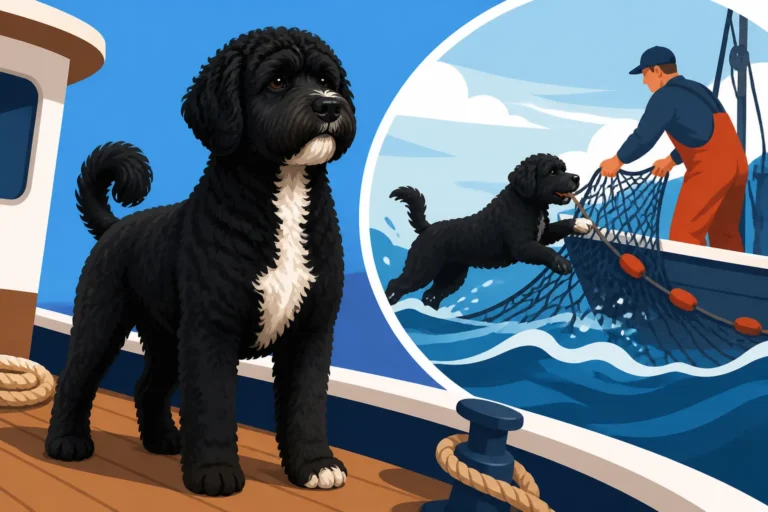
These dogs were traditionally tasked with retrieving lost tackle, herding fish into nets, carrying messages between boats, and even guarding the catch. Think about the mental challenge involved in "herding fish" – that's not a simple fetch command! It required understanding currents, anticipating fish movements, and working collaboratively yet independently with their human partners. This bred a dog that is incredibly perceptive and quick-thinking, always scanning their environment and ready to spring into action. How a Portuguese Water Dog Drove Fish Into a Net goes into more detail about these fascinating historical roles.
Because they often worked far from their handlers, sometimes in challenging conditions, Portuguese Water Dogs developed a remarkable ability to think for themselves. They weren't bred to be automatons; they were partners who could make their own decisions when necessary. This means they are often highly intelligent problem-solvers who can quickly learn sequences of tasks and adapt to new situations. However, this independence can sometimes be misinterpreted as stubbornness if an owner expects unquestioning obedience. It’s not that they don’t understand; it’s that they might have an opinion on the best way to do something, or even if it needs doing at all.
Their intelligence also manifests in their incredible memory. They remember commands, people, places, and routines with impressive accuracy. Once a Portuguese Water Dog learns something, they tend to retain it for a very long time, whether it's a complicated trick or the path to their favorite swimming spot. This makes them excellent candidates for advanced training and dog sports like agility, obedience trials, and especially water work, where their natural instincts and intelligence truly shine. What a Water Trial Asks of a Portuguese Water Dog details some of these demanding activities.
How a Portuguese Water Dog's History Shaped Its Smart Thinking
The very survival and utility of the Portuguese Water Dog depended on their intelligence. Imagine being out at sea, relying on your dog to retrieve equipment that's gone overboard in rough waters. That requires a dog that can quickly assess the situation, understand the task, and execute it efficiently. Their webbed feet and powerful bodies were for swimming, but their brains were for knowing what to swim for and how to get it back safely. How a Portuguese Water Dog Was Bred to Work a Boat, Not a Yard explores this background further.
Their role as a companion and worker on a boat also fostered a deep connection with humans. While independent, they are intensely bonded with their families, thriving on interaction and having a "job" to do alongside their people. This desire to be involved and to contribute makes them highly engaged learners, eager to participate in training activities, provided those activities are stimulating and rewarding. They respond exceptionally well to positive reinforcement and methods that make them feel like active participants rather than just recipients of commands.
This breed's intelligence also makes them highly observant. They pick up on subtle cues from their environment and from their human companions. This can be a double-edged sword: they learn good habits quickly, but they can also learn bad habits with equal speed if not properly managed. For example, a PWD might quickly figure out that counter-surfing yields tasty rewards or that barking gets attention, if those behaviors are inadvertently reinforced. Consistency in training and clear boundaries are absolutely essential for a dog with this level of observational intelligence.
Moreover, their capacity for empathy and social understanding is also a hallmark of their intelligence. Portuguese Water Dogs are known for being sensitive to their owners' moods and can be very comforting companions. This emotional intelligence, while not directly related to obedience commands, is a significant part of what makes them such wonderful and intelligent family members. It contributes to their overall ability to interact and live harmoniously in a human household. A Portuguese Water Dog With Children and Other Dogs talks about their social dynamics.
Training a Portuguese Water Dog to Excel
Training a Portuguese Water Dog isn't just about repetition; it's about engaging their brilliant minds and leveraging their desire to work alongside you. Their high intelligence means they can get bored with monotonous drills, and a bored PWD can quickly become a mischievous PWD. Variety, challenge, and positive reinforcement are key to successful training.
Engaging Their Minds with Varied Training
Portuguese Water Dogs thrive on mental stimulation. Instead of drilling the same 'sit-stay' command for twenty minutes, try incorporating it into a game or a more complex sequence. For instance, have them sit, then retrieve a toy from the water, then come to a heel, then sit again. This keeps them thinking and prevents boredom. Puzzle toys are also a fantastic way to engage their intelligence, though many PWDs will solve them faster than you can unpack them from an Amazon delivery box! They love to figure things out, so make training a puzzle for them to solve with your guidance.
When teaching new commands, break them down into small, achievable steps and reward generously for each success. Because they are so smart, they can sometimes anticipate what you want before you even finish the command, which can be both impressive and a bit challenging. Be precise with your cues and body language. For new owners, or even experienced ones looking for a structured approach, online training programs like those from BAXTER & Bella can be incredibly helpful. They offer comprehensive modules that cater to a dog's natural intelligence and provide tools for consistent, positive training.
Remember, a Portuguese Water Dog that "offers its own solution" instead of immediately obeying isn't necessarily being disobedient; they might genuinely believe their idea is better or more efficient. This is where patience and clear communication become vital. Redirect their cleverness into the desired behavior with enthusiasm and reward. They respond much better to being guided and motivated than to harsh corrections. What a Harsh Word Does to a Portuguese Water Dog's Water Work emphasizes the importance of positive methods.
Consistency and Clear Boundaries
While Portuguese Water Dogs are intelligent, they are also excellent at testing boundaries. Their smarts mean they'll quickly learn what they can get away with. This isn't malice; it's just a highly intelligent dog exploring its world and its limits. Consistency from all family members is paramount. If one person allows counter-surfing and another doesn't, the dog will quickly learn which person to exploit. Establish rules early, communicate them clearly to your dog, and ensure everyone in the household enforces them uniformly.
Early socialization and puppy classes are incredibly beneficial, not just for exposure to other dogs and people, but also for laying a foundation for consistent training in a structured environment. These classes often introduce various commands and challenges that appeal to a PWD's intelligence. Continuing with advanced obedience or even dog sports after puppyhood helps maintain that mental engagement throughout their lives. Their keen minds truly flourish when regularly challenged and given a purpose.
A key aspect of consistent training is making sure your PWD gets enough physical and mental exercise. An under-exercised Portuguese Water Dog is a prime candidate for using their intelligence to invent their own, often destructive, entertainment. Swimming, long walks, retrieving games, and interactive play are essential. How Many Miles a Portuguese Water Dog Needs on a Dry Day and Whether Swimming Tires a Portuguese Water Dog Enough provide insights into their exercise needs. A tired PWD is a well-behaved PWD, much more receptive to training and less likely to engage in unwanted behaviors.
Beyond the Rankings: Real-World Signs of PWD Intelligence
Forget the arbitrary numbers on a list; the true measure of a Portuguese Water Dog's intelligence comes from their everyday actions and their ability to integrate seamlessly into a human household. They might not always jump to attention at a moment's notice, but they display intelligence in countless other ways that make them exceptional companions.
Problem-Solving and Adaptability
One of the most striking aspects of PWD intelligence is their problem-solving ability. Owners often recount stories of their PWDs figuring out how to open gates, retrieve items from seemingly impossible locations, or even communicate their needs through complex sequences of actions. My own PWD, Finn, once figured out how to open a childproof gate by systematically trying different angles and pressure points, all to get to a coveted tennis ball on the other side. He didn't just push; he thought about it. This kind of ingenuity is far more impressive than simply sitting on command.
They are also incredibly adaptable. Whether you're moving to a new home, introducing a new pet, or changing your daily routine, a Portuguese Water Dog will generally adjust well, provided they feel secure and connected to their family. This adaptability speaks to a high level of cognitive flexibility, allowing them to process new information and integrate it into their understanding of the world. This is especially useful for a dog that might accompany you on various adventures, from boat trips to hiking trails. How a Portuguese Water Dog Adjusts to a New Home touches on this adaptability.
Their ability to learn and respond to subtle environmental cues is another sign of their intelligence. They often seem to know when you're getting ready for a walk before you even pick up the leash, or when it's time for their favorite swimming activity. This isn't just routine; it's an intelligent dog paying close attention to patterns and anticipating events, showcasing a deep understanding of their world.
Communication and Connection
Portuguese Water Dogs are excellent communicators. They use a wide range of vocalizations, body language, and even their mouths (often called "mouthing") to express themselves. They can communicate a desire to play, an urge to go outside, or even discomfort with surprising clarity. Learning to "read" your PWD's communication style is key to understanding their intelligent expressions. This open line of communication fosters a strong bond and allows for a more harmonious partnership.
Their intense connection with their families is also a testament to their intelligence. They are often described as "velcro dogs," constantly seeking to be near their people and participate in whatever they are doing. This isn't just clinginess; it's an intelligent dog who understands the dynamics of their family unit and seeks social interaction and belonging. They thrive on being part of the pack, demonstrating a sophisticated understanding of social structures.
Ultimately, while the Portuguese Water Dog might not always be at the absolute top of every "smartest breeds" list focused purely on immediate obedience response, their overall intelligence, problem-solving capabilities, adaptability, and deep connection with humans place them among the most intelligent and rewarding canine companions you could ever have. They are thinking, feeling partners, and that's a ranking that truly matters.
| Aspect of Intelligence | Description for Portuguese Water Dogs |
|---|---|
| Obedience Learning | Learn commands quickly, but may require engaging methods to maintain interest and consistent application due to independent nature. Often excel with positive reinforcement. |
| Problem-Solving | Highly adept at figuring things out, whether it's opening doors, finding hidden toys, or navigating complex environments. This is a strong suit from their working history. |
| Adaptability | Generally adjust well to new situations, routines, and environments, showcasing cognitive flexibility. |
| Memory | Possess excellent long-term memory for commands, people, and routines. Once learned, usually retained. |
| Instinctive | Strong natural aptitude for water work, retrieving, and collaborative tasks, stemming from their original purpose with fishermen. |
| Observational | Quick to pick up on subtle cues, patterns, and habits in their environment and from their human companions. |
| Emotional/Social | Sensitive to human moods, capable of forming deep bonds, and understand social dynamics within the family. |
Disclaimer
This article is for general informational purposes only and does not constitute professional advice. Laws, prices and regulations vary by location and change over time. Consult a qualified professional for guidance on your specific situation.