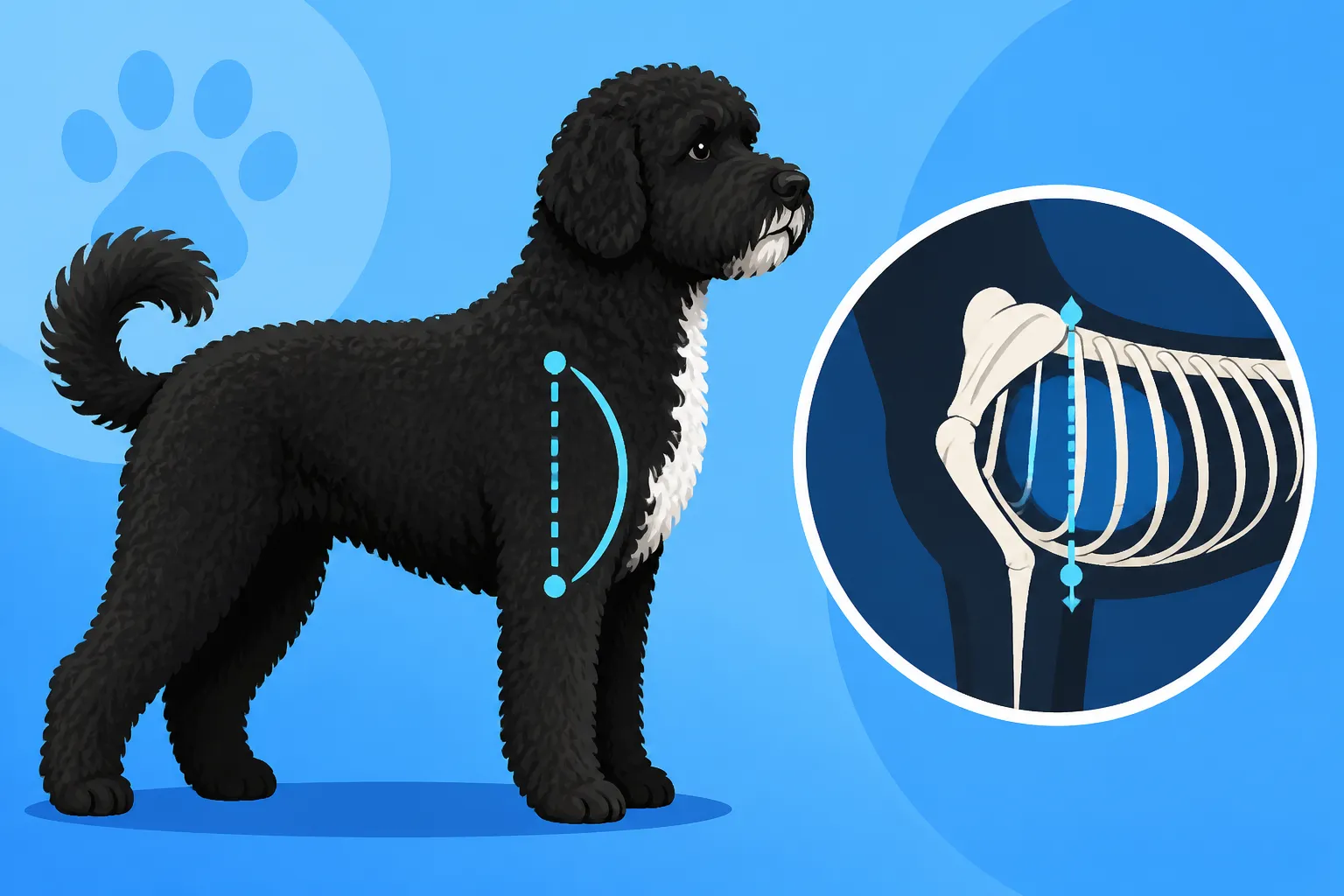
How Deep a Portuguese Water Dog’s Chest Should Be
A Portuguese Water Dog’s chest should be deep enough to reach the elbows, with well-sprung ribs that give the body room without making it look barrel-shaped. That description can be hard to picture on a curly, shaggy dog, especially when you are comparing a puppy, a pet, and a show prospect. This guide explains what chest depth means, how to assess it, and when a body-shape concern deserves a veterinarian’s attention.
What chest depth means in a Portuguese Water Dog
The breed’s chest should reach the elbows
In the Portuguese Water Dog, chest depth describes how far the chest extends downward from the topline toward the underside of the body. The breed standard describes a deep chest reaching the elbows. In practical terms, when the dog is standing naturally, the lowest part of the chest should come down to about the level of the elbow joint, where the front leg meets the body.
That is a proportion, not a fixed measurement in inches. A larger dog will have a larger chest than a smaller dog, but the relationship between the chest and the legs is what matters. The standard’s wording gives a useful visual guide; it is not an instruction to judge every dog with a ruler or to expect a perfectly identical outline.
The coat can make this harder to see. A Portuguese Water Dog may have a curly or wavy coat, and longer hair around the chest and underside can obscure the body’s outline. If you are trying to assess structure, look at the dog standing squarely on a level surface and gently feel through the coat rather than relying on a quick glance. For more about the overall outline, see What a Correct Portuguese Water Dog's Outline Looks Like.
Depth is different from chest width and girth
Chest depth is often confused with chest width or girth. Depth is the top-to-bottom dimension: from the back down toward the sternum and underside. Width describes how broad the chest is across the front, while girth is the distance around the body behind the front legs. These are related features, but they are not interchangeable.
The breed is expected to have a substantial, well-developed chest, with ribs that are well sprung. “Well sprung” means the ribs curve outward from the spine and then toward the underside of the body. It does not mean the ribs should bulge dramatically or that the dog should look round from every angle. A deep chest can still appear athletic and balanced.
| Feature | What it describes | What to look for |
|---|---|---|
| Chest depth | Top-to-bottom distance | Chest reaches approximately to the elbows |
| Chest width | Side-to-side breadth | A developed front without an excessively broad or heavy appearance |
| Rib spring | Curve of the ribs | A rounded, supportive rib cage that narrows toward the underside |
| Girth | Distance around the torso | A practical measurement often used for harness fitting |
If you are comparing your dog with a breed description, keep these distinctions in mind. A dog can have a deep chest without being overweight, and a dog can have a large girth because of coat, body condition, or measurement technique without having unusually deep structure. The wider context of size and proportion is covered in What a Portuguese Water Dog Weighs and How Tall It Stands.
How to assess chest depth at home
Check posture and use a consistent view
Start with your dog standing naturally on a flat, non-slip surface. The front legs should be reasonably straight beneath the shoulders, the head in a neutral position, and the dog neither stretched forward nor leaning back. A dog that is reaching for a treat, slouching, or standing with one front foot out of place can look quite different from one moment to the next.
Look at the dog from the side, then compare the bottom of the chest with the elbow. You can gently feel for the elbow joint through the coat and identify the underside of the chest without pressing hard. The goal is to understand the general relationship, not to pin the dog into a show pose or force the legs into position. If the coat is especially full, you may need to feel through it to distinguish the chest from the hair.
Take more than one look. A dog’s posture changes with fatigue, excitement, a slippery floor, or the position of its feet. If you want to keep a record, take a side-view photo with the dog standing naturally, and repeat it later from a similar angle. Measurements and photos are useful for tracking changes, but they do not replace an examination by a veterinarian or an assessment by an experienced breed evaluator.
Measure carefully when fit is the reason
If your real concern is a harness, measure the girth around the broadest part of the rib cage, usually just behind the front legs, and follow the harness maker’s fitting instructions. That measurement is not the same as chest depth. A flexible tape should lie flat against the coat without squeezing the body; if the dog has a dense coat, part the hair enough to avoid measuring a puff of fur.
A soft sewing tape is often easier to use than a rigid ruler, and pet-supply retailers such as Chewy may carry basic measuring supplies. If your dog dislikes being handled, make the process brief: let the dog sniff the tape, reward calm standing, and take the measurement in a few short steps rather than restraining them. Never wrap a tape tightly around the chest or leave it around the dog unattended.
Harness fit matters for comfort and movement. A harness that is too tight can rub behind the elbows, while one that is too loose may shift or allow the dog to back out of it. If you are shopping on Chewy or elsewhere, use the manufacturer’s size chart and compare the actual girth measurement with the listed range; do not select a size based only on breed name or estimated weight. For a swimming dog, check that straps do not chafe when wet, and remove the harness after use so the coat and skin can dry.
How age, coat, and activity affect appearance
Puppies do not have their adult proportions yet
A Portuguese Water Dog puppy grows unevenly. At different stages, legs may look long, the body may seem narrow, or the chest may appear shallow compared with the adult outline. Growth is not perfectly symmetrical from week to week, and a puppy’s stance can change how deep the chest seems. Avoid treating one awkward growth phase as a permanent structural problem.
The adult proportions develop over time, so a puppy’s current chest depth does not necessarily predict the final appearance with precision. A responsible breeder can explain how the puppy’s relatives developed and what changes are typical in their lines, but even experienced breeders cannot promise an exact adult outline from a young puppy. The breed’s general body shape is discussed in How Deep a Portuguese Water Dog's Chest Should Be—and for a broader view of maturity and size, consult The Age a Portuguese Water Dog Stops Growing.
If you have a puppy and notice a sudden change in posture, reluctance to move, or signs of discomfort, treat that as a health question rather than a conformation question. A puppy that seems weak, painful, or unusually tired needs a veterinary assessment. Normal growth can look ungainly; persistent pain or a sudden loss of function should not be written off as “just a phase.”
Coat and body condition can disguise the outline
A long coat can make the chest look fuller or lower than it is, while a freshly clipped coat may reveal more of the underlying shape. Wet curls can also hang differently from dry ones. For a fair comparison, assess the dog with the coat in its usual condition and use your hands gently to locate the chest and elbow rather than relying on hair length.
Body condition matters too. Extra weight may soften the outline of the rib cage and make the underside appear lower, while a very lean dog may show more definition. Neither coat appearance nor a single view is enough to determine whether a dog is at a healthy weight. Use your veterinarian’s body-condition assessment alongside how the dog feels and moves. What a Portuguese Water Dog's Feet Should Look Like and Why a Portuguese Water Dog Is Built to Swim offer additional context for understanding the breed’s working structure.
Chewy and other pet retailers can be useful when you need grooming or measuring basics, but products cannot tell you whether a dog’s body condition is appropriate. If you are unsure whether you are feeling ribs, muscle, or coat, ask your veterinary team to demonstrate during a routine visit. That quick hands-on explanation is often far more useful than comparing a shaggy dog with a photograph online.
When chest shape is a concern
Normal variation is not the same as a medical problem
Dogs vary in build, and a pet does not need to match a show-ring silhouette exactly to be a healthy companion. Chest depth should be considered alongside the dog’s overall proportions, movement, condition, age, and family background. A dog may look somewhat different from a written standard and still move comfortably and enjoy normal activity.
A markedly shallow-looking chest, an unusual outline, or a difference between the left and right sides is worth discussing with a veterinarian, particularly if it is new or accompanied by other changes. Pay attention to breathing difficulty, exercise intolerance, persistent coughing, weakness, pain, or a reluctance to jump or walk. Those signs call for medical attention; they cannot be diagnosed by judging chest depth from a photograph.
For breeding or show questions, speak with a knowledgeable Portuguese Water Dog breeder or a qualified conformation evaluator who can assess the dog in person. Chest depth is only one part of structure. A full evaluation also considers balance, movement, topline, shoulders, legs, and how the dog functions. What a Portuguese Water Dog Judge Puts a Hand On First explains why a hands-on assessment can reveal details hidden by coat and stance.
A practical checklist for owners
When you check your dog’s chest, focus on a relaxed, repeatable observation rather than trying to produce a perfect measurement. Stand the dog on level ground, look from the side, locate the elbow through the coat, and compare it with the bottom of the chest. If you are measuring for equipment, take the girth measurement separately and use the sizing instructions for that specific harness.
Keep a note of what prompted your concern. Is the dog a growing puppy? Has the coat recently been clipped? Is the concern about appearance, harness fit, weight, or a change in breathing or movement? Answering that question helps you choose the right next step. A harness issue may call for a different fit; a sudden health change calls for a veterinarian.
The breed’s deep chest reflects its athletic, working-dog build, but no single measurement explains a Portuguese Water Dog’s health or quality. Use the elbow as a practical visual reference, account for coat and posture, and ask for an in-person assessment when you are uncertain. For additional background on proportions and breed type, see How Tall a Portuguese Water Dog Stands, Which Coat Types a Portuguese Water Dog Comes In, and What a Portuguese Water Dog Did for a Fishing Crew.
Disclaimer
This article is for general informational purposes only and does not constitute professional advice. Laws, prices and regulations vary by location and change over time. Consult a qualified professional for guidance on your specific situation.