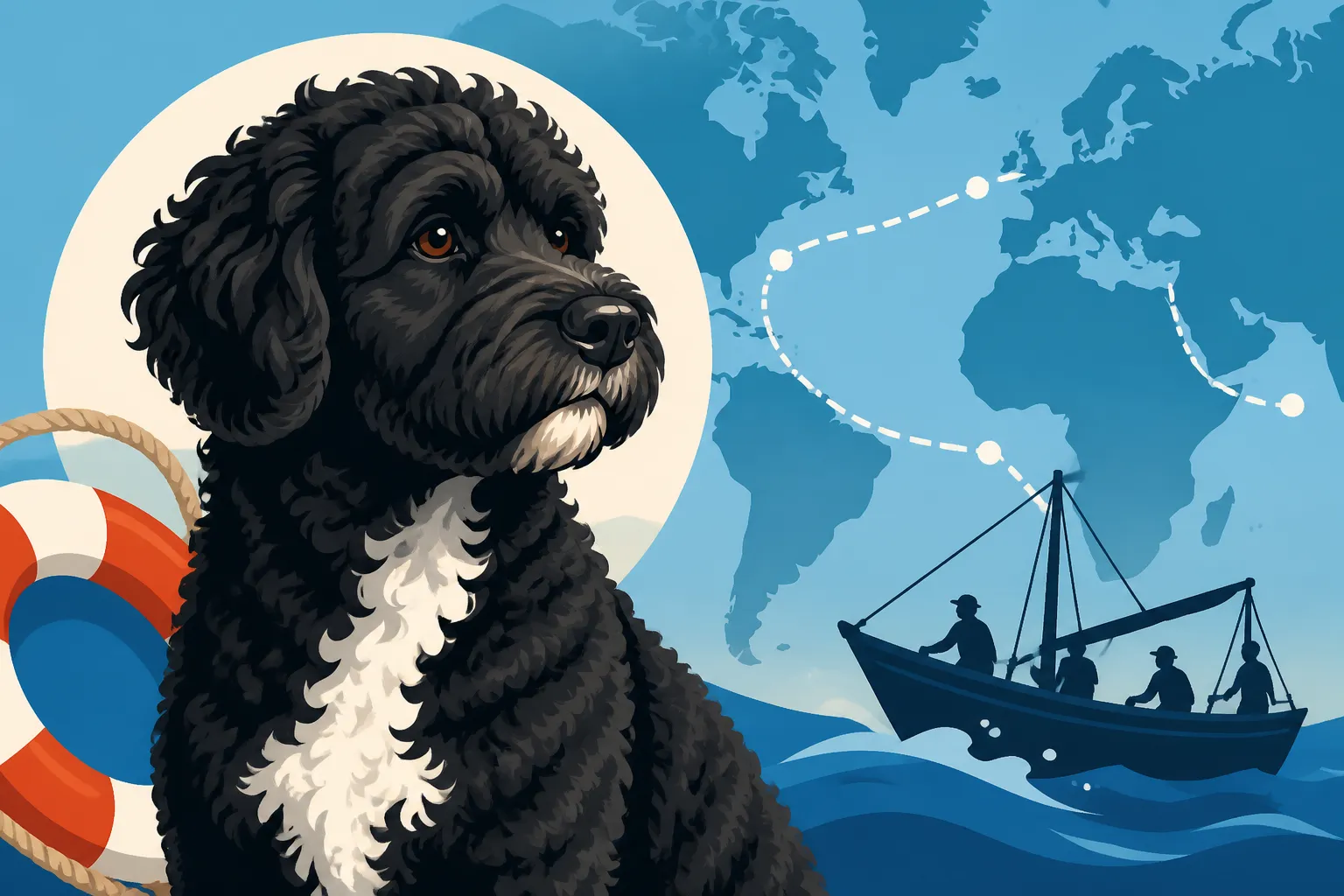
Whether the Portuguese Water Dog Was Ever Used at Sea Elsewhere
A Portuguese Water Dog’s webbed feet and water-loving reputation can make it seem as though it must have worked aboard fishing boats around the world. The historical picture is more specific: the breed is closely tied to Portugal’s fishing coast, while other countries had their own water-working dogs. This guide separates documented Portuguese history from broader maritime-dog lore.
The Portuguese Water Dog’s maritime roots
A working dog on Portugal’s coast
The Portuguese Water Dog is most closely associated with the fishing communities of Portugal, where a capable dog could be useful aboard a boat as well as on shore. Its Portuguese name, Cão de Água, means “dog of water,” a fitting description for an animal developed around an everyday working relationship with the sea.
Accounts of the breed describe dogs helping fishing crews with tasks such as retrieving items from the water, carrying messages between boats and shore, and assisting around nets. Their work depended on cooperation with people and a willingness to enter the water, often in conditions that were not especially comfortable. This was practical labor, not simply recreation. For more on the breed’s home waters, see The Portuguese Water Dog Worked the Algarve Fishing Fleet.
A dog’s value on a boat would have depended on more than swimming skill. It needed to respond amid noise and movement, stay attentive to its handlers, and manage the tight space of a working vessel. Those demands help explain why the Portuguese Water Dog’s maritime story is about a working partnership, rather than just a dog that enjoyed a swim.
What the dog did for fishing crews
A Portuguese Water Dog could retrieve gear or other objects that had gone overboard, and could help carry messages where boats and shore were separated by water. Some accounts also describe dogs working around fishing nets and helping move fish toward them. The precise jobs likely varied by crew, boat, and local conditions; there was no single task list followed by every dog.
These duties fit the breed’s physical and behavioral traits. A strong swimmer could cover short distances between a vessel and the shore, while an alert, trainable dog could learn to respond to a fisherman’s signals. That did not mean every individual was equally suited to every task, or that every dog spent its life at sea. For an overview of the working relationship, read What a Portuguese Water Dog Did for a Fishing Crew and How a Portuguese Water Dog Earned Its Place on a Boat.
The breed’s familiar clips are often connected with its working past, too. A traditional lion clip leaves the rear of the body shorter and retains a fuller coat around the front and tail. The style is part of the breed’s history, but it should not be treated as proof that every dog wore it in exactly the same way or for a single agreed-upon reason.
How far the historical record reaches
The strongest association is with Portuguese fishing communities. It is reasonable to imagine Portuguese dogs traveling with people and boats, but that is different from having clear evidence that Portuguese Water Dogs became established working breeds in other countries. A dog might have crossed a border or sailed beyond its home coast without leaving a lasting, well-documented population there.
That distinction matters because the breed’s modern reputation can make its history feel more global than the evidence supports. The safest conclusion is that Portuguese Water Dogs were valued in their home maritime setting, while claims that they formed regular working populations in distant ports should be treated cautiously unless supported by specific historical records.
Were Portuguese Water Dogs used at sea outside Portugal?
Travel is not the same as a separate working tradition
Portuguese fishermen and vessels traveled beyond the immediate shoreline, and dogs aboard boats could have accompanied crews on longer journeys. But the fact that a dog may have been carried on a voyage does not establish that Portuguese Water Dogs were commonly used by fishing fleets in other nations, or that they created a distinct tradition there.
To make that stronger claim, historians would ideally look for records identifying the dogs, describing their work, and showing that the practice continued in a particular place. A general reference to “water dogs” is not enough to identify a Portuguese Water Dog. Nor does a dog’s ability to swim tell us where it originated or who used it.
So, was the breed ever at sea elsewhere? Individual dogs may have traveled with Portuguese crews, but the breed’s well-known maritime identity remains rooted in Portugal. The available story is much clearer about the Portuguese coast than about a sustained presence in foreign fishing fleets.
Other countries had their own water-working dogs
Maritime communities in different places relied on dogs suited to local work. Newfoundland dogs, for example, became strongly associated with the cold waters and working communities of Newfoundland. In parts of Europe, other water dogs and retrievers were used for retrieving game, working around boats, or helping people near rivers and coasts. Similar abilities do not mean these dogs were Portuguese Water Dogs.
It is easy to blur the lines because many water-working breeds share practical traits: stamina, a coat that can cope with wet conditions, and an interest in retrieving. But breed histories are not interchangeable. The Portuguese Water Dog’s connection to Portuguese fishing work is its own story, even when other dogs performed comparable jobs elsewhere.
The same caution applies to related breeds. A shared appearance or overlapping role does not establish that one breed was simply a local version of another. For context, How Portuguese Water Dog Differs From Spanish Water Dog and How Portuguese Water Dog Is Related to the Irish Water Spaniel explore the distinctions between breeds with some water-work associations.
| Historical question | Careful answer |
|---|---|
| Where is the Portuguese Water Dog’s strongest maritime connection? | Portugal’s fishing coast |
| Did Portuguese Water Dogs work on boats? | Historical accounts describe dogs assisting fishing crews |
| Could individual dogs have traveled beyond Portugal? | Yes, that is plausible, but travel alone does not prove a widespread foreign working tradition |
| Were similar dogs used elsewhere? | Yes, other communities had their own water-working breeds |
| Does a similar job mean another breed was a Portuguese Water Dog? | No; similar work and traits do not establish the same breed or origin |
What the breed’s name and reputation can suggest
The name Cão de Água points to a water-associated dog, but a name alone cannot map the breed’s exact historical range. The same is true of webbed feet, swimming ability, or a modern dog’s enthusiasm for retrieving. Those traits help explain why the breed was useful around water; they do not show that it worked in every seafaring culture.
Likewise, stories about dogs carrying messages between boats may be true descriptions of the work, but they should not be stretched into claims that the breed served as a standard communication system across international fleets. For the narrower question of movement between vessels, see Whether a Portuguese Water Dog Swam Between Boats. It is useful to keep the well-supported core—Portuguese fishing crews and water work—separate from attractive but less certain extensions.
Why the Portuguese Water Dog’s seafaring work faded
Fishing technology and changing work
The breed’s usefulness depended on the needs of fishing crews. As boats, equipment, and communication methods changed, some tasks that a dog could perform became less necessary or were handled in other ways. When a working role shrinks, the number of dogs needed for that role can shrink too.
This change was part of a wider shift in the relationship between people, animals, and work. A dog once valued for helping with a day’s fishing might later be kept chiefly as a companion. That transition did not erase its heritage, but it did change what most owners expected from the breed. Why Fishermen Stopped Needing the Portuguese Water Dog looks more closely at this shift.
The breed also experienced a period when it became much less common. Its survival and later development depended on people who took an interest in preserving it. The move from a working dog in fishing communities to a recognized companion and show breed helps explain why today’s Portuguese Water Dog may have the instincts and athleticism associated with water work without having been trained for a fisherman’s actual routine.
From Portuguese working dog to a breed known abroad
The Portuguese Water Dog eventually became established outside Portugal, including in the United States. That later spread is different from claiming it had long been a common working dog in maritime communities around the world. A breed can travel internationally through deliberate breeding and ownership even when its original working history is geographically specific.
For that reason, it helps to separate three questions: where the breed developed, where individual dogs may have traveled, and where the breed later became popular. Those histories overlap, but they are not the same. When the Portuguese Water Dog Reached America covers one important part of the breed’s later spread.
Today’s owners may encounter the maritime history through water trials, retrieving games, or swimming outings rather than fishing work. These activities can celebrate useful instincts, but they should be introduced thoughtfully. A modern dog is not automatically safe around boats or open water just because its ancestors worked near the sea.
What the maritime history means for owners today
Heritage is not a substitute for water safety
Portuguese Water Dogs often enjoy swimming, but no breed should be assumed to be safe in every body of water or situation. A dog can tire, panic, encounter currents, or struggle to get back onto a boat or dock. Calm, gradual introductions and close supervision matter, particularly for puppies and dogs that have not swum before.
If you are preparing for a boat outing, think about the setting rather than relying on breed reputation. Check the water conditions, give the dog a clear way to exit, and consider a properly fitted canine life jacket. A dog that swims confidently in a quiet pool may respond very differently to waves, cold water, motor noise, or a crowded launch area.
For owners gathering supplies, Chewy can be one place to compare life jackets and sizing information, but fit and comfort matter more than a product’s marketing language. Chewy’s listings can also help you compare practical options such as towels and drying supplies for the ride home. Before choosing anything, check that the item suits your dog’s measurements and the kind of water activity you have planned.
After-swim care is part of the outing
A successful swim does not end when the dog leaves the water. Rinse away salt, sand, or pool residue as appropriate, then dry the coat thoroughly. Pay attention to the ears and the areas where damp hair meets skin, especially if the dog swims often. A thick coat can hold moisture longer than it appears to from the outside.
Pack more than a towel if you are spending the day near water. Bring fresh drinking water, a secure lead, and a shaded place for breaks. If you are comparing travel or grooming supplies, Chewy may be useful for browsing choices, but your dog’s coat condition and your veterinarian’s guidance should shape how you handle ear care. A simple routine after each swim can make outings easier and help you notice irritation early.
Most importantly, don’t turn a historical working role into pressure for a modern dog. Some Portuguese Water Dogs are keen swimmers; others are hesitant or prefer different activities. Introduce water at the dog’s pace, reward calm behavior, and make it easy to leave. The breed’s past explains why water is part of its story, but the dog in front of you still deserves an individual approach.
Disclaimer
This article is for general informational purposes only and does not constitute professional advice. Laws, prices and regulations vary by location and change over time. Consult a qualified professional for guidance on your specific situation.