Signs a Portuguese Water Dog Is Overweight
It’s a tricky thing, isn't it? One day your vibrant Portuguese Water Dog is bounding around, full of life, and the next you start to notice they're a little slower, a bit less enthusiastic. Before you know it, you’re wondering if those extra pounds have crept on, but how can you tell under all that beautiful, dense coat? This guide is here to walk you through the tell-tale signs, both obvious and subtle, that your beloved PWD might be carrying too much weight, helping you keep them healthy and active for years to come.
The Subtle Traps of Weight Gain in Portuguese Water Dogs
It's astonishingly easy for a Portuguese Water Dog to gain weight without their owner fully realizing it. Their magnificent, dense coat, combined with their generally robust and energetic nature, can mask those creeping pounds until they become a more significant issue. Many owners find themselves caught off guard, wondering how they missed the signs until their dog is noticeably heavier.
The Deceptive Coat: How the PWD's Fur Hides Early Weight Gain
One of the biggest culprits in masking weight gain in a Portuguese Water Dog is their incredible coat. Whether it's the tight, distinct curls or the softer, wavier variety, this double layer of fur is designed to protect them in water and cold. However, it also acts like a natural sweater, effectively camouflaging any thickening around the waist, ribs, or hips. You might be brushing them daily, running your hands over their body, and still not truly feel the underlying changes in their physique. The hair can fluff out, giving the illusion of the same lean dog underneath, even as fat deposits accumulate.
This deceptive quality means that simply looking at your PWD or giving them a quick pat often isn't enough to assess their true body condition. It requires a more deliberate, hands-on approach to get past that insulating coat. If you’re used to seeing your PWD in a full, shaggy retriever clip, for instance, it becomes even harder to spot the subtle rounding that signals the beginning of weight accumulation. What a Portuguese Water Dog's Coat Is Made Of explains more about this unique fur.
Activity Levels and Owner Perception: When 'Active' Isn't Enough
Portuguese Water Dogs are renowned for their boundless energy and their love for activity, especially swimming. This natural athleticism can lead owners to believe that their dog is constantly burning enough calories to stay lean, regardless of their food intake. You might think, "My PWD swims every day! There's no way they could be overweight." However, even a highly active dog can gain weight if their caloric input consistently exceeds their output. The type and intensity of exercise also play a huge role. A leisurely swim in the pool isn't the same as an hour of high-intensity dock diving or a long, brisk hike.
Furthermore, a PWD that is starting to gain weight might subtly decrease their own activity levels over time, creating a vicious cycle. They might not chase the ball quite as vigorously, or their sprints might be shorter. These changes can be so gradual that you might attribute it to them just "slowing down" or "maturing," rather than seeing it as a symptom of creeping weight. It's a common oversight, and one that many PWD owners grapple with as their dogs move past their puppy exuberance. How Much Exercise a Portuguese Water Dog Needs delves into their activity requirements.
Breed Predisposition: Why PWDs Can Be Prone to Weight Issues
While Portuguese Water Dogs are generally considered a healthy and robust breed, they aren't immune to weight issues. Like many breeds, individual dogs can have varying metabolic rates, and genetics can play a role in how easily they gain or lose weight. As they age, their metabolism naturally slows down, and if their diet isn't adjusted accordingly, weight gain becomes almost inevitable. You might feed them the exact same amount you did when they were two years old, but by seven or eight, that might be too much.
Certain health conditions, although less common, can also contribute to weight gain, such as an underactive thyroid (hypothyroidism). While this isn't exclusively a PWD issue, it's something to be aware of if weight gain is sudden and unexplained despite a reasonable diet and exercise routine. The strong retrieving instinct of a PWD can also mean they're excellent at finding dropped crumbs or charming extra treats out of family members, adding hidden calories to their daily intake. Signs a Portuguese Water Dog's Thyroid Is Low provides more information on this condition.
Visual Cues: What Your Eyes Can Tell You About Your PWD's Weight
Even with that luscious coat, there are visual indicators you can start to look for that might signal your Portuguese Water Dog is carrying a few too many pounds. These cues often become more apparent as the weight progresses, but learning to spot them early can make a big difference.
Loss of a Defined Waistline: The Hourglass Disappearing Act
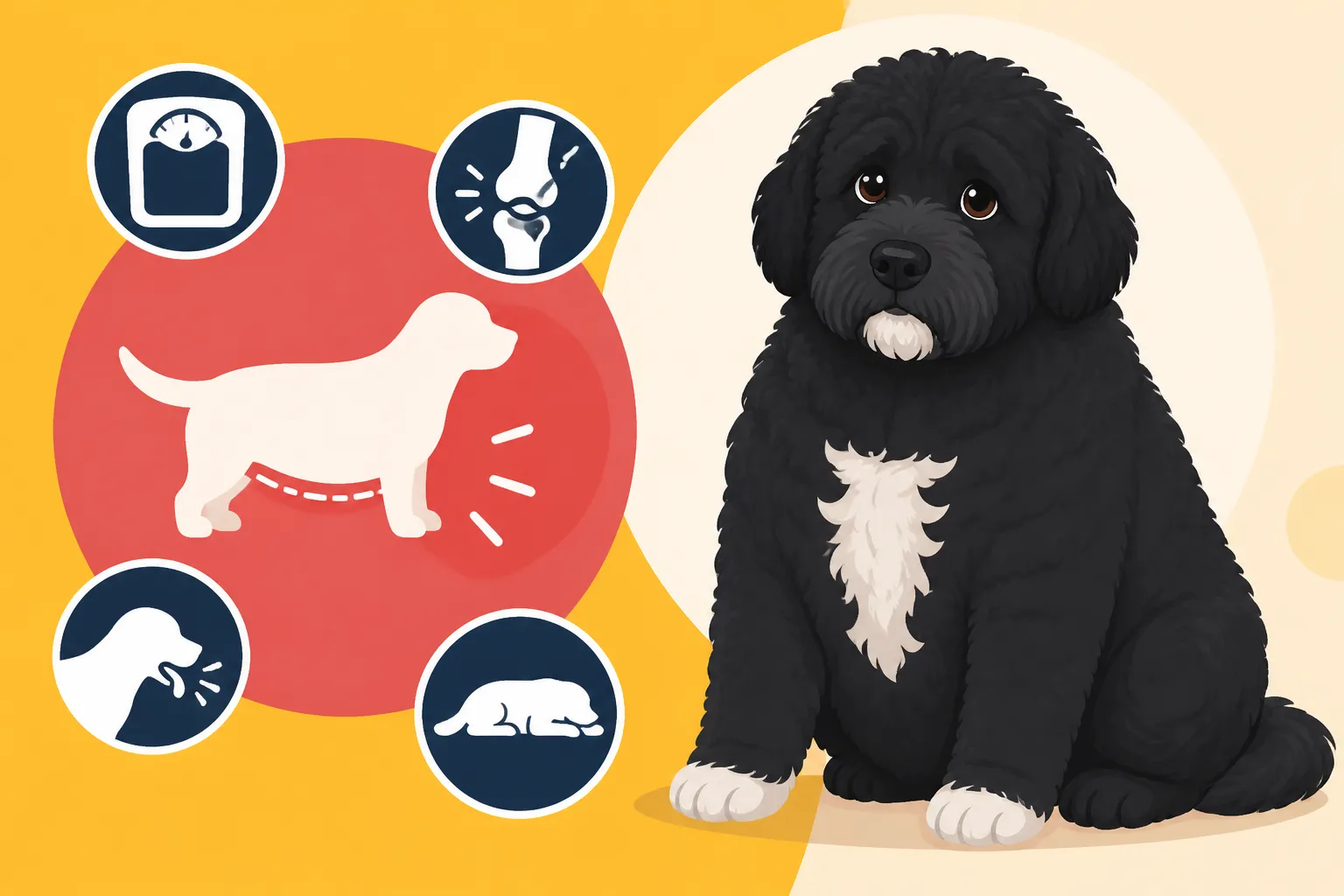
A healthy weight Portuguese Water Dog should have a noticeable "tuck-up" or waistline when viewed from above. Imagine an hourglass figure; their body should narrow slightly behind the rib cage and before the hips. When a PWD starts to become overweight, this waistline begins to disappear. The body will appear more like a straight line from their rib cage to their hips, or even bulge outwards. It’s no longer the graceful, athletic swimmer’s build you remember.
This loss of definition is often one of the first visual signs, though it can still be tricky to discern through a thick coat, especially if your PWD has a wavy rather than a curly coat which tends to lie flatter. Try looking at your dog after they've been swimming and their coat is matted down, or when they are freshly groomed in a shorter clip. You'll likely see the body contours more clearly then. If their sides are starting to look like a furry barrel, it's a strong indicator.
Broadening of the Chest and Rib Cage: The 'Barrel' Look
Beyond the waistline, pay attention to the overall shape of your PWD's chest and rib cage area. A lean Portuguese Water Dog will have a well-sprung rib cage that flows smoothly into their abdomen. As they gain weight, fat accumulates over the ribs and chest, making this area appear broader and more rounded. Instead of a streamlined torpedo shape built for cutting through water, they might start to look more like a wide-set barrel.
This is distinct from muscular development; while a well-muscled PWD will have a powerful chest, it will still retain definition, whereas fat accumulation will smooth out those muscle lines. Look for a lack of angularity or a more bulbous appearance around the torso. This change can affect their gait slightly, making them appear less agile, especially when turning or navigating tight spaces. For comparison, understanding What a Portuguese Water Dog's Ideal Day Looks Like can give you a baseline for their typical active shape.
A Wider Base of the Tail: Subtle Changes in the Rear
One often-overlooked area where fat tends to accumulate in dogs is at the base of the tail. In a Portuguese Water Dog, a healthy tail base should feel and look relatively lean, with the bone structure somewhat discernible beneath the fur and muscle. If your PWD is gaining weight, you might notice a subtle but distinct widening or thickening at the point where the tail joins the body.
This area will feel softer and more padded when you run your hands over it, and you might see small, fatty deposits that create a slight bulge. It's not always obvious, especially with their characteristic strong, thick tail, but it's a consistent indicator across many breeds. Combined with a disappearing waistline, a thicker tail base can provide further evidence that those extra calories are settling in. This area is also less prone to muscle development from exercise, making fat accumulation more pronounced here.
Palpation: Using Your Hands to Assess Your PWD's Body Condition
Visual cues can be misleading with a Portuguese Water Dog's coat, which is why getting hands-on is absolutely essential for accurately assessing their body condition. This isn't just a casual pat; it's a deliberate, systematic check that gives you real insight into what's happening beneath the fur.
Feeling for Ribs: The Key Indicator
The absolute best way to tell if your Portuguese Water Dog is at a healthy weight is to feel their ribs. You should be able to easily feel your dog’s ribs with just a light touch of your fingertips, like running your hand over the knuckles of your loosely clenched fist. You shouldn't see them prominently, but you should definitely feel them. If you have to press down firmly to locate them, or if you can't feel them at all because there's a thick layer of fat over them, then your PWD is likely overweight.
When assessing, run your flat palm over their rib cage on both sides. You should feel individual ribs distinctively, almost like a washboard, but without them feeling sharp or jagged (which would indicate they are underweight). This is a crucial skill for any PWD owner to develop. Make it a regular part of your grooming routine, perhaps when you're doing your weekly brushing, to keep a consistent check. Remember, the goal is to feel the ribs without seeing them too much.
Assessing the Spine and Hip Bones: Beyond the Ribs
While the ribs are a primary indicator, don't stop there. Move your hands along their spine and over their hips. Along the spine, you should be able to feel the individual bumps of the vertebrae without having to press too hard. If the spine feels like a smooth, unbroken line, cushioned by a layer of fat, that's another sign of excess weight. Similarly, the hip bones (pelvic bones) should be palpable just beneath the skin with a moderate touch. If you struggle to find them or they feel heavily padded, this indicates fat deposition in that area.
A good comparison to aim for is the back of your hand: you can feel the bones of your knuckles and wrist, but they aren't sharply protruding. When a dog is carrying too much weight, these bony prominences disappear under a cushion of fat, making them feel much softer and less defined. Regularly checking these spots, especially if your PWD is prone to weight gain, gives you a comprehensive picture of their body condition. This helps you understand How to Feel a Portuguese Water Dog's Ribs Under the Coat.
The Tummy Tuck Test: Checking for an Abdominal Tuck
A healthy Portuguese Water Dog, when standing, should have a definite "tuck-up" in their abdomen. This means their belly should rise up from their rib cage to their hind legs, creating an upward curve rather than hanging down. If, when viewed from the side, your PWD's belly hangs low or is level with their chest, rather than tucking up, they are likely overweight.
To perform the "tummy tuck test," have your dog stand squarely. Then, look at their profile. Does their belly rise gracefully? Or does it sag? You can also gently run your hands underneath their belly. It should feel firm and tucked, not soft, pendulous, or dragging. A sagging belly, especially in an otherwise active dog, is a strong visual and tactile indicator that they're carrying extra weight, even if their rib cage still feels somewhat decent. This is particularly important because excessive belly fat can put strain on their internal organs and joints.
Here’s a simple table to help you assess your PWD's Body Condition Score (BCS):
| BCS | Description | Visual Assessment (Through coat) | Palpation Assessment (Hands-on) | Action Needed |
|---|---|---|---|---|
| 1 | Emaciated | Ribs, spine, pelvic bones very visible. | Ribs, spine, pelvic bones very prominent; no fat. | Urgent veterinary intervention and diet adjustment. |
| 2 | Very Underweight | Ribs, spine, pelvic bones easily visible. | Ribs, spine, pelvic bones easily felt with minimal fat. | Increase caloric intake, monitor closely, vet check. |
| 3 | Ideal Weight | Waist visible, abdomen tucked. | Ribs easily felt with slight fat cover; spine, hips palpable. | Maintain current diet and exercise. |
| 4 | Overweight | Waist diminished, slight abdominal sag. | Ribs difficult to feel without firm pressure; spine/hips padded. | Reduce calories, increase exercise. |
| 5 | Obese | No waist, obvious abdominal distension. | Ribs, spine, hips not palpable; heavy fat deposits. | Significant diet change, structured exercise, vet guidance. |
Behavioral and Performance Indicators: Beyond the Physical
Sometimes, the most telling signs of weight gain in your Portuguese Water Dog aren't what you see or feel, but what you observe in their daily behavior and how they perform. These changes can often be subtle at first, manifesting as a general lack of enthusiasm or a diminished capacity for activities they once loved.
Decreased Stamina and Enthusiasm for Exercise: A Less Spirited PWD
One of the most heartbreaking signs of a Portuguese Water Dog carrying too much weight is a noticeable drop in their stamina and overall enthusiasm for exercise. These are dogs bred for work and tireless activity, often swimming for hours. If your PWD, who once lived for long walks, extended games of fetch, or joyous swims, now seems to tire more quickly, lags behind, or shows less excitement for these activities, it's a huge red flag. They might even opt to lie down during a walk or resist getting in the water as readily as before.
This isn't just about laziness; it’s about their body struggling under the extra load. The additional weight makes every movement more demanding, their heart has to work harder, and their joints endure more stress. You might notice they pant more heavily after minimal exertion or are simply less playful than usual. What you thought was just them "mellowing out" could actually be their body telling you it's struggling. A happy, healthy PWD should retain a zest for activity well into their senior years. This might mean adjusting How Long a Portuguese Water Dog Will Play Fetch.
Labored Breathing and Heat Intolerance: Signs of Stress
Another significant behavioral indicator is a change in breathing patterns and their ability to regulate body temperature. Overweight dogs often have a harder time cooling themselves down because the insulating layer of fat retains more heat. They might pant excessively, even in mild temperatures or after minimal activity. You could also notice them seeking out cool spots more often or appearing generally uncomfortable in warmer weather when they previously handled it with ease.
This labored breathing isn't just uncomfortable; it can be a sign of the increased strain on their cardiovascular system. Their heart and lungs have to work much harder to supply oxygen to a larger body mass and to dissipate heat. This is particularly concerning for a breed like the PWD, who often exercise vigorously. If your PWD is panting heavily after a short walk or seems to overheat quickly, especially compared to their past self, it's a serious sign that their weight is impacting their health and needs immediate attention. Whether a Portuguese Water Dog Overheats explains more about managing their temperature.
Joint Discomfort and Reluctance to Move: The Silent Pain
Extra weight places immense stress on a dog’s joints, tendons, and ligaments. For a breed that loves to leap, swim, and run, this can lead to significant discomfort and even accelerate the onset or worsening of conditions like arthritis or hip and elbow dysplasia. You might observe a subtle reluctance to jump onto the couch or into the car, stiffness after resting, or a hesitant gait. They might be slower going up or down stairs, or appear sore after a long play session, even limping slightly.
Sometimes, dogs are incredibly stoic about pain, so these signs can be very subtle. They might not cry out, but rather just avoid activities that cause them discomfort. They might shift their weight differently when standing or try to shake out a sore leg. Ignoring these signs can lead to chronic pain and further joint degeneration, significantly impacting their quality of life. Addressing their weight early can prevent or alleviate much of this suffering, improving their mobility and comfort for years to come. Hips and Joints in a Portuguese Water Dog offers more depth on joint health.
The Role of Diet and Portions: Understanding What Goes In
Understanding that your Portuguese Water Dog might be overweight is the first step, but then comes the critical question: why? Often, the answer lies squarely in what and how much they're eating. It's not always about 'bad' food, but simply too much of a good thing.
Calorie Creep: When Treats and Extra Portions Add Up
It's so easy for calories to creep into a PWD's diet without owners even realizing it. Those small handfuls of kibble given as training rewards, the bits of human food shared from the dinner table, the dental chews, the special long-lasting treats – individually, they seem insignificant. But consistently, day after day, week after week, they add up. A single small biscuit can have more calories than you'd think, and if your PWD is charming enough to get several from different family members throughout the day, those calories can quickly sabotage their weight management.
Many commercial dog foods also vary widely in their caloric density. If you switch brands or types of food without adjusting the portion size, you could unknowingly be feeding significantly more or less calories. Even measuring 'a cup' can be imprecise if you're not using a standard measuring cup, leading to overfeeding. This 'calorie creep' is often the silent saboteur of a PWD's lean physique, turning a healthy weight into an overweight one over time. Being mindful of everything that goes into their mouth is crucial. For specific dietary needs, brands like Ollie offer tailored meal plans, and you can find a wide variety of portion control tools on Amazon or Chewy.
Age-Related Metabolism Changes: Adjusting as Your PWD Matures
Just like humans, a Portuguese Water Dog's metabolism changes as they age. A vibrant, energetic two-year-old PWD will burn calories much more efficiently than a seven or eight-year-old dog, even if their activity levels appear similar. As dogs mature and become senior, their caloric needs often decrease by 20-30%, sometimes more. If you continue to feed them the same amount of food they ate in their prime, weight gain is almost inevitable.
It’s vital to acknowledge these physiological changes and adjust their diet accordingly. This might mean transitioning to a "senior" formula dog food, which is typically lower in calories and fat, or simply reducing the portion size of their regular food. Monitoring their weight and body condition score becomes even more critical in their middle and senior years. Ignoring these age-related shifts can quickly lead to an overweight senior PWD, which will exacerbate any existing joint issues and overall health. The Age a Portuguese Water Dog Is Considered Senior explains more about this life stage.
Seeking Professional Guidance: When to Talk to Your Vet
If you suspect your Portuguese Water Dog is overweight, or if you're struggling to get their weight under control, the very best thing you can do is consult with your veterinarian. They can accurately assess your PWD's body condition, rule out any underlying medical conditions (like hypothyroidism) that might be contributing to weight gain, and help you develop a safe and effective weight loss plan. They can provide specific recommendations for caloric intake, suitable dog food options, and exercise modifications.
Your vet can also help you understand how to precisely measure food, how to factor in treats, and provide guidance on appropriate exercise levels that won't put undue stress on their joints. Sometimes, a tailored diet plan is necessary, and your vet might recommend specific prescription weight-loss diets or help you choose a high-quality, lower-calorie food available through retailers like Chewy. Don't go it alone; your vet is your most valuable partner in ensuring your Portuguese Water Dog lives a long, healthy, and happy life at their ideal weight. They can also advise on What an Adult Portuguese Water Dog Should Weigh.
Disclaimer
This article is for general informational purposes only and does not constitute professional advice. Laws, prices and regulations vary by location and change over time. Consult a qualified professional for guidance on your specific situation.