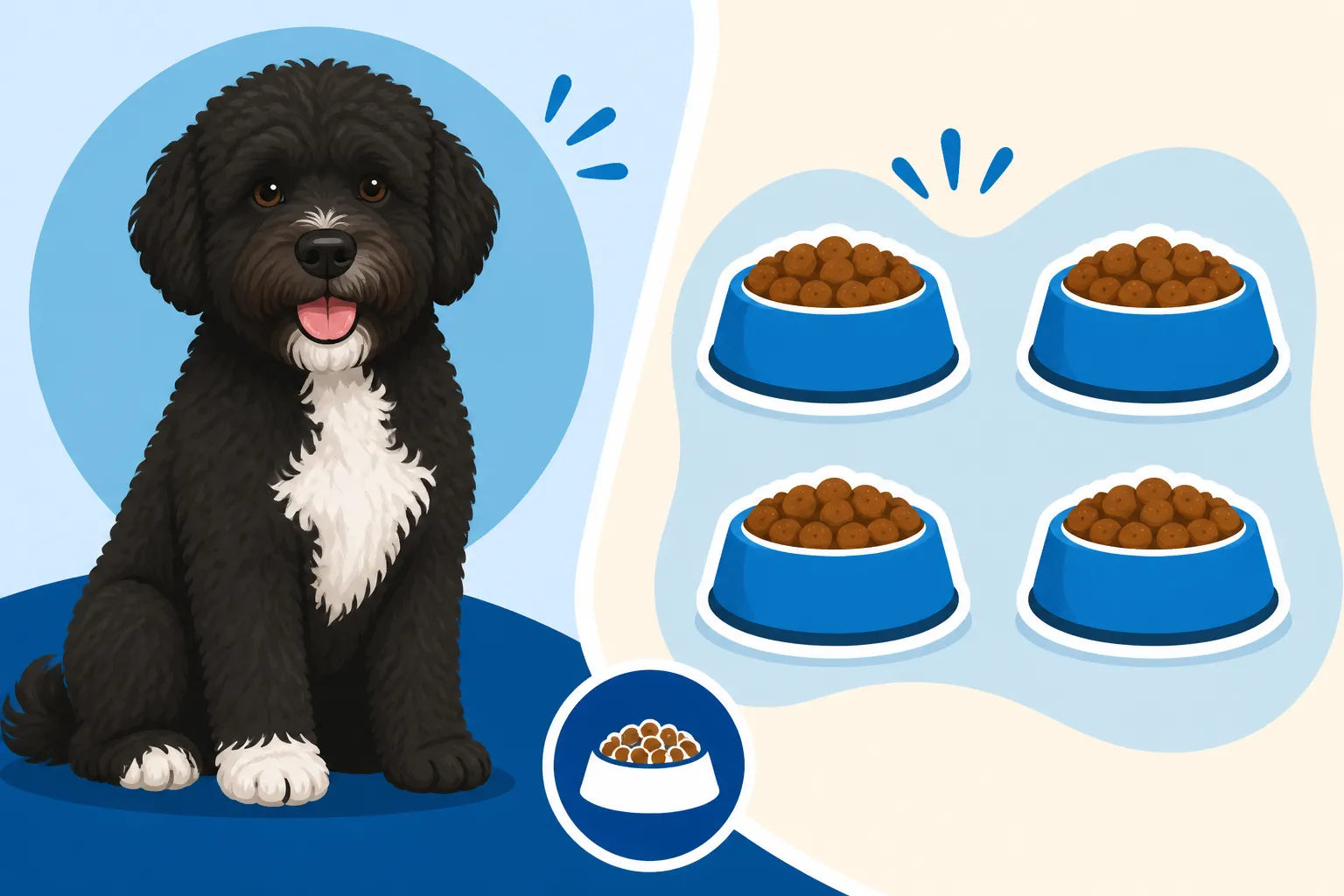
How Many Cups a Day an Adult Portuguese Water Dog Eats
One of the biggest questions I hear from fellow Portuguese Water Dog owners, especially those new to the breed, is a variation of: "My PWD is a boundless ball of energy, always ready for the next adventure. How on earth do I make sure they're getting enough to eat without overfeeding them?" It's a valid concern, because while these dogs are known for their athleticism, it can be deceptively easy to either underfuel a working dog or pack on extra pounds if their activity wanes. This guide is here to walk you through the nuances of figuring out exactly how much food your adult Portuguese Water Dog really needs each day, so you can keep them healthy, energetic, and at their ideal weight.
Understanding Your Portuguese Water Dog's Unique Nutritional Blueprint
It would be wonderfully simple if there was a single, universal answer to how many cups of food an adult Portuguese Water Dog needs. Just scoop and go, right? But the truth is, these dogs are individuals, and their daily dietary requirements are a dynamic calculation influenced by several key factors. We're not dealing with a static equation here; rather, it's about understanding the variables and how they play into your dog's personal needs. A one-size-fits-all approach just won't cut it for our intelligent, active companions.
The Role of Activity Level and Lifestyle
This is perhaps the most significant factor in determining your PWD's daily food intake. Portuguese Water Dogs were bred to be highly active working dogs, herding fish, retrieving lost tackle, and swimming in rough waters. Even if your dog isn't working on a fishing boat off the coast of Portugal today, their genetics still predispose them to a need for vigorous exercise. A PWD that spends its days hiking, swimming, performing in Dock Diving and Water Trials With a Portuguese Water Dog, or participating in agility is going to burn significantly more calories than one whose primary activity is a leisurely stroll around the block.
Think of it like this: a professional athlete needs more fuel than someone with a desk job. It's the same for your dog. A PWD regularly engaging in intense physical activity, like a long session of retrieving bumpers from the lake or a brisk several-mile run, will naturally require more caloric intake to maintain their energy levels and muscle mass. If you've got a dog that's truly living up to its heritage, you're likely going to be feeding on the higher end of the recommended ranges, possibly even looking at high-performance formulas. On the flip side, if life circumstances mean your PWD is currently less active, perhaps due to age or temporary injury, then scaling back their food intake is crucial to prevent unhealthy weight gain. It's a constant recalibration that depends heavily on how much you and your dog are out there tackling the world.
Age, Metabolism, and Individual Differences
Just like people, dogs' metabolic rates can vary. A young, vibrant two-year-old PWD might burn through calories faster than a laid-back eight-year-old. Puppies, of course, have different needs entirely as they're growing rapidly, but even among adult dogs, there can be subtle variations. Some dogs are simply "hard keepers," meaning they naturally have a higher metabolism and struggle to keep weight on, even with ample food. Others might be "easy keepers," prone to gaining weight easily on the same amount of food. Genetics play a role here, too.
As your Portuguese Water Dog ages, their metabolism will naturally slow down. You might notice they're a little less inclined to chase a ball for hours or aren't quite as quick to leap into the water. This is a normal part of Caring for an Aging Portuguese Water Dog, and their food intake should adjust accordingly. An older dog might need fewer calories to maintain their weight, or they might benefit from a senior-specific formula that's lower in calories but still packed with essential nutrients and joint support. It’s also important to remember that medical conditions, even minor ones like allergies or Signs a Portuguese Water Dog's Thyroid Is Low, can affect metabolism and how well your dog utilizes their food. Always consult your vet if you notice sudden changes in weight or appetite that don't seem linked to activity.
Spay/Neuter Status and Health Considerations
Whether your Portuguese Water Dog is spayed or neutered also has an impact on their caloric needs. Generally, spayed and neutered dogs tend to have a slightly lower metabolic rate compared to intact dogs, meaning they require fewer calories to maintain a healthy weight. The hormonal changes that occur after these procedures can lead to a predisposition for weight gain if their diet isn't adjusted. This doesn't mean you have to drastically cut their food, but it does mean you need to be more mindful of portion control and monitor their weight more closely.
Beyond spay/neuter status, any underlying health conditions can influence how much your PWD should eat. A dog managing Addisons Disease Is Common in Portuguese Water Dogs, for example, might have different energy needs or require a specific diet recommended by their veterinarian. Dogs recovering from an injury or illness might need extra calories for healing, or conversely, less if they're on restricted activity. Even something as simple as a sensitive stomach or allergies could necessitate a specific food type, which then influences the caloric density and how much you feed. Always factor in these health nuances and work closely with your veterinarian to tailor their diet.
General Guidelines for Feeding Your Adult Portuguese Water Dog
With all those individual factors at play, how do you even begin to determine the right amount of food? The good news is that dog food manufacturers provide guidelines, and we can use those as a starting point. However, remember these are guidelines, not commandments carved in stone. Your PWD is a living, breathing, uniquely active creature, and the bag's recommendations are a generalization.
Manufacturer's Guidelines and Calorie Content
Every bag or can of quality dog food will have a feeding chart, usually based on the dog's weight. This chart will suggest a range, often in cups, for how much to feed daily. For example, a bag might say a 40-pound dog needs 2.5-3 cups per day. This is your initial reference point.
However, it's crucial to understand that not all dog foods are created equal in terms of caloric density. A "performance" formula designed for highly active dogs will have more calories per cup than a "weight management" formula. So, while one brand might recommend 2.5 cups of their standard kibble, another brand's performance blend might deliver the same calories in 2 cups. Always check the caloric content (often listed as kcal/cup or kcal/kg) on the label. This is where a little math comes in handy. If your vet suggests a certain daily caloric intake, you can then calculate how many cups of your chosen food will provide that. Services like Ollie, which provides fresh, pre-portioned meals, often take this guesswork out by customizing plans based on your dog's profile, delivering the right amount of food directly. Similarly, when browsing options on Chewy or Amazon, pay close attention to the ingredient list and the guaranteed analysis for calorie counts.
Estimating Daily Caloric Needs
While exact numbers are best discussed with your vet, we can talk about the range of what an active, medium-sized dog like a Portuguese Water Dog typically requires. These are broad strokes, but they give you a sense of scale. A general rule of thumb for moderately active dogs is around 25-30 calories per pound of body weight per day. For a very active PWD, especially one doing regular strenuous water work or competitive sports, this could easily jump to 35-40+ calories per pound. A less active or senior PWD might only need 20-25 calories per pound.
Let's put this into a hypothetical scenario. If your PWD is a lean 50 pounds and moderately active, their needs might be in the ballpark of 1250-1500 calories a day. If they are a dock-diving champion, they might need 1750-2000 calories. If they're a couch potato senior, perhaps 1000-1250. These are just illustrative numbers to show the spectrum. The important takeaway is that activity level directly correlates with caloric demand.
Here's a simplified table to help visualize the general spectrum of caloric needs relative to activity for a typical adult Portuguese Water Dog, recognizing that actual numbers vary widely by individual and food:
| Activity Level | Description | Estimated Daily Caloric Need (per pound of body weight) | Portion Adjustment Guidance |
|---|---|---|---|
| Sedentary/Low | Minimal exercise (short walks, mostly indoors), senior dogs, or those recovering from injury. | Lower end of the scale (e.g., 20-25 calories) | Start with the lowest manufacturer recommendation; monitor weight carefully. Reduce if weight gain occurs. |
| Moderately Active | Daily walks, occasional swimming, regular playtime in the yard. This often describes a typical family PWD with a good exercise routine. | Mid-range (e.g., 25-30 calories) | Begin with the middle of the manufacturer's suggested range; adjust up or down based on energy levels and body condition. |
| Highly Active | Consistent, vigorous exercise (long runs, frequent intense swims, advanced training, dog sports like What Dock Diving Asks of a Portuguese Water Dog or What a Water Trial Asks of a Portuguese Water Dog). | Higher end of the scale (e.g., 30-35+ calories) | Feed at the higher end or slightly above manufacturer recommendations. Consider performance formulas. Monitor for weight loss and muscle condition. |
| Working Dog | Dogs actively performing tasks for extended periods, competing in demanding sports, or very athletic individuals with exceptional drive. | Very high (e.g., 35-40+ calories) | Often requires specialized high-calorie diets. Frequent small meals might be beneficial. Work with a vet or canine nutritionist for precise calculations. |
Remember, these are descriptive guides. Always consult your veterinarian for specific caloric recommendations tailored to your individual dog's health and lifestyle.
The Importance of High-Quality Food
Regardless of how much you're feeding, the quality of that food cannot be overstated. A cheaper, filler-laden food might mean you have to feed more cups to meet caloric needs, but it won't provide the same nutritional value, and it might leave your PWD feeling hungry or lacking essential vitamins and minerals. Think about the ingredients: real meat as the first ingredient, wholesome grains or vegetables, and a lack of artificial colors, flavors, or unnecessary by-products.
A high-quality diet supports everything from a healthy coat (which is a big deal for Portuguese Water Dogs!) to strong muscles and a robust immune system. It can also impact their stool quality and energy levels. Many owners find success with reputable brands available on platforms like Chewy, which offer a vast selection of premium kibbles, wet foods, and even fresh food options. Investing in good nutrition now can save you a lot in vet bills and improve your dog's quality of life for years to come.
Monitoring Your PWD's Weight and Adjusting Portions
You can read all the feeding charts and calorie guides in the world, but ultimately, the proof is in your dog's body condition. This is where observation and hands-on checks become your most valuable tools. A healthy Portuguese Water Dog should be lean and muscular, with a clearly defined waist.
The Rib Check and Body Condition Score
The "rib check" is a simple, effective way to gauge your PWD's body condition. Run your hands along their sides, over their rib cage. You should be able to feel their ribs easily, like feeling the knuckles on the back of your hand, but not see them protruding sharply. If you have to press hard to feel them, your dog is likely overweight. If they're clearly visible and sharp, your dog might be too thin. This is a subtle art with a Portuguese Water Dog, whose thick, dense coat can often How a Portuguese Water Dog's Coat Hides Weight Loss. You really need to get your hands on them.
Veterinarians use a "Body Condition Score" (BCS) chart, typically on a scale of 1 to 9, with 4 or 5 being ideal. You can find these charts online, and they usually include images and descriptions to help you assess your dog. Familiarize yourself with what a healthy BCS looks like for a Portuguese Water Dog, paying close attention to their waistline when viewed from above and their abdominal tuck when viewed from the side. Regular checks, ideally once a month, will help you catch any creeping weight gain or loss before it becomes a significant issue. Don't just rely on the scale, as muscle mass can weigh more than fat, and the ideal What a Portuguese Water Dog Weighs and How to Keep It There can vary slightly.
Adjusting Portions Based on Observation
Once you've assessed your dog's body condition, you'll know whether you need to increase, decrease, or maintain their current food intake.
- If your PWD is too thin: Gradually increase their food by about 10-15% for a week or two. Re-evaluate their body condition. You might need to add an extra small meal, especially if they are a highly active dog that is Whether a Working Portuguese Water Dog Needs More Food.
- If your PWD is too heavy: This is a common issue for dogs whose activity doesn't quite match their caloric intake. Start by decreasing their daily food by 10-15%. Avoid drastic cuts, as this can make your dog feel perpetually hungry and potentially lead to nutrient deficiencies. Instead, make small, consistent reductions and be patient. It takes time to lose weight safely. Sometimes, simply eliminating extra treats can make a huge difference. Signs a Portuguese Water Dog Is Overweight can be subtle at first, so consistent monitoring is key.
- If their weight is ideal: Keep doing what you're doing! Continue to monitor, especially if their activity levels change with seasons or life stages.
Remember, any changes to their diet should be gradual. Sudden changes can upset their digestive system. Spread their daily portion into two meals to help manage hunger and digestion. For example, if they need 3 cups a day, give 1.5 cups in the morning and 1.5 cups in the evening.
Treats, Table Scraps, and Training Rewards
This is where many owners unintentionally sabotage their PWD's diet. Those little bits of kibble for training, the sneaky table scrap, the daily dental chew – it all adds up! Treats are often high in calories and can quickly push your dog's daily intake far beyond what they need, leading to Getting Weight Off a Portuguese Water Dog.
Be mindful of all the calories your dog consumes in a day. If you're doing a lot of training, consider using a portion of their daily kibble as rewards instead of extra treats. If you do give treats, choose healthy, low-calorie options and factor them into their overall daily caloric allowance. A good rule of thumb is that treats should make up no more than 10% of your dog's daily caloric intake. And those human foods? Most are not only calorie-dense but can also be unhealthy or even toxic for dogs. Stick to canine-specific treats and rewards.
Common Feeding Mistakes and How to Avoid Them
Even with the best intentions, it's easy to fall into common feeding traps. Understanding these pitfalls can help you avoid them and keep your Portuguese Water Dog thriving.
Overfeeding or Underfeeding
The most obvious mistake is simply giving too much or too little food. Overfeeding, as discussed, leads to obesity, which can contribute to a host of health problems including joint issues, diabetes, and heart disease. Given the PWD's predisposition to joint concerns like Hip Dysplasia in a Portuguese Water Dog, maintaining a lean body condition is paramount. Underfeeding, on the other hand, can lead to lethargy, nutritional deficiencies, and a loss of muscle mass, particularly concerning for such an active breed.
To avoid this, use a consistent measuring cup. Don't just eyeball it. A typical coffee mug is not an accurate measuring tool. Invest in a proper 1-cup measuring scoop. Stick to a routine, feeding at the same times each day. And, critically, regularly perform the rib check and body condition assessment. Your hands are your best guide here.
Ignoring Water Intake and Hydration
While we're talking about food, it's vital not to overlook water. Portuguese Water Dogs are, as their name suggests, water lovers! They often spend significant time swimming, which means they need access to fresh, clean water at all times. How Much Water a Portuguese Water Dog Drinks a Day can vary depending on their activity, the weather, and their diet, but they should always have it available. Dehydration can lead to serious health issues and can sometimes be mistaken for a lack of appetite or energy.
If your PWD is frequently swimming in a lake, ocean, or pool, they might accidentally ingest some of that water, but it's not a substitute for fresh drinking water. Always offer fresh water immediately after any water activities. You might even consider bringing a portable water bottle and bowl with you on outings, especially during warm weather or long walks.
Changing Foods Too Quickly
A common mistake, often made with good intentions, is abruptly switching your dog's food. Perhaps you found a new food on Chewy with rave reviews, or your vet recommended a different formula. While new foods can be beneficial, a sudden change can wreak havoc on your PWD's digestive system, leading to upset stomachs, diarrhea, or vomiting. This is particularly true if your Portuguese Water Dog has Whether a Portuguese Water Dog Has a Sensitive Stomach.
Whenever you transition to a new food, do it gradually over 7-10 days. Start by mixing about 25% new food with 75% old food for a few days. Then move to a 50/50 mix, then 75% new food with 25% old, until you're feeding 100% new food. This allows your dog's digestive system to adjust slowly, minimizing any gastrointestinal upset.
Not Consulting Your Veterinarian Regularly
Finally, and perhaps most importantly, never hesitate to involve your veterinarian in discussions about your Portuguese Water Dog's diet. They are your most valuable resource. They can help you determine an ideal weight and body condition score, recommend specific food types or brands based on your dog's individual health needs, and help you navigate any dietary challenges.
If you notice persistent weight changes, digestive issues, changes in appetite, or anything else that seems concerning about your PWD's eating habits, make an appointment. Your vet can rule out underlying medical conditions and provide tailored advice. Remember, proper nutrition is a cornerstone of your Portuguese Water Dog's overall health and longevity, helping them to enjoy The Twelve to Fifteen Years a Portuguese Water Dog Gets to the fullest.
Disclaimer
This article is for general informational purposes only and does not constitute professional advice. Laws, prices and regulations vary by location and change over time. Consult a qualified professional for guidance on your specific situation.