The Age a Portuguese Water Dog Stops Growing
A Portuguese Water Dog can look nearly grown well before its body has finished developing. That makes it easy to mistake a lanky adolescent for an adult—or to worry that a puppy is growing too slowly. This guide explains when most Portuguese Water Dogs reach adult height, how long they may keep filling out, and what to watch while their bones and body mature.
When a Portuguese Water Dog Reaches Adult Size
Height often comes before adult body condition
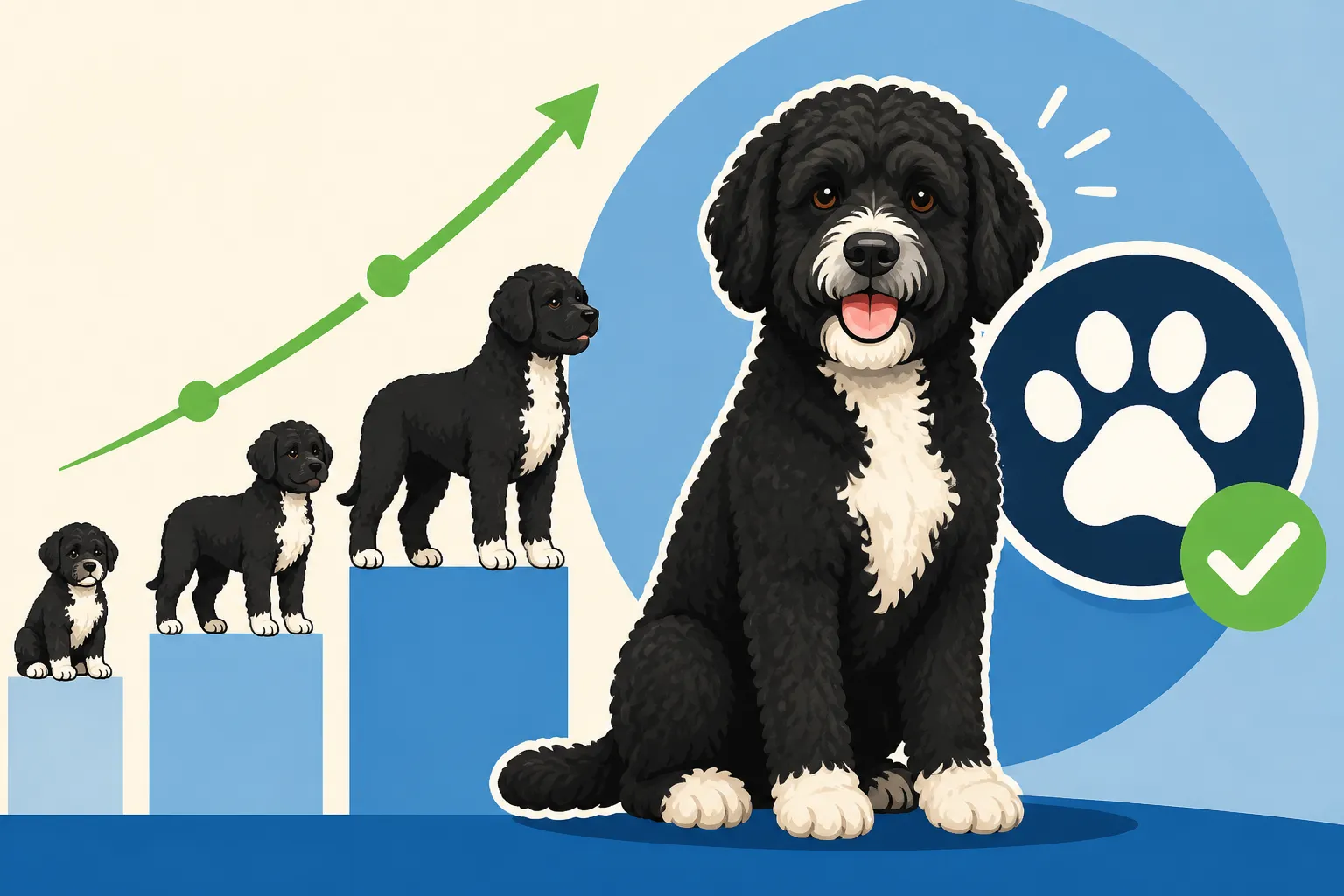
Many Portuguese Water Dogs reach most of their adult height by around 12 months, though timing varies from dog to dog. After that, a young dog may continue gaining muscle, broadening through the chest, and developing a more adult outline. It is common for a dog to look tall and leggy at one stage, then appear more substantial months later.
That difference matters when you are trying to judge growth from appearance alone. A fluffy coat can make a young dog look bigger or heavier than it is, while a wet coat can make the same dog look surprisingly slim. Rather than expecting a puppy to look like a finished adult at a particular birthday, track body condition and growth over time.
Portuguese Water Dogs are medium-sized, athletic dogs, and individual size varies. The breed standard’s height ranges can give you a general reference, but they are not a growth chart or a health diagnosis. For the standard’s measurements, see What Height the Portuguese Water Dog Standard Asks For. Your veterinarian can help interpret your dog’s size in the context of age, sex, family lines, and overall health.
Many dogs keep filling out after their first birthday
A Portuguese Water Dog may continue to gain muscle and mature in body shape into the second year. Some dogs look close to adult size at a year old; others remain noticeably narrow or adolescent-looking for longer. There is no single birthday when every Portuguese Water Dog is suddenly “done growing.”
This later development is especially easy to miss if you focus only on the number on the scale. A dog might gain weight because it is building muscle, but weight gain can also come from excess calories. A healthy growth pattern is about more than getting heavier: it includes appropriate body condition, steady development, and comfortable movement.
If you want to understand what normal growth might look like across puppyhood, What a Portuguese Water Dog Puppy Should Weigh by Month offers a helpful related topic. Treat any age-based figures as broad context, not a pass-or-fail test. Puppies from different litters can develop at different rates, and a single weigh-in does not tell the whole story.
Growth plates are a separate part of the picture
A dog’s height and visible shape do not tell you precisely when its growth plates have closed. Growth plates are areas of developing cartilage near the ends of long bones. As a dog matures, these areas gradually become bone. The timing varies with the individual, and a dog can look almost adult while its skeleton is still developing.
This is one reason to be thoughtful about strenuous, repetitive exercise during puppyhood. Long sessions of high-impact jumping or repeated hard stops may be inappropriate for a growing dog, especially if the puppy is tired or sore. Normal play, short walks suited to the puppy, and gradual skill-building are different from pushing a young dog to train like an adult athlete.
For more on the topic, read When a Portuguese Water Dog's Growth Plates Close. If you are planning a demanding sport, discussing timing with your veterinarian is sensible. They can consider your dog’s development, health, and activity rather than relying on a birthday alone.
How to Tell Whether Your Dog Is Still Growing
Track changes, not one measurement
A simple growth record can make it easier to see what is happening. Weigh your puppy periodically under similar conditions, note the date, and write down observations such as changes in height, body shape, appetite, or energy. You do not need to weigh every day; frequent fluctuations can distract from the overall pattern.
If you have access to a reliable pet scale, use it consistently. Some veterinary clinics can weigh your dog during routine visits, and retailers such as Chewy may offer home pet scales for owners who prefer to keep their own record. If weighing at home is stressful or impractical, a notebook of clinic weights is still useful.
A trend is more informative than a single number. For example, a puppy may gain steadily for several weeks and then slow down as it approaches adult size. Another puppy may have a temporary change in appetite during a busy or stressful period. If you are unsure how often to check, How Often a Portuguese Water Dog Should Be Weighed can help you think through a practical routine.
Use body condition alongside the scale
A scale cannot distinguish muscle from fat. To assess body condition, feel gently along the rib cage rather than judging through the coat. You should generally be able to feel the ribs without pressing hard, while they should not be sharply visible on a dog in appropriate condition. A defined waist when viewed from above and a slight abdominal tuck from the side can also be useful clues.
Portuguese Water Dogs often have a dense, textured coat, so visual checks can be misleading. A dog with extra weight may look simply “fluffy,” and a dog with a naturally lean adolescent frame may look thinner than expected. Ask your veterinarian to show you how to assess your own dog’s body condition; once you have felt the difference, routine checks become much less guesswork. The guide How to Feel a Portuguese Water Dog's Ribs Under the Coat covers that hands-on check.
Here is a practical way to interpret common clues:
| What you notice | What it may mean | A sensible next step |
|---|---|---|
| Height seems stable but the dog is gaining some muscle | Normal later maturation may be continuing | Track condition and discuss routine growth at the next visit |
| Ribs are difficult to feel and the waist is less defined | Your dog may be carrying excess weight | Review feeding and activity with your veterinarian |
| Weight is not increasing as expected, or is falling | Several causes are possible, including illness or inadequate intake | Contact your veterinarian, especially if appetite or energy has changed |
| Your dog is limping, stiff, or reluctant to move | Pain or an injury may be involved | Reduce strenuous activity and seek veterinary advice |
| Growth seems very different from littermates | Differences can be normal, but context matters | Ask the breeder and veterinarian about family size and your dog’s health |
The table is a guide for deciding what to discuss, not a way to diagnose a problem at home.
Know when a change deserves a call
A growth rate that seems unusual does not automatically mean something is wrong. Still, a sudden drop in appetite, persistent vomiting or diarrhea, a noticeable loss of weight, weakness, or a puppy that seems unusually tired deserves attention. So does a young dog that is consistently limping or showing discomfort after ordinary activity.
Try not to compare your puppy too closely with a sibling or a dog you see online. Those comparisons rarely account for age, sex, parent size, coat, diet, or the angle of a photograph. If a concern is bothering you, bring your notes and any weight history to your veterinarian. A clear timeline is often more useful than saying only that the puppy “seems small.”
Supporting Healthy Growth Through Puppyhood
Feed for steady development, not rapid size
Growing puppies need an appropriate, complete diet, but more food does not make a dog grow better or reach its adult size sooner. Overfeeding can lead to excess body weight, which places unnecessary strain on developing joints. Follow the feeding guidance on your chosen food as a starting point, then adjust with your veterinarian based on body condition and your puppy’s progress.
Avoid adding calcium, vitamins, or other supplements unless a veterinarian recommends them. A balanced commercial puppy diet is designed to provide the nutrients puppies need when fed as directed; extra supplementation can upset that balance. If you are comparing puppy foods, Chewy is one place owners may use to review product labels and ingredient information, but your veterinarian can help determine whether a particular food suits your dog.
A growing dog’s needs can shift as activity, appetite, and body condition change. Keep meal routines consistent enough that you can notice meaningful changes, and ask your vet before making a major diet switch. When the transition to adult food is appropriate depends on the individual dog and the food being used. For additional context, see When a Portuguese Water Dog Moves to Adult Food.
Keep exercise age-appropriate
Portuguese Water Dogs are energetic and often eager to retrieve, run, and swim. Their enthusiasm can make it tempting to keep going long after a puppy is tired. Short, varied activity with rest breaks is usually a better fit for a young dog than trying to exhaust it through long runs or repetitive jumping.
Swimming can be enjoyable, but it is not automatically risk-free or a substitute for supervision. Introduce water gradually, make sure the puppy can leave the water safely, and stop before it becomes exhausted. A young dog should not be pushed into repeated dock jumps or hard, repetitive exercise simply because it seems keen. Whether a Portuguese Water Dog Puppy Should Swim for Exercise and Why Swimming Protects a Portuguese Water Dog's Joints explore the subject in more detail.
Watch your dog during and after activity. A puppy that is playful at the park but stiff later, reluctant to climb stairs, or slow to get up may have overdone it or may be experiencing discomfort. Rest and observation can be appropriate after ordinary exertion, but repeated or worsening signs warrant a veterinary conversation.
Plan for the dog you have, not a predicted adult weight
It is natural to wonder whether your puppy will be small, average, or at the larger end of the breed. The size of the parents and close relatives can offer clues, but they cannot guarantee an exact adult height or weight. Mixed factors influence development, and siblings may mature differently even when they share the same litter.
If you are choosing equipment, such as a crate, harness, or bed, look for practical adjustability rather than buying solely for a predicted final size. Make sure a harness fits safely as your puppy changes shape, and check it regularly so it is not rubbing or restricting movement. A too-large setup can be awkward and less secure; a too-small one becomes uncomfortable quickly.
For a broader overview of adult measurements and body condition, see What a Portuguese Water Dog Weighs and How to Keep It There. The most useful goal is not to make a puppy match a chart, but to support gradual growth, maintain a healthy body condition, and notice changes early.
Common Growth Questions and When to Seek Advice
Is a Portuguese Water Dog fully grown at one year?
Not necessarily. Many are close to their adult height around that age, but may continue to fill out and mature afterward. One dog may look adult at a year, while another has a more obvious adolescent build for several additional months. Adult height, muscle development, and skeletal maturity are related but not identical milestones.
If your dog is healthy, active, and maintaining an appropriate body condition, a slower-looking transition into adulthood is not automatically a problem. Your veterinarian can assess growth across more than one visit, which is far more useful than interpreting a single measurement in isolation.
Should I change food when my dog stops getting taller?
Not based on height alone. Food transitions should account for the dog’s age, body condition, health, and the feeding instructions for the specific diet. Some dogs continue developing after most of their height is established, so a taller-but-still-lean adolescent may not be at the same stage as a fully mature adult.
If you are unsure whether to keep feeding puppy food, how much to offer, or when to switch, ask your veterinarian. Chewy may be useful for comparing available food labels and formats, but product availability does not replace advice tailored to your dog. Make changes gradually when recommended, and keep an eye on appetite, stool, and body condition during the transition.
When should I call the veterinarian?
Contact your veterinarian if your puppy is losing weight, repeatedly refusing food, having ongoing digestive problems, or showing a marked change in energy. Seek advice about limping, persistent stiffness, or reluctance to move, particularly if signs recur after routine activity. An abrupt change is more concerning than a puppy simply being smaller or leggier than a neighbor’s dog.
At routine visits, ask the veterinarian to review your dog’s growth, body condition, diet, and activity together. Bring your weight notes and mention any changes you have seen at home. That conversation can help distinguish normal variation from a problem that needs closer assessment—and it can give you a calmer, clearer picture of how your Portuguese Water Dog is developing.
Disclaimer
This article is for general informational purposes only and does not constitute professional advice. Laws, prices and regulations vary by location and change over time. Consult a qualified professional for guidance on your specific situation.