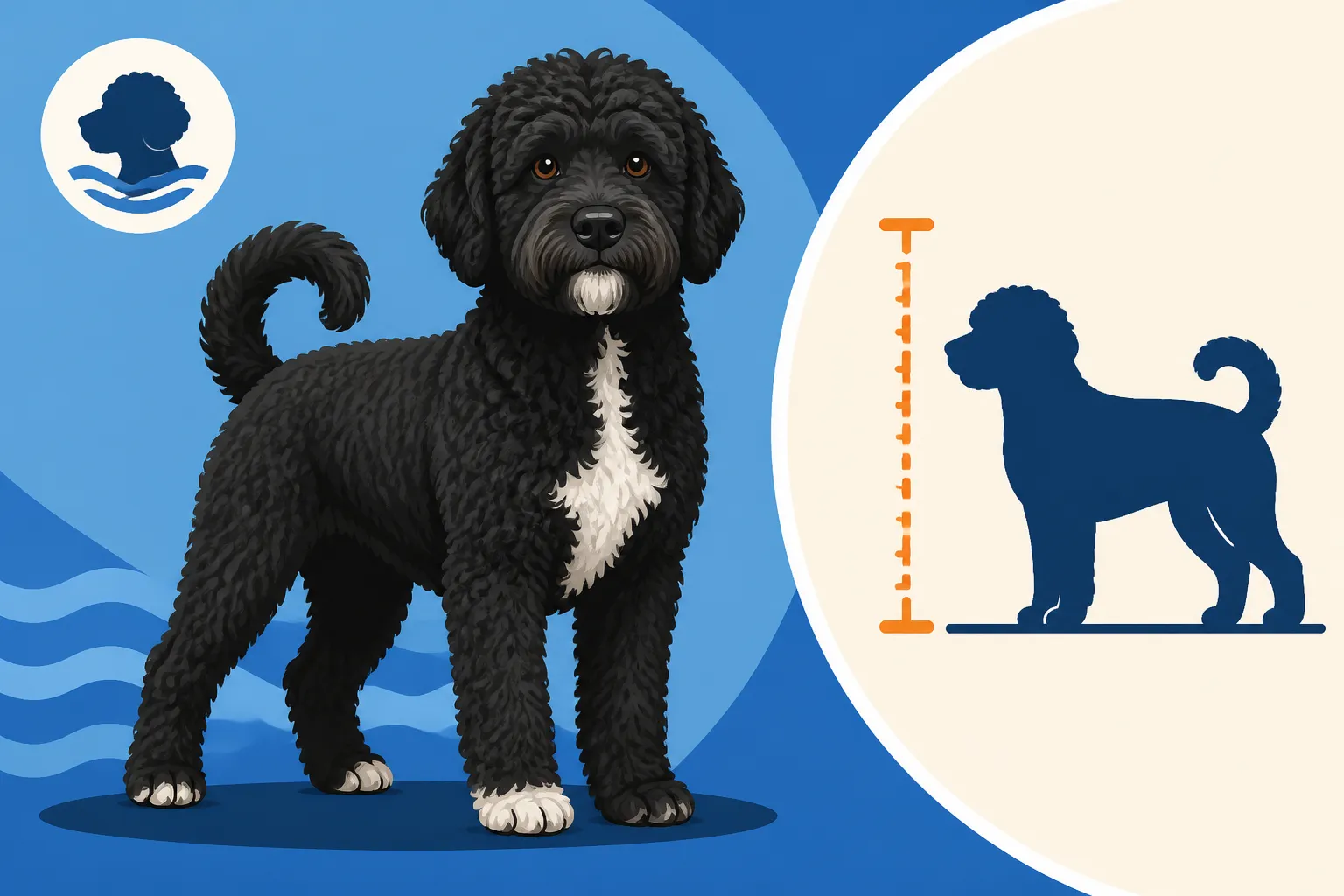
What Height the Portuguese Water Dog Standard Asks For
A Portuguese Water Dog can look taller or shorter depending on coat, posture, and whether you are measuring to the head or the shoulder. The breed standard uses a precise point: the top of the withers. Here’s how the standard’s height ranges work, how to measure your dog at home, and what to make of a result that falls outside the range.
Portuguese Water Dog height by the breed standard
The standard gives different height ranges for males and females. These ranges describe adult dogs measured at the withers, the highest point of the shoulders—not to the top of the head, ears, or coat.
| Sex | Standard height range at the withers | Ideal height |
|---|---|---|
| Male | 20 to 23 inches | 22 inches |
| Female | 17 to 21 inches | 19 inches |
A dog does not need to land exactly on the ideal height to be a Portuguese Water Dog. The ideal is a reference point within the permitted range; it is not a requirement that every individual match precisely.
What the male height range means
An adult male measuring from 20 through 23 inches at the withers falls within the standard’s height range. The ideal is 22 inches, but a healthy, well-proportioned dog at 20½ or 22¾ inches is not automatically a poor example of the breed just because he is not exactly 22 inches tall.
Think of the range as one part of a much larger picture. A dog’s structure, movement, temperament, coat, and overall balance matter too. Height alone cannot tell you whether a dog is well bred, healthy, or a good fit for your home. If you are comparing puppies or adult dogs, it helps to learn about the breed’s overall proportions as well as its height. What a Correct Portuguese Water Dog's Outline Looks Like
A male near the upper end of the range may simply look more substantial than a smaller female. That can be especially noticeable when the coat is long and fluffy, or when one dog is standing alert while another is relaxed. The coat can change the visual impression, but it does not change the measurement used by the standard.
What the female height range means
An adult female in the 17-to-21-inch range meets the standard’s height requirement. Her ideal height is 19 inches. There is intentional overlap between the female and male ranges: a female measuring 20 inches and a male measuring 20 inches can both be within the stated ranges for their sex.
That overlap is one reason visual guesses are unreliable. A smaller male and a larger female may be close in height, and thick coat can make either dog appear bigger. If you are choosing a puppy, don’t assume that the tallest puppy in a litter will become the best match for the standard—or that a smaller puppy will remain small as an adult. Early growth gives clues, but it does not guarantee a final measurement.
Breed standards describe an ideal, not a promise about the adult size of each puppy. For a broader look at expected size, see How Tall a Portuguese Water Dog Stands and How Much a Portuguese Water Dog Weighs.
Height is only one part of the picture
People often search for a single number because it feels like an easy way to judge whether a dog is “the right size.” In practice, height is just one measurement. Two dogs of the same height can differ in build, muscle, body length, and how they carry themselves.
A dog’s outline should look balanced rather than awkwardly tall or low. When the dog is standing naturally, the body should appear functional and athletic—not simply large or small. The breed’s working background is relevant here: Portuguese Water Dogs were developed as capable, active dogs, so the standard considers the whole dog, not just a measurement at the shoulder. Why a Portuguese Water Dog Is Built to Swim
How to measure a Portuguese Water Dog at home
A careful home measurement is useful for tracking growth or satisfying your curiosity, but it is easy to get a misleading result if your dog is slouching, standing on an uneven surface, or wearing a thick, unruly coat. Measure at the withers and repeat the process rather than relying on one hurried attempt.
Find the withers before measuring
The withers are the highest point of the dog’s shoulder area, where the neck meets the back. They are not the top of the skull or the highest point of a topknot. On a curly or wavy Portuguese Water Dog, the coat can make the shoulder area harder to feel, so use your hands to locate the underlying structure rather than judging the puffiest part of the coat.
Have your dog stand on a firm, level floor. A dog standing on a thick rug, sloped driveway, or soft lawn may appear to measure differently because the feet sink or sit at different levels. Ask the dog to stand naturally with all four feet beneath the body. Avoid stretching the neck upward or pulling the head into an exaggerated pose.
A helper can make this much easier. One person can keep the dog calm with a treat while the other checks the measurement. If you are already ordering puppy-care basics through Chewy, you can check whether a suitable measuring tool is available; otherwise, a straight ruler, level surface, and pencil mark on a wall can work. The important part is that the tool measures vertically from the floor to the withers.
Use a wall and a level object
Stand your dog beside a wall, making sure the feet are on the same level surface as the wall. Place a flat object—such as a book or a carpenter’s level—gently across the withers, keeping it parallel to the floor. Mark where the underside of the object meets the wall, then measure from the floor to that mark.
Do not press hard enough to flatten the coat or make the dog crouch. The goal is to locate the shoulder height, not force a particular number. If the dog keeps stepping away, take a break and try again when they are calmer. Several relaxed attempts are more useful than one stressful measurement.
Write down the date, the dog’s age, and the result. If you use a flexible tape measure ordered through Chewy or another retailer, make sure it is held straight and vertical; a tape that bows or angles can give you a false reading. A simple record helps you see the direction of growth without treating every small difference as meaningful.
Repeat the measurement consistently
A small variation between measurements is normal. Your dog may shift weight, move a paw, or stand with the shoulders slightly different each time. Measure two or three times in the same session and use the consistent readings rather than making a big deal of a single result.
For a growing puppy, measure under similar conditions each time: same floor, similar stance, and the same point at the withers. You might record the measurement every few weeks rather than measuring daily. Daily checks create noise and can make ordinary growth feel like a problem. A notebook or phone note is usually enough to keep a useful record.
If you are shopping for puppy supplies at Chewy, consider pairing any measurement notes with a routine reminder for weigh-ins or veterinary visits. Height tracking does not replace a physical examination, but keeping dated observations can help you explain a concern clearly if your veterinarian asks how your puppy has been growing.
How age, coat, and posture affect the number
A Portuguese Water Dog’s height does not settle into its adult measurement overnight. Puppies grow at different rates, and a measurement taken during a growth spurt should not be treated like a final adult result. Coat and posture add further confusion, especially when owners compare their dog with photographs or breed charts.
Puppies are still growing
A puppy’s current height is only a snapshot. One puppy may look tall early and then grow more slowly, while another may continue gaining height later. Growth also happens alongside changes in muscle and body proportions, so a puppy can look temporarily leggy or uneven without that being a reliable prediction of adult structure.
If you are monitoring a puppy, focus on steady overall development and discuss concerns with your veterinarian or breeder. A height measurement by itself cannot diagnose a growth problem. Useful context includes appetite, energy, weight trend, movement, and whether the puppy is developing comfortably. The Age a Portuguese Water Dog Stops Growing
It is tempting to compare littermates or use a puppy’s current height to predict exactly where they will land as adults. That can lead to unnecessary worry. Two puppies from the same litter may develop at different paces, and the eventual adult measurement is not always obvious when they are young.
Coat and stance can fool the eye
Portuguese Water Dogs have curly or wavy coats, and grooming can change the silhouette dramatically. A full coat may make the dog appear taller or broader, while a close trim can make the same dog look more compact. The coat should not be included in the height measurement; the reference point is the underlying structure at the withers.
Posture matters too. A dog standing squarely with the head level can look different from one leaning forward, stretching its neck, or sitting back on its haunches. Photos are particularly unreliable because camera angle and distance can distort proportions. A dog photographed close to the camera may look much larger than one farther away.
This is why a tape measure is more useful than a quick visual comparison with another dog. It also explains why owners should avoid making firm judgments from social-media photos, where the dog’s stance, coat length, and camera angle are unknown.
Body condition does not change the standard’s measuring point
Weight and body condition can affect how tall a dog appears, but they do not move the withers. An overweight dog may look heavier and less athletic; a thin dog may look rangier. Neither impression changes the height measurement itself.
If you have concerns about your dog’s build, discuss body condition with a veterinarian rather than trying to infer health from height. A dog can be within the standard’s height range and still need help with weight, fitness, or another health issue. Conversely, a dog outside the standard’s height range is not automatically unhealthy. For practical guidance on maintaining a suitable body condition, see What a Portuguese Water Dog Weighs and How to Keep It There.
What it means if your dog is outside the range
A home measurement outside the standard does not automatically mean something is wrong. First check the measurement technique, then consider the dog’s age and the reason you are comparing the dog with the standard. The answer differs for a family pet, a growing puppy, and a dog being evaluated for conformation showing.
Check your measurement before drawing conclusions
Before worrying about a result, repeat the measurement on a level surface and confirm that you found the withers rather than the head or coat. A dog that is fidgeting, crouching, or leaning can produce a poor reading. If possible, ask another person to measure independently.
Remember that small differences can come from technique. If you measure your dog at 20 inches one day and a little more or less another day, that does not necessarily mean the dog has changed height. The same is true when two people measure using different tools or positions.
For an adult dog, your veterinarian or a knowledgeable breed professional can help check the measurement. If your concern relates to growth, pain, mobility, or an unusual change in posture, bring that up directly during a veterinary visit. The standard is not a medical chart.
The standard matters differently for pets and show dogs
For a family companion, being slightly above or below the listed range does not erase the dog’s personality, bond with the household, or need for good care. Many owners are not choosing a dog for the show ring. A dog’s fit for a home depends on temperament, exercise needs, training, grooming, and health—not a single inch measurement.
For conformation showing, the standard has a more direct role because judges evaluate how closely a dog matches the breed ideal. Height is considered alongside many other features. A dog outside the stated range may not be considered ideal for that purpose, but a height reading alone cannot tell you how the dog would be assessed overall. If showing matters to you, ask a breed club or experienced, responsible breeder to explain the standard in context.
Whatever your plans, prioritize responsible breeding and appropriate health screening over chasing a particular number. The breed’s health and structure deserve more attention than whether a puppy seems likely to mature at the exact ideal height. What a Portuguese Water Dog Breeder Should Have Tested
When to ask a veterinarian or breeder
Ask your veterinarian if the dog’s growth seems unusually uneven, if the dog is limping or reluctant to move, or if you notice a sudden change in stance. Those observations are more important than a small mismatch with a breed-standard range. Your veterinarian can assess the dog’s overall development and determine whether further evaluation is appropriate.
A responsible breeder can discuss the height of the puppy’s parents and relatives, but family measurements are context—not a guarantee. Puppies inherit a mix of traits, and adult height can vary. A breeder should be willing to talk honestly about what they know without promising an exact adult measurement.
If you are still learning what size and lifestyle to expect, it may also help to read What a Portuguese Water Dog Weighs and How Tall It Stands and What People Get Wrong About the Portuguese Water Dog. The standard gives you a useful benchmark, but it is only one piece of understanding the breed.
Disclaimer
This article is for general informational purposes only and does not constitute professional advice. Laws, prices and regulations vary by location and change over time. Consult a qualified professional for guidance on your specific situation.