Which Faults Judges Penalize in a Portuguese Water Dog
A Portuguese Water Dog can look healthy, athletic, and unmistakably charming yet still lose points in the show ring for drifting from the breed standard. Judges assess structure, movement, coat, and overall balance—not whether a dog is lovable or a good companion. This guide explains the common faults, how they differ from disqualifications, and what owners should know before interpreting a show result.
What judges mean by a fault
A fault is a difference from the breed standard
In a conformation show, a judge compares each Portuguese Water Dog with the written standard for the breed. That standard describes the dog’s overall shape and proportions, as well as details such as its head, coat, feet, and movement. A fault is a feature that falls short of that description.
Not every fault carries the same weight. A small departure from the standard might make little difference if the dog is otherwise well balanced. A more serious structural problem may affect how the dog moves or performs the work the breed was developed to do. Judges consider the whole dog rather than treating every minor imperfection as equally important.
That distinction can be confusing when a dog owner hears that a dog has a “fault.” It does not automatically mean the dog is unhealthy, poorly behaved, or unsuitable as a pet. It means that, in the context of conformation judging, the dog has a characteristic that does not fully match the ideal described by the standard.
A disqualification is different from a judged fault
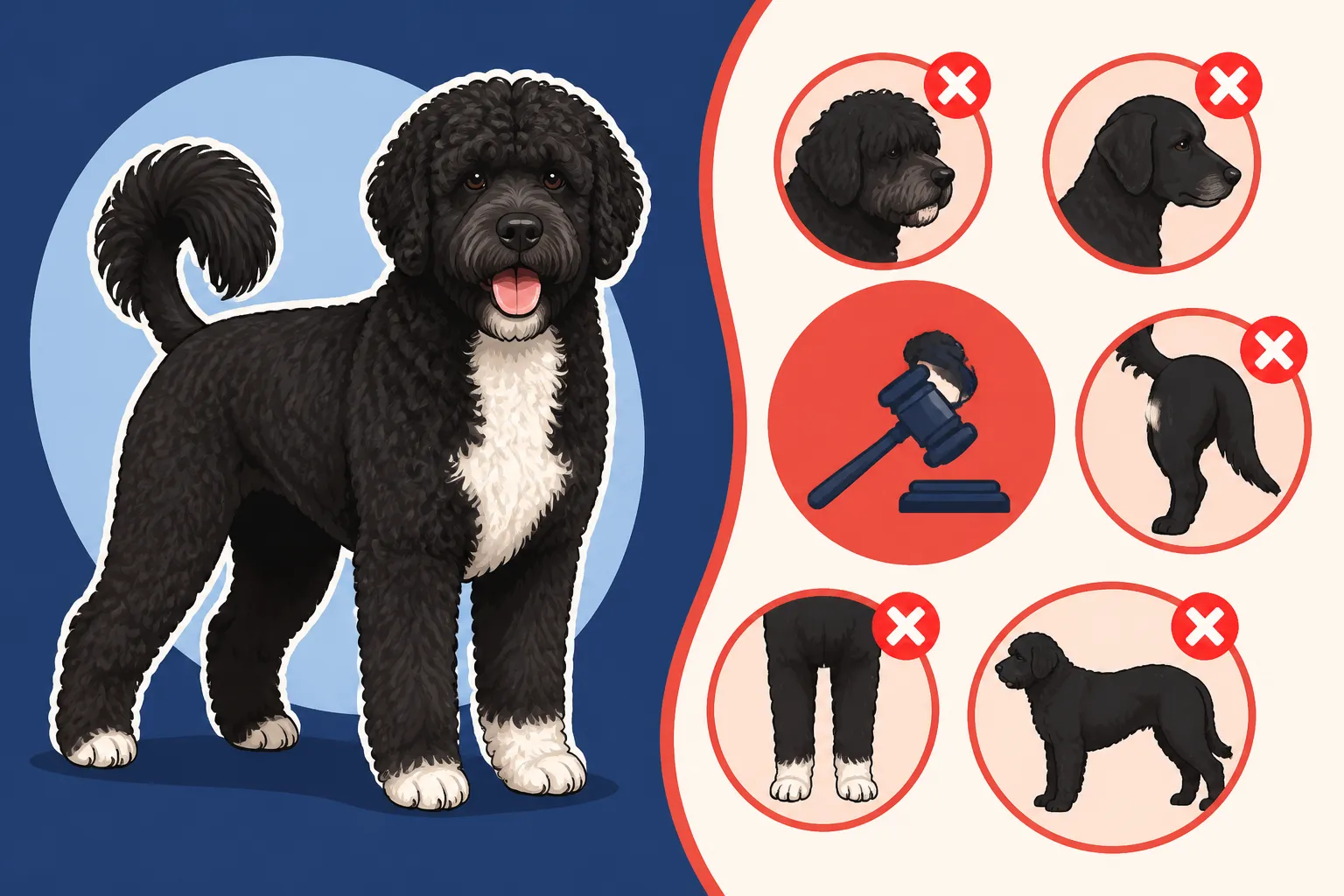
Some characteristics are not simply penalized; they can make a dog ineligible for competition under the applicable show rules. These are called disqualifications. The exact wording and application depend on the registry and the standard being used, so anyone preparing for a show should check the rules for that event rather than rely on a general description.
A fault may affect a dog’s placement relative to other entries, while a disqualification can remove the dog from competition. That is why it is useful to separate the two ideas when reading a judge’s report or asking a breeder about a dog’s conformation.
| Ring observation | What it generally means | What to check |
|---|---|---|
| Minor departure from the standard | A fault that may be weighed against the dog’s overall quality | How noticeable it is and whether it affects balance or function |
| More substantial structural deviation | A fault that may have a greater effect on the dog’s evaluation | The relevant breed-standard language and the judge’s assessment |
| A trait listed as disqualifying | The dog may be ineligible for competition under that standard | The current rules of the registry and show |
| A health or behavior concern | Not automatically a conformation fault or disqualification | Advice from a veterinarian or qualified behavior professional |
If you are comparing ring performance with a dog’s everyday life, keep those categories separate. A dog can be a wonderful family companion and still have a conformation fault; a show result on its own is not a veterinary diagnosis.
The structure and proportions judges examine
Overall balance matters more than a single measurement
Judges look at whether a Portuguese Water Dog is balanced and built to move efficiently. The breed should have a strong, athletic appearance, with proportions that support stamina and work in the water. A dog that appears too long, too short in leg, too heavy, or poorly balanced may not match the desired outline.
Height is one part of that picture, but it is not the whole picture. A dog can fall within an expected size range and still lack the overall proportion or outline judges want. Conversely, a compact or substantial appearance should not be confused with a specific fault unless it departs from the written standard. For a closer look at the breed’s shape, see What a Correct Portuguese Water Dog's Outline Looks Like. For general height and weight context, What a Portuguese Water Dog Weighs and How Tall It Stands is also useful.
Judges may assess the dog standing and in motion. A beautiful outline while posed cannot necessarily make up for movement that looks inefficient or unbalanced. The standard is concerned with a functional dog, not just an attractive silhouette.
Feet, legs, and movement reveal functional faults
A Portuguese Water Dog’s feet and legs help support its athletic work. Weakness, poor alignment, or feet that do not fit the standard can affect the impression of strength and soundness. Judges may also notice whether the dog appears stable when standing and whether its legs track appropriately as it moves.
Movement gives judges a chance to assess how the dog uses its structure. An inefficient gait, awkward coordination, or lack of balance can draw attention to underlying structural differences. Some faults may be more apparent on the move than when the dog is standing still, which is one reason handlers are asked to move their dogs around the ring.
That does not mean every unusual stride is automatically a serious fault. A dog may be distracted, tense, tired, or unfamiliar with the show environment. A judge evaluates what they observe in the ring, but a single performance should not be treated as a complete assessment of a dog’s long-term soundness. For related details, read What a Portuguese Water Dog's Feet Should Look Like and How a Portuguese Water Dog Should Move.
Size outside the standard can matter greatly
Size is a practical consideration in a breed whose outline and working ability are part of its identity. A dog that is notably outside the permitted measurements may face a serious penalty or disqualification, depending on the specific standard. Because measurements can be affected by stance and handling, an owner should not judge a dog’s eligibility from a casual visual estimate.
If show eligibility matters, confirm the relevant measurement limits and ask an experienced breed mentor or show official how measurement is conducted. Do not assume that being tall, small, or unusually substantial automatically makes a dog disqualified; the written rule, the registry, and the actual measurement all matter. The discussion in Whether an Oversized Portuguese Water Dog Can Be Shown can help explain why the question needs a precise answer rather than a guess based on appearance.
Coat, color, and head faults
Coat texture and presentation are part of the evaluation
Portuguese Water Dogs have curly and wavy coat types. Judges expect a coat that fits the breed’s standard, and they consider both its texture and how it is presented in the ring. A coat that is sparse, excessively soft, or otherwise different from the standard may be penalized. A coat fault is not the same as a grooming mistake, though poor preparation can make a dog’s features harder to assess.
The breed’s two permitted clips are part of its presentation, but the dog still needs to be properly prepared. Mats, uneven trimming, or a coat that obscures the dog’s outline can distract from the features the judge is trying to evaluate. Owners preparing for an event may find it helpful to plan brushing and coat maintenance well ahead of show day instead of attempting a rushed grooming session at the last minute.
For routine coat preparation at home, some owners browse grooming tools through retailers such as Chewy. The important point is choosing tools suitable for the dog’s coat and learning how to use them gently; a product cannot correct a coat-texture or structural fault. To understand presentation options, see Whether Both Portuguese Water Dog Clips Are Allowed in the Ring and Whether a Curly Portuguese Water Dog Is Preferred.
Color and markings must be assessed against the standard
Color is another area where people can mistake personal preference for a judging rule. The accepted colors and markings are defined by the breed standard. A color or pattern outside those rules may be faulted or disqualifying, depending on the wording that applies. Do not assume that an unusual-looking marking is automatically unacceptable without checking the standard.
The same caution applies when viewing puppy photographs online. Lighting, wet coat, grooming, and a dog’s age can all change how color appears in a picture. If color eligibility is important for showing, review the written requirements and ask an experienced Portuguese Water Dog breeder or exhibitor to explain how they apply to that dog.
For the actual accepted colors, use Which Colors the Portuguese Water Dog Standard Accepts rather than relying on informal descriptions or social-media comments. A dog’s color does not, by itself, tell you whether it is healthy, well bred, or a good companion.
Head, eyes, ears, and bite contribute to breed type
Judges also look at whether the dog’s head and expression fit the breed. Proportion, shape, eye appearance, and ear placement all contribute to the overall impression. A head that departs noticeably from the standard may be considered a fault, especially when several features combine to make the dog look unlike the breed.
Bite is another detail that may have a specific place in the standard. Because bite-related wording can include important distinctions, owners should consult the exact standard rather than assume that every variation receives the same consequence. Some traits may be treated as faults, while specific conditions may be listed as disqualifying.
These details can be hard for a new exhibitor to evaluate on their own. A knowledgeable mentor can show you what a judge is looking for and help distinguish a meaningful departure from a harmless difference in expression. For more on the breed’s features, read What Shape a Portuguese Water Dog's Head Is and How a Portuguese Water Dog's Ears Should Sit.
How to interpret a judge’s decision and prepare responsibly
A placement is a comparison, not a complete verdict
A judge places the dogs entered in a particular class against one another, using the standard as a guide. A dog may be a strong example of the breed and still place behind a competitor whose balance, movement, coat presentation, or other qualities better match the judge’s interpretation on that day.
Likewise, a lower placement does not necessarily point to one dramatic fault. It may reflect several small differences, the strength of the competition, or the judge’s view of which characteristics matter most. If you are curious about a result, a respectful question to an experienced exhibitor can be more useful than trying to diagnose the reason from a photograph.
Try not to treat a ribbon as a universal rating of a dog’s worth. Conformation results say something about a dog’s performance in a specific judged setting. They do not measure temperament, family compatibility, training, health, or the bond the dog has with its people.
Prepare the dog without trying to hide its natural features
Good preparation means presenting the dog cleanly, comfortably, and in a way that allows the judge to see its natural structure. It does not mean using grooming or handling to disguise a feature. If a coat is tangled or hides the outline, regular brushing and a suitable clip can make the dog easier to assess, but preparation cannot change its underlying proportions or structure.
Practice handling in short, positive sessions. Teach the dog to stand comfortably, accept a gentle examination, and move on a loose lead. If you are assembling basic home-care supplies, Chewy is one retailer owners may look at for brushes, combs, and grooming accessories. Choose equipment based on your dog’s coat and comfort, and ask a groomer or experienced handler to demonstrate safe technique if you are unsure.
It can also help to keep notes after a show. Record what the judge or mentor observed, which parts of the standard you want to understand better, and how the dog behaved in the ring. That turns a disappointing result into a practical learning opportunity rather than a reason to overcorrect the dog’s appearance.
Keep show goals separate from health and everyday care
A conformation fault does not automatically mean a health problem. If a dog shows pain, stiffness, an unusual gait outside the ring, changes in appetite, or another concerning symptom, discuss that with a veterinarian. A judge’s opinion is not a substitute for medical evaluation, and a veterinary check is not a conformation assessment.
For non-show owners, the standard can still be a helpful way to learn what the breed was developed to look and move like. But daily care should be guided by the individual dog’s health, coat, activity, and comfort—not by trying to make a pet match a show-ring ideal. Owners often use retailers such as Chewy to find ordinary grooming and care supplies, while relying on their veterinarian or groomer for advice specific to the dog.
The most useful approach is to understand the difference between a minor fault, a serious departure, and a disqualification; consult the standard that applies to the event; and avoid drawing sweeping conclusions from one judge’s placement. That gives you a clearer picture of what the ring result does—and does not—say about your Portuguese Water Dog.
Disclaimer
This article is for general informational purposes only and does not constitute professional advice. Laws, prices and regulations vary by location and change over time. Consult a qualified professional for guidance on your specific situation.